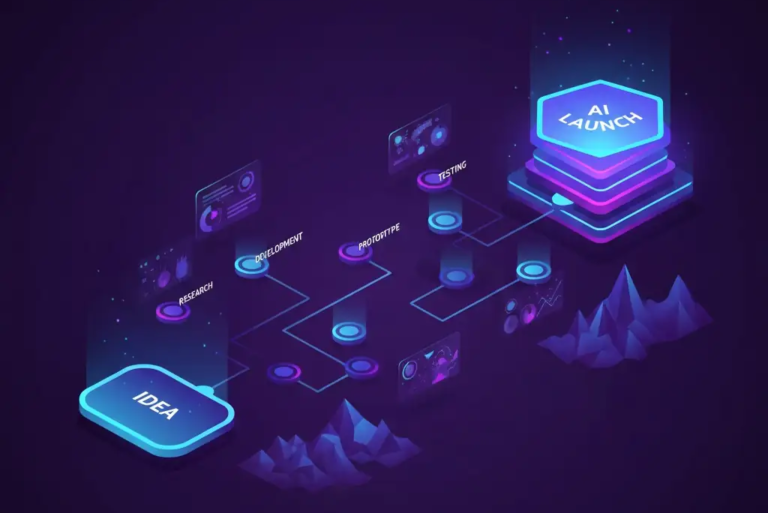
You don’t have six months to build your product. In the current velocity of the tech market, six months is an eternity. By the time you launch a traditional software product, three competitors have already integrated AI agents that do the work for the user, rather than just providing a tool to do it themselves.
If you are founding a startup today, you aren’t just building software; you are building an intelligence layer.
The goal isn’t to build a “perfect” application. It’s to survive the 90-day sprint from idea to a working, revenue-generating MVP (Minimum Viable Product). This roadmap cuts through the noise of AI hype and focuses strictly on execution, costs, and the technical reality of generative AI development services.
Here is how you go from zero to a deployed AI product in one quarter.
Why Generative AI is the New MVP Standard in 2026
A few years ago, an MVP was a set of forms, a database, and a dashboard. Users would input data, and the software would store it.
That standard is dead.
In 2026, users expect software to be proactive. They don’t want to fill out forms; they want to upload a document and have the AI extract the data for them. They don’t want to filter through a dashboard; they want to ask, “Which marketing channel gave us the best ROI last week?” and get an immediate answer.
If your MVP doesn’t include a generative layer, you are building legacy software from day one. Generative AI development services have shifted from being a “nice-to-have” feature to the core infrastructure of modern SaaS.
Startups that successfully build an AI MVP are seeing:
- Higher Retention: Users engage with natural language interfaces 3x longer than static dashboards.
- Pricing Power: AI-native apps command a premium because they replace labor, not just paper.
- Faster Iteration: LLMs allow you to change product behavior by tweaking prompts rather than rewriting thousands of lines of code.
Step 1: Validating Your AI Use Case (Feasibility vs. Hype)
Before you write a single line of Python, you have to pass the “Wrapper Test.”
Is your startup just a “wrapper” around GPT-4 or Claude 3.5? If OpenAI releases a small update tomorrow, does your entire business model evaporate? If the answer is yes, you don’t have a startup; you have a feature.
To validate your AI startup roadmap, you need to identify where your value leverage lives. Usually, this comes down to Proprietary Data or Proprietary Workflows.
Cost Analysis: Fine-Tuning LLMs vs. RAG Architecture
This is the most common pitfall for non-technical founders. You assume you need to “train” an AI model.
99% of the time, you do not need to train or even fine-tune a model. You need RAG (Retrieval-Augmented Generation). Here is the difference, explained simply:
- Fine-Tuning (The Medical Student approach): You take a general model and force-feed it thousands of specific examples to teach it a new “skill” or “tone.”
- Cost: High ($5,000 – $20,000+ per run).
- Pros: Great for specific speaking styles or highly niche coding languages.
- Cons: It doesn’t remember new facts. If you fine-tune it on data from 2024, it won’t know about 2025.
- RAG Architecture (The Open-Book Test approach): You give a standard model (like GPT-4) access to a library of your documents (PDFs, Databases, Emails). When a user asks a question, the AI looks up the answer in your library and summarizes it.
- Cost: Low (Pennies per query).
- Pros: Always up to date, cheaper, significantly less hallucination.
- Cons: Requires setting up a Vector Database.
Verdict for your MVP: Start with RAG. It is faster to build, cheaper to run, and much easier to debug.
Step 2: Selecting the Right Tech Stack (Python, LangChain, Vector DBs)
Do not get creative here. In the AI space, the ecosystem moves so fast that using obscure languages or frameworks will leave you unable to integrate the latest models.
To build an AI MVP in 90 days, this is the “Gold Standard” stack you should use:
- The Brain (LLM):OpenAI (GPT-4o) or Anthropic (Claude 3.5 Sonnet).
- Why: They are the smartest models available via API. Do not host your own Llama 3 model yet; it’s too much DevOps overhead for an MVP.
- The Backend:Python.
- Why: Python is the native language of AI. All the libraries, tutorials, and support assume you are using Python.
- The Orchestrator:LangChain or LangGraph.
- Why: These libraries handle the “glue” code—connecting the AI to your database, managing conversation history, and handling errors.
- The Memory (Vector Database):Pinecone or Weaviate.
- Why: To make RAG work, you need to store your data as “vectors” (numbers). These databases allow the AI to search your data by meaning, not just keywords.
- The Frontend:Next.js / React.
- Why: You need a snappy, responsive UI to handle streaming text (the typewriter effect users expect from AI).
Step 3: Security & Compliance (SOC 2 for AI Startups)
If you are selling B2B, your customers especially enterprise ones are terrified of AI. They are worried about two things:
- Data Leakage: Will their private data be used to train OpenAI’s models?
- Hallucinations: Will the AI lie to their customers?
Your generative AI development services partner must implement an “Enterprise Gateway.”
- Zero-Training Agreements: You must use API endpoints (like Azure OpenAI or AWS Bedrock) that contractually guarantee your data is not used for model training.
- SOC 2 Preparation: Even for an MVP, implement basic role-based access control (RBAC) and data encryption.
- Guardrails: Implement libraries like NVIDIA NeMo Guardrails to prevent the AI from answering off-topic questions or generating toxic content.
Case Study: How We Built a 99% Accurate AI Dashboard
We recently worked with a fintech startup that wanted an AI to answer questions about users’ bank statements.
The Problem: The initial prototype used a basic LLM prompt. When a user asked, “How much did I spend on coffee?” the AI would guess. It would hallucinate transactions that didn’t exist. In fintech, 90% accuracy is a failure. It has to be 100%.
The Solution: We moved from a text-generation approach to a Code-Generation approach.
Instead of asking the AI to guess the answer, we asked the AI to write a Python script or a SQL query to calculate the answer from the database.
- User: “How much did I spend on coffee?”
- AI (Internal thought): I need to query the
transactionstable where the category isfood_and_drinkand the merchant containscoffee. - System: Executes the SQL query securely.
- AI: Reads the SQL result ($45.50) and tells the user.
The Result: The hallucination rate dropped to near zero because the math was done by the database, not the LLM.
Hiring an AI Squad: In-House vs. Agency Cost Comparison
You have a roadmap, but who builds it?
Finding a full-stack developer who also understands vector embeddings, prompt engineering, and RAG pipelines is like finding a unicorn. If you find one, they will cost you $200k/year minimum.
Here is the breakdown for the 90-day sprint phase:
Option A: In-House Team
- Senior AI Engineer: $18,000/mo
- Frontend Dev: $10,000/mo
- Recruiting Time: 2-4 months (You lose the speed advantage).
- Risk: High burn rate before finding product-market fit.
Option B: Specialized AI Development Agency
- Cost: Fixed project fee (usually $30k – $60k depending on complexity).
- Speed: Immediate start.
- Expertise: They bring pre-built modules for RAG, auth, and payments, saving weeks of coding.
- Risk: Lower. You pay for deliverables, not overhead.
For the MVP stage, leveraging an external AI startup roadmap expert or agency is almost always the faster path to market. Once you hit $1M ARR, then you hire the in-house team to scale it.
Frequently Asked Questions
How much does it cost to build a Generative AI MVP?
A basic GenAI MVP typically ranges from $15,000 to $50,000 depending on whether you use existing APIs (OpenAI/Claude) or require custom model fine-tuning and vector database integration.
What is the best tech stack for AI startups in 2026?
The gold standard currently includes Python (backend), React/Next.js (frontend), LangChain (orchestration), and Pinecone or Weaviate (Vector Database) for efficient RAG implementation.
How long does it take to develop a custom AI chatbot?
A custom AI chatbot with RAG (Retrieval-Augmented Generation) usually takes 4-8 weeks to develop, test, and deploy, ensuring it answers accurately based on your proprietary data.
AI – Powered Products. Measurable Impact.
Ready to start your 90-day sprint?
The market rewards speed, but only if that speed is paired with stability. Don’t just wrap a prompt; build a system. Focus on your proprietary data, secure your infrastructure, and choose the stack that scales. Your MVP is waiting.
Discover more from Diginatives
Subscribe to get the latest posts sent to your email.