
What Is RSD Testing?
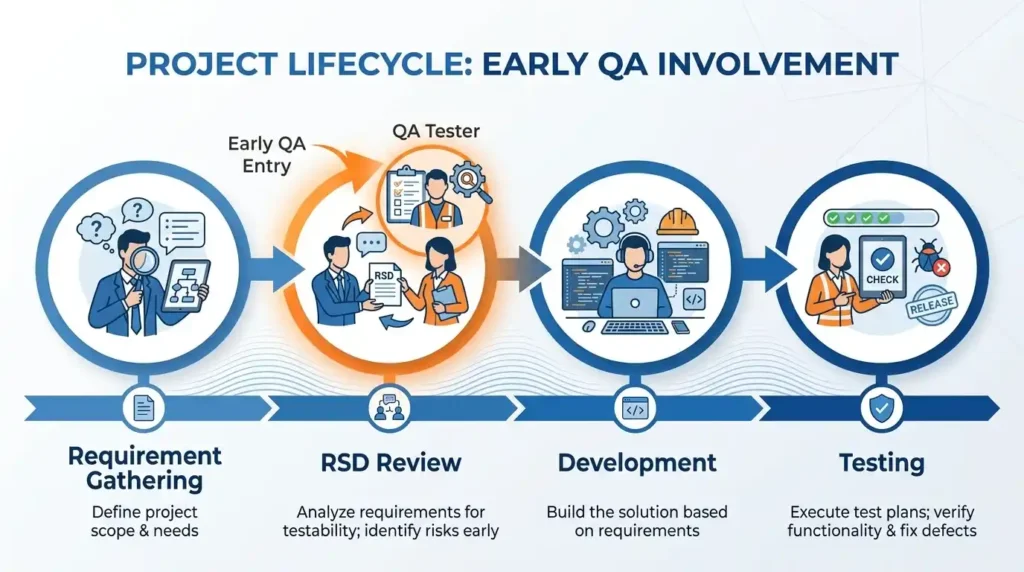
RSD testing is a QA practice that is aimed at establishing if an application performs as stipulated in the specification.
The Software Requirement Specification (RSD) is a document that contains the expectations concerning the characteristics of the upcoming product. In the context of application testing, this set of criteria serves as a basis for the QA team to plan their scenarios and procedures. The document helps the specialists understand the purpose of the product and what they should consider a successful outcome.
In essence, using the RSD, the QA specialists can shift the focus from finding bugs to establishing if the software does what it is supposed to do.
Why Requirement Specifications Matter for QA
The specification acts as a document that establishes common grounds for understanding between the stakeholders, developers, and testers. They stipulate what the application is supposed to do before it is built, which reduces misinterpretations and issues during the development and testing phases.
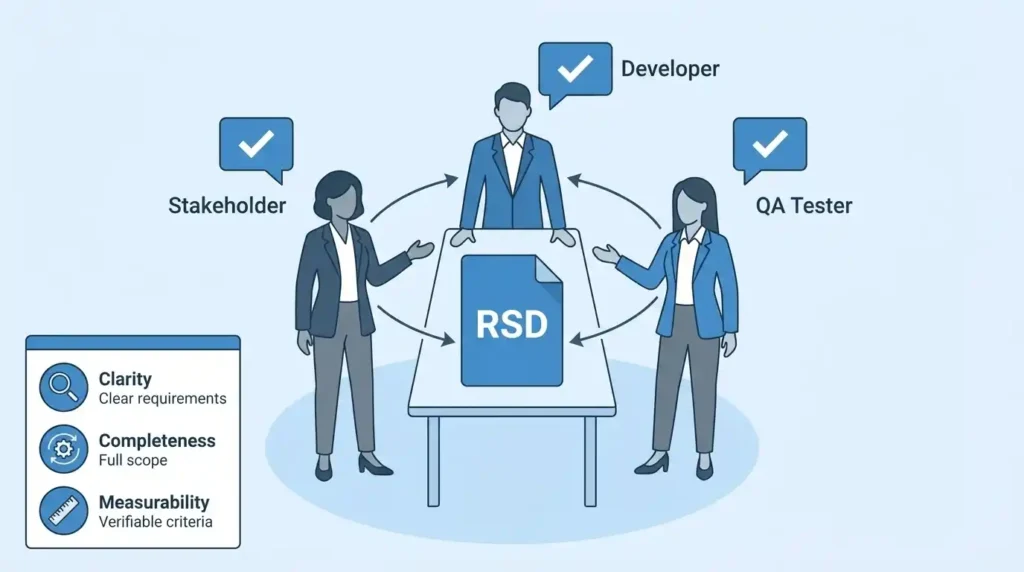
When examining the statements in the RSD Testing, the QA specialists would usually look for:
- Clear and understandable formulation
- Completeness and consistency
- Measurability
- Relevance to the product
- Absence of ambiguity
- Correlation with the acceptance criteria
A vague wording can lead to divergent interpretations and subsequent problems with the test coverage. The lack of clarity on what the developers and the testers see as an acceptable outcome can also result in disagreements about the outcome of a particular scenario.
Who Writes the RSD, and When Does QA Get Involved?
The RSD is typically authored by a Business Analyst or Product Manager, often in collaboration with technical leads and key stakeholders, during the requirement-gathering phase of the project before development begins.
QA involvement, however, should not wait until the document is “finished.” Ideally, testers are brought in during the review stage of the RSD, not after development is complete. Early QA input helps catch ambiguous or untestable statements before they turn into disputed bugs later. This practice is sometimes called “shift-left testing” moving quality checks earlier in the lifecycle rather than treating testing as a final gate.
How Does Requirement-Based Testing Work?
In contrast to an ad-hoc approach, requirements-based testing uses a documented set of criteria to review the application. The team goes over the specification and derives statements that can be transformed into verifiable conditions.
The typical sequence comprises the following steps:
- Specification review: Analysts go over the functional and non-functional statements and identify the focus areas.
- Condition identification: The team isolates the relevant behaviors of the application that they will use to form scenarios.
- Scenario creation: The QA specialists design situations that reflect the behaviors stipulated in the specification.
- Execution: The created scenarios get executed and reported.
- Discrepancy collection: The conditions that differ from the stipulated outcome get noted.
In essence, the QA team has an opportunity to follow a systematic approach to verify the application’s behaviors.
How to Test Software Against Requirement Specification Document

The initial step in testing the application against the RSD is decomposing the specifications into verifiable conditions.
Taking a sample statement such as:
The system should provide secure login
The QA specialists can create a set of conditions, such as:
- Users can log on with a valid email and password
- Invalid email or password returns an appropriate error message
- Unauthorized users do not have access to restricted areas
- Failed login attempts within a specified number of times lead to the specified response
The testers can then create positive, negative, boundary, and validation scenarios for each of the conditions, execute them, and report if the actual outcome corresponds to the expected outcome. The results can then be reported to the respective developers.
How These Scenarios Map to Testing Types
Each scenario type derived from a requirement typically corresponds to a recognized testing technique:
| Scenario Type | Testing Technique | What It Checks |
|---|---|---|
| Positive scenario | Functional testing | Confirms the feature works under normal, expected conditions |
| Negative scenario | Negative/error-handling testing | Confirms the system handles invalid input gracefully |
| Boundary scenario | Boundary value analysis | Confirms behavior at the edges of accepted input ranges |
| Validation scenario | Equivalence partitioning / input validation | Confirms different classes of input are handled consistently |
Knowing which technique a scenario belongs to helps QA teams ensure they aren’t accidentally skipping a category of coverage.
Sample Test Case Format
Once a condition is identified, it’s typically documented as a formal test case rather than left as a bullet point. A common format includes:
| Field | Example |
|---|---|
| Test ID | TC-01 |
| Title | Valid login with correct credentials |
| Preconditions | User has an active, verified account |
| Steps | 1. Navigate to login page. 2. Enter valid email and password. 3. Click “Log In.” |
| Expected Result | User is redirected to the dashboard |
| Actual Result | (filled in during execution) |
| Status | Pass / Fail |
Writing test cases in this structured format rather than as loose conditions is what makes them reusable, assignable, and trackable across test cycles.
Example: Testing a Non-Functional Requirement
Functional requirements aren’t the only kind that need decomposition. Non-functional requirements like performance, security, or usability need the same treatment.
Take the statement:
The dashboard should load quickly
This is too vague to test. A testable version would be:
The dashboard should fully load in under 2 seconds under normal network conditions, for up to 500 concurrent users
From this, QA can derive measurable conditions such as:
- Dashboard load time is recorded under standard network conditions
- Load time is measured under peak concurrent user load
- Load time is re-verified after code changes to confirm no regression
Unlike functional test cases, these are often verified using performance testing tools rather than manual clicks.
Manual vs Automated Requirement-Based Testing
Requirement-based test cases can be executed either manually or through automation, and most teams use a mix of both:
- Manual testing is generally better suited for exploratory scenarios, usability checks, and one-off or rapidly changing requirements where writing automation isn’t cost-effective yet.
- Automated testing works well for stable, repetitive scenarios like regression checks on login flows where the same conditions get tested across every release.
A common practice is to start new requirements with manual testing and gradually automate the stable, high-value test cases once the feature settles.
Common Tools Used in RSD Testing
While the RSD Testing itself is usually a document (Word, Confluence, or a requirements-management tool), the resulting test cases and traceability are typically managed in dedicated QA tools, such as:
- Jira – for tracking requirements as tickets/epics and linking them to test tasks
- TestRail – for organizing and executing structured test cases
- Zephyr – Jira-integrated test management
- Xray – another Jira-native testing add-on with traceability features
- qTest – standalone test management with requirement mapping
These tools generally let teams link a requirement directly to its test cases, which is what makes traceability practical at scale rather than something maintained in a spreadsheet.
Using Traceability to Improve QA Coverage
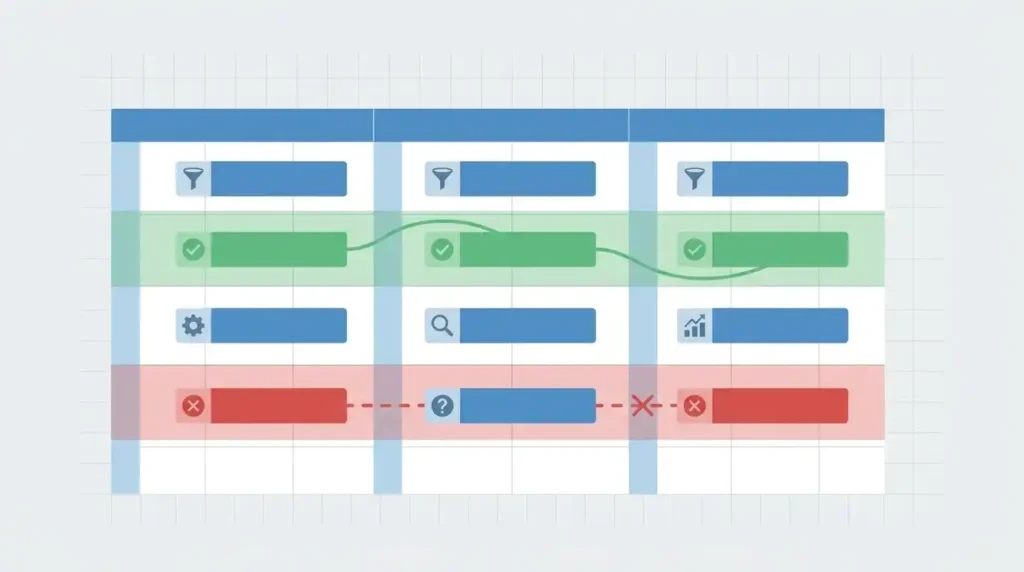
The requirements traceability testing is an approach that examines the association between the documented requirements and the corresponding test cases. The practice helps the QA team to verify that all the conditions have been covered by the test scenarios and identify those that have not. A traceability matrix can help to visualize the relationship:
| Specification | Test Case | Expected Result | Status |
|---|---|---|---|
| User login | TC-01 | Valid user can log in | Pass |
| Invalid password | TC-02 | Error message appears | Pass |
| Password reset | TC-03 | Reset process completes | Fail |
In addition, the matrix can also help QA specialists identify which test cases to update when a certain specification is updated.
Measuring Coverage: Key Metrics
A traceability matrix becomes far more useful when paired with a few simple metrics that QA teams and stakeholders can track over time:
- Requirement coverage (%): The proportion of requirements that have at least one linked test case
- Test execution rate: How many of the planned test cases have actually been run in the current cycle
- Defect density: Number of defects found per requirement or per module, useful for spotting weak areas
- Pass/fail ratio per requirement: Highlights which specific requirements are consistently failing verification
These numbers give stakeholders an objective view of how “tested” the application really is, rather than a subjective sense of confidence.
Requirement Specification Document for QA: What Should It Contain?
The contents of the document can vary depending on the project’s nature, the industry it belongs to, and the type of application. Nevertheless, it should ideally contain sufficient detail to communicate the intended behaviors to the developers and testers. The document usually contains:
- Functional and non-functional requirements
- Rules and regulations
- User roles and permissions
- Input and output conditions
- Error handling
- Constraints
- Acceptance criteria
- Dependencies
- Assumptions
The QA team does not need to get into every detail of the application. Rather, the RSD should provide a reliable point of reference for the QA and development teams.
RSD vs SRS: Understanding the Difference
Depending on the company, RSD can stand for various documents, including the Requirement Specification Document. Similarly, the SRS can also have several meanings, including the Software Requirements Specification. For some companies, RSD and SRS can be two different documents with distinct purposes.
Other organizations can use the terms interchangeably. Either way, there is no universal agreement on the differences between RSD and SRS.
The QA specialists should refer to the particular specifications and documentation practices of the company and, in any case, clarify the expectations.
RSD Testing in Agile Teams
Many teams today don’t maintain a traditional, upfront RSD at all they work in Agile/Scrum, where requirements live as user stories with acceptance criteria instead of a single static specification document.
The good news is that the same requirement-based testing logic still applies:
- A user story’s acceptance criteria play the same role an RSD statement would they get decomposed into testable conditions the same way
- Traceability still matters, just mapped between user stories and test cases instead of RSD line items and test cases
- The “Definition of Done” for a story often functions like a mini requirement checklist
So if a team says “we don’t have an RSD, only user stories” the requirement-based testing approach doesn’t change, only the source document does.
Common Mistakes in RSD-Based Testing
Even with a well-written specification, QA teams can run into avoidable problems:
- Assuming missing details rather than flagging them — filling in gaps with guesses instead of raising the ambiguity with the BA or PM
- Treating the RSD as static — not revisiting test cases when the requirement is updated, leading to outdated coverage
- Skipping non-functional requirements — focusing only on functional flows and neglecting performance, security, or accessibility conditions
- Accepting vague acceptance criteria — signing off on a requirement without pushing back on unmeasurable language like “should be fast” or “should be user-friendly”
- Weak or missing traceability — writing test cases without linking them back to a specific requirement, making coverage gaps hard to detect later
Requirement Testing Checklist for QA Teams
Prior to developing test scenarios detailed enough, the testers can use the following list of questions as a guide:
- Are the statements clear?
- Is there an objective way to verify each of the items?
- Are the expected outcomes defined and documented?
- Are there any acceptance criteria available?
- Can positive and negative scenarios be developed for each item?
- Are the dependencies defined?
- Is there a possibility of contradictions?
- Can each item be associated with a test case?
- Has the modification been approved?
Using this list, the QA team can examine the RSD for possible issues before proceeding with the creation of test scenarios.
How to Write a Testable Requirement Specification Document

The specification document should be precise enough to enable the QA testers to verify each of the stipulations. Conditions such as the application being fast are too vague and can be interpreted differently by different people.
Instead, such requirements should be specified with precision, such as stipulating that the opening time of the dashboard should be less than a certain number of seconds under specified conditions. This way, the QA specialist can objectively measure the duration and report if the application meets the expectation.
FAQs
What is RSD testing?
RSD testing is a QA process that examines if the implemented application functions as per the stipulations in the specification.
Why is requirements-based testing important?
QA teams can use it to create scenarios based on the stipulated outcomes in the RSD
What are requirements for traceability testing?
It is a QA practice that examines the association between the stipulations in the RSD and the test cases.
What makes a requirement testable?
A condition should be clear and specific to enable objective verification.
Is RSD the same as SRS?
Not necessarily; the terminology depends on the convention of each company.
Can RSD testing work in Agile teams without a formal RSD?
Yes the same decomposition logic applies to user stories and their acceptance criteria.
What’s the difference between manual and automated requirement-based testing?
Manual testing suits exploratory and rapidly changing requirements; automated testing suits stable, repetitive scenarios like regression checks.
Conclusion
RSD testing provides QA teams with a structured way to determine whether an application behaves according to its documented expectations. By reviewing specifications, defining clear scenarios, checking actual results, and maintaining traceability, teams can identify gaps before they affect the final product.
A clear and measurable RSD also makes collaboration easier between developers, testers, and stakeholders. When expected behavior is specific and verifiable, QA professionals can evaluate the application more objectively and support a smoother software delivery process.
Discover more from Diginatives
Subscribe to get the latest posts sent to your email.