Cloud computing has become the backbone of modern digital infrastructure. From startups to global enterprises, organizations rely on cloud platforms to store data, run applications, and enable remote collaboration. As we move into 2026, cloud adoption continues to accelerate, but so do the risks associated with it. Cyber threats are growing more sophisticated, regulations are becoming stricter, and business dependency on cloud services is deeper than ever. In this environment, understanding and applying Cloud Security Tips is no longer optional—it is a critical business requirement.
This article explains why cloud security matters more in 2026, the threats organizations face, best practices to mitigate risk, and how businesses can build resilient cloud environments for the future.
Why Cloud Security Is More Critical Than Ever in 2026
The cloud has evolved far beyond simple data storage. Today, it supports artificial intelligence, machine learning, DevOps pipelines, Internet of Things (IoT) platforms, and mission-critical business operations. With this expanded role comes increased exposure.
Several factors are driving the urgency around cloud security:
- Expanded attack surface due to hybrid and multi-cloud environments
- Remote and distributed workforces accessing cloud systems globally
- Increased data volumes, including sensitive and regulated information
- Automated attacks powered by AI, capable of exploiting misconfigurations at scale
According to the Verizon Data Breach Investigations Report, misconfiguration and credential theft remain among the top causes of cloud-related breaches.
Authority source: https://www.verizon.com/business/resources/reports/dbir/
In 2026, attackers are not just targeting infrastructure—they are targeting identities, APIs, and automation workflows. This makes proactive cloud security guidance essential.
Understanding the Shared Responsibility Model
One of the most misunderstood aspects of cloud security is the shared responsibility model. Cloud service providers secure the underlying infrastructure, but customers are responsible for how they configure, access, and use cloud services.
Cloud Responsibility Breakdown
| Cloud Layer | Provider Responsibility | Customer Responsibility |
|---|---|---|
| Physical Data Centers | ✅ | ❌ |
| Network Infrastructure | ✅ | ❌ |
| Virtualization Layer | ✅ | ❌ |
| Operating Systems | ❌ | ✅ |
| Applications | ❌ | ✅ |
| Data & Identity | ❌ | ✅ |
Misunderstanding this division leads to false assumptions about security coverage, which is one of the biggest contributors to cloud breaches.
The Rising Threat Landscape in Cloud Environments
1. Identity-Based Attacks
Stolen credentials, API keys, and OAuth tokens are now prime attack vectors. Once attackers gain identity access, they often move laterally without triggering alarms.
2. Misconfigured Cloud Services
Open storage buckets, overly permissive IAM roles, and exposed management ports remain common vulnerabilities.
3. Ransomware and Data Extortion
Cloud workloads are increasingly targeted by ransomware groups, often through compromised CI/CD pipelines.
4. Supply Chain Attacks
Third-party integrations and dependencies can introduce hidden risks into cloud environments.
According to ENISA’s cloud threat landscape report, identity compromise and misconfiguration continue to dominate cloud security incidents.
Authority source: https://www.enisa.europa.eu/topics/cloud-and-big-data/cloud-security
Growth of Cloud Security Incidents (Illustrative)
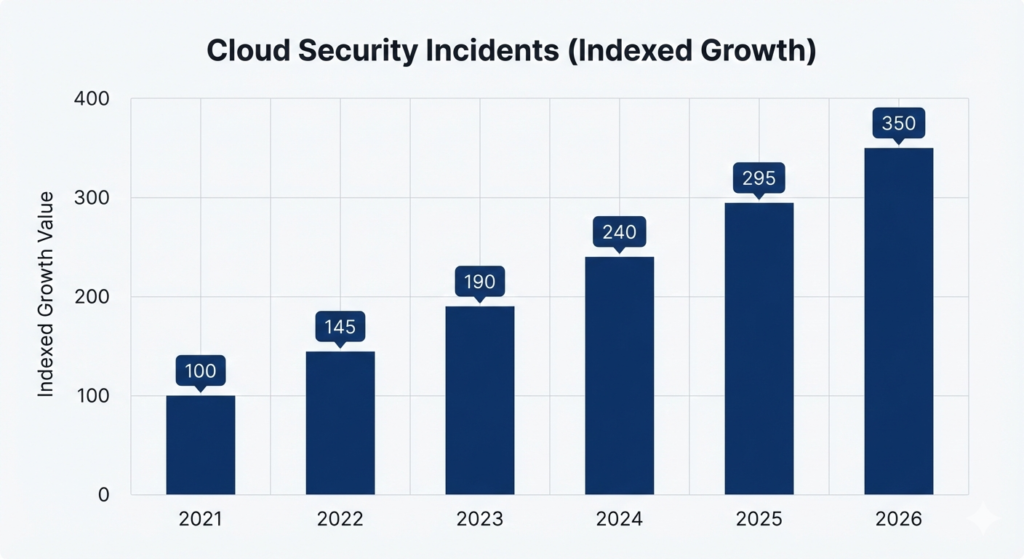
This upward trend reflects not just increased attacks, but greater reliance on cloud systems across industries.Why Cloud Security Tips Are Essential for Businesses
Applying Cloud Security Tips helps organizations move from reactive defense to proactive risk management. These practices reduce breach likelihood, limit blast radius, and support compliance requirements.
Key business benefits include:
- Reduced risk of data breaches and downtime
- Improved regulatory compliance
- Stronger customer trust and brand reputation
- Faster incident detection and response
Cloud security is not just a technical issue—it is a business continuity issue.
Essential Cloud Security Tips for 2026
1. Adopt Zero Trust Architecture
Zero Trust assumes no implicit trust, even inside the network. Every request is verified based on identity, device posture, and context.
NIST provides guidance on Zero Trust implementation.
Authority source: https://www.nist.gov/zero-trust-architecture
2. Strengthen Identity and Access Management
- Enforce multi-factor authentication
- Apply least-privilege access
- Rotate credentials and secrets regularly
Identity is now the primary security perimeter in the cloud.
3. Encrypt Data Everywhere
Encryption should be applied:
- At rest
- In transit
- During processing where possible
Cloud providers offer native encryption tools, but configuration remains the customer’s responsibility.
4. Monitor Continuously and Automate Response
Use cloud-native security monitoring tools and SIEM platforms to detect anomalies. Automated remediation reduces response time and human error.
5. Secure APIs and Automation Pipelines
APIs are foundational to cloud-native architectures. Protect them with authentication, rate limiting, and continuous testing.
These Cloud Security Tips help address both technical vulnerabilities and operational weaknesses.
Most Common Cloud Security Failures
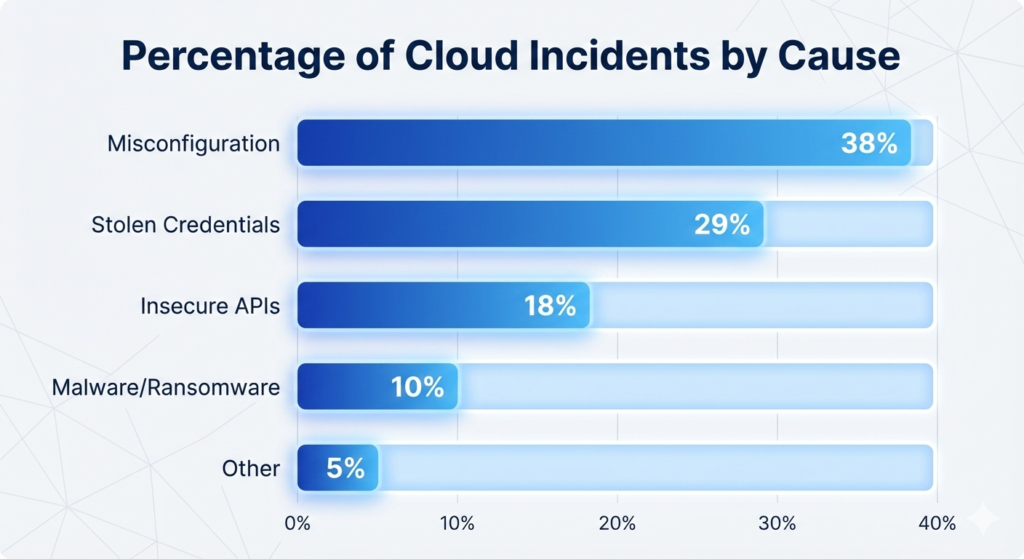
This highlights why configuration management and identity security must be top priorities.Compliance and Regulatory Pressure in 2026
Regulatory requirements around data protection continue to expand globally. Laws such as GDPR, HIPAA, and industry-specific frameworks require demonstrable security controls in cloud environments.
Organizations must now prove:
- Data residency compliance
- Access control enforcement
- Breach detection and reporting capabilities
Failure to meet these obligations can result in significant fines and reputational damage.
IBM’s Cost of a Data Breach Report consistently shows higher costs for cloud-related breaches when governance is weak.
Authority source: https://www.ibm.com/reports/data-breach
Cloud Security and Business Resilience
Security directly impacts resilience. A secure cloud environment enables faster recovery from incidents, smoother scaling, and safer innovation.
When organizations implement strong Cloud Security Tips, they gain:
- Improved uptime
- Reduced operational risk
- Greater confidence in deploying new services
Security becomes an enabler rather than a blocker.
The Role of Automation and AI in Cloud Security
By 2026, manual security management is no longer sustainable. Cloud environments change too quickly.
Automation and AI help by:
- Detecting anomalous behavior
- Enforcing configuration standards
- Responding to incidents in real time
Microsoft emphasizes automation as a core pillar of modern cloud security strategies.
Authority source: https://learn.microsoft.com/en-us/security/
Manual vs Automated Cloud Security Response Time
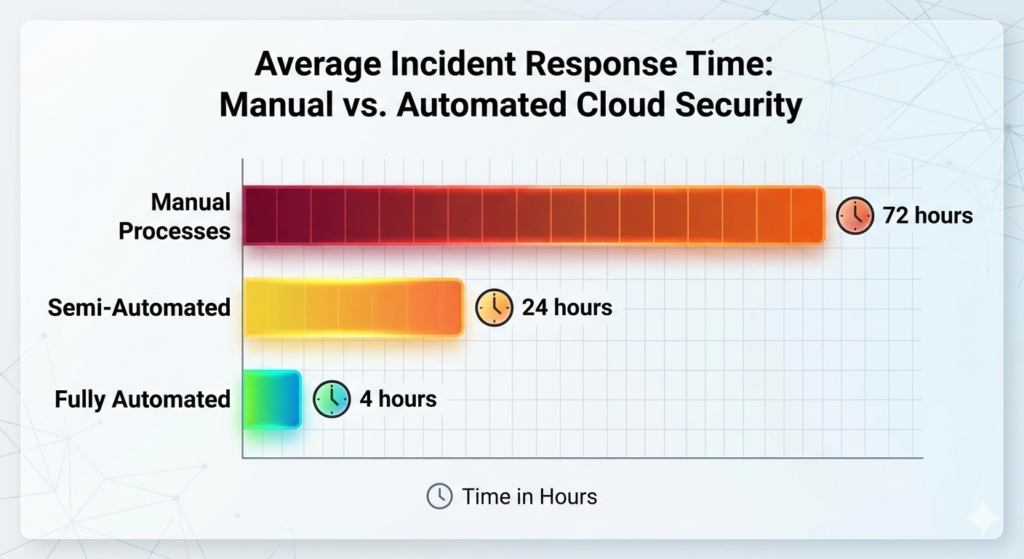
Faster response significantly reduces breach impact.Training and Human Factors
Technology alone is not enough. Human error remains a leading cause of security incidents.
Organizations should:
- Train developers on secure cloud design
- Educate employees on phishing and credential safety
- Conduct regular security reviews and drills
Cloud security culture is just as important as tooling.
Future Outlook: Cloud Security Beyond 2026
Looking ahead, cloud security will continue to evolve alongside AI-driven systems, edge computing, and decentralized architectures. The principles behind effective Cloud Security Tips—visibility, identity protection, automation, and governance—will remain foundational.
Organizations that invest now will be better positioned to adapt to new threats and technologies without constant disruption.
How Diginatives Supports Cloud Security in 2026
As cloud environments grow more complex, many organizations choose to work with specialized security providers to strengthen their defenses. Diginatives is offering Cloud Security services designed to help businesses implement proven best practices, reduce risk, and maintain compliance across cloud platforms. Their approach focuses on securing identities, monitoring configurations, protecting workloads, and enabling continuous visibility into cloud environments. By combining technical expertise with strategic guidance, Diginatives helps organizations apply effective Cloud Security Tips in real-world scenarios, ensuring security controls evolve alongside business and technology needs.
AI – Powered Products. Measurable Impact.
Conclusion
In 2026, cloud security is inseparable from business success. As organizations rely more heavily on cloud platforms, the cost of security failures continues to rise. Understanding threats, applying best practices, and following proven Cloud Security Tips are essential steps toward protecting data, maintaining trust, and ensuring operational resilience.
Cloud security is no longer just an IT responsibility—it is a strategic priority. Businesses that recognize this reality and act accordingly will be the ones that thrive in an increasingly complex digital world.
Frequently Asked Questions (FAQs)
1. Why are cloud security tips important in 2026?
Cloud security tips are important in 2026 because organizations rely more heavily on cloud infrastructure while cyber threats, regulatory requirements, and attack sophistication continue to increase.
2. What are the biggest cloud security risks businesses face today?
The biggest risks include misconfigured cloud services, stolen credentials, insecure APIs, ransomware attacks, and weak identity and access management controls.
3. Who is responsible for cloud security: the provider or the customer?
Cloud security follows a shared responsibility model. Cloud providers secure the infrastructure, while customers are responsible for securing applications, data, identities, and configurations.
4. How do cloud security tips help prevent data breaches?
Cloud security tips help by enforcing least-privilege access, strengthening identity protection, enabling encryption, improving monitoring, and reducing misconfigurations that attackers exploit.
5. What role does identity management play in cloud security?
Identity management is critical because identities are the new security perimeter in cloud environments. Strong authentication and access controls reduce unauthorized access and lateral movement.
6. How does automation improve cloud security?
Automation improves cloud security by detecting threats faster, enforcing security policies consistently, and responding to incidents in real time, reducing human error and response time.
7. Are cloud security tips only relevant for large enterprises?
No, cloud security tips are relevant for organizations of all sizes. Small and medium businesses are often targeted due to weaker defenses and must follow best practices to reduce risk.
8. How does cloud security support compliance requirements?
Cloud security supports compliance by enforcing access controls, encryption, logging, and monitoring required by regulations such as GDPR, HIPAA, and industry-specific standards.
9. What is Zero Trust, and why is it important for cloud security?
Zero Trust is a security model that verifies every request based on identity and context. It is important because cloud environments lack traditional network boundaries.
10. How often should cloud security configurations be reviewed?
Cloud security configurations should be reviewed continuously using automated tools and formally audited at regular intervals to prevent drift and misconfigurations.
Discover more from Diginatives
Subscribe to get the latest posts sent to your email.