How to safely deploy generative AI without exposing sensitive data
Your engineering team demonstrates impressive productivity gains using ChatGPT for code generation. Customer service reports faster ticket resolution with AI-powered responses. Marketing produces content at unprecedented speed. Then your CISO discovers employees pasted proprietary source code, customer data, and confidential strategy documents into public AI interfaces. The productivity gains suddenly look like massive security incidents waiting for discovery.
This scenario plays out repeatedly across enterprises rushing to adopt generative AI without addressing fundamental security risks. The technology offers genuine business value but introduces attack surfaces and data exposure vectors traditional security controls do not address. Organizations need practical frameworks balancing AI adoption benefits against real security threats including data leaks, prompt injection attacks, and model manipulation.
Understanding Enterprise AI Security Risks
AI security risks extend beyond traditional cybersecurity concerns into territory where standard defenses prove inadequate. Generative AI systems process vast amounts of data, learn from user interactions, and generate outputs based on training that may include sensitive information. These characteristics create unique vulnerabilities requiring specialized security approaches.
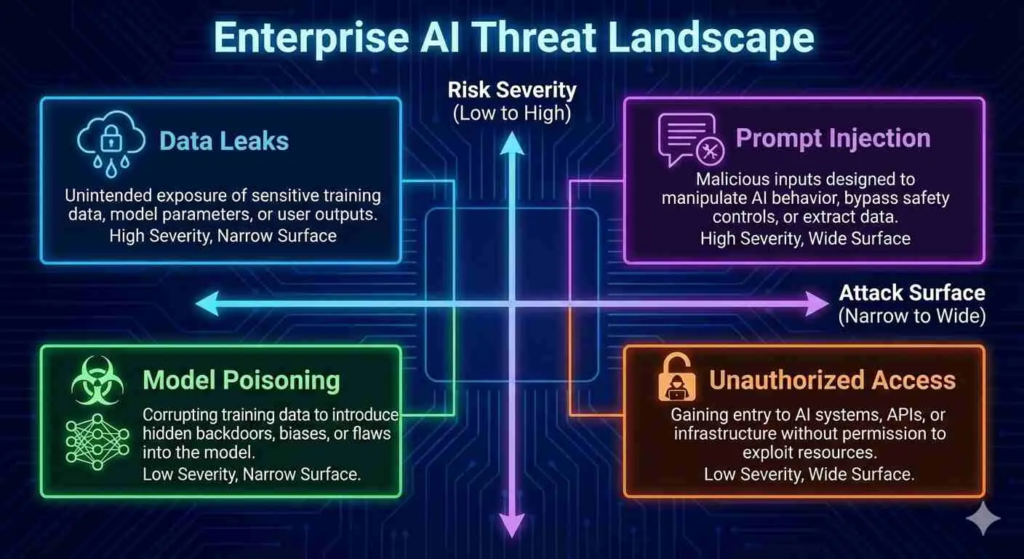
Data Exposure Through Training: AI models trained on company data potentially memorize and reproduce sensitive information. Employees using ChatGPT, Claude, or similar services may inadvertently feed proprietary data into systems where it becomes part of training datasets accessible to other users or the AI provider. Once sensitive data enters external AI systems, organizations lose control over its use and distribution.
Prompt Injection Attacks: Attackers manipulate AI systems through carefully crafted prompts bypassing security controls. These attacks trick AI models into revealing training data, executing unauthorized actions, or generating harmful content. Unlike traditional injection attacks targeting databases or code, prompt injection exploits how AI systems interpret natural language instructions making defense particularly challenging.
Model Poisoning: Adversaries compromise AI models during training or fine-tuning by introducing malicious data. Poisoned models produce incorrect outputs, leak information, or execute backdoor behaviors triggered by specific inputs. Organizations training custom models on internal data face risks from compromised training datasets whether through external data sources or insider threats.
Enterprise AI Threat Landscape
Framework for Safe AI Deployment
Enterprises deploying AI safely follow structured approaches addressing security throughout the AI lifecycle from selection through ongoing operations. These frameworks balance security requirements with practical usability enabling productive AI adoption without unacceptable risk exposure.
Establish Data Governance Controls
Classify Sensitive Data: Begin by identifying which data cannot be shared with AI systems. Classification typically includes customer personal information, proprietary algorithms, trade secrets, financial records, and confidential communications. Clear classification enables enforcing appropriate controls on AI interactions. Organizations need technical capabilities identifying sensitive data in real-time as employees attempt using AI tools.
Implement Data Loss Prevention: Deploy DLP solutions monitoring and controlling data flow to AI services. Modern DLP tools detect when employees paste sensitive information into ChatGPT, upload confidential documents to AI systems, or include restricted data in prompts. These controls block risky interactions while allowing legitimate AI use with non-sensitive information. Effective DLP requires configuring policies matching your data classification scheme.
Create Approved AI Sandboxes: Provide controlled environments where employees experiment with AI using synthetic or sanitized data. Sandboxes let teams learn AI capabilities without exposing real customer data or business information. Organizations can deploy private AI instances with strict data boundaries ensuring sensitive information never leaves corporate infrastructure. For solutions supporting safe AI experimentation, Diginatives provides secure AI implementation services helping enterprises balance innovation with security.
Enforce Strong Access Controls
Role-Based Permissions: Implement granular access controls limiting which employees can use AI systems and what data they can process. Not every employee needs access to AI tools trained on company data or capable of generating sensitive outputs. Role-based permissions ensure only authorized users interact with AI systems while preventing unauthorized experimentation with production models.
Authentication and Session Management: Require strong authentication for AI system access including multi-factor authentication where appropriate. Session timeouts and periodic re-authentication prevent compromised credentials enabling extended AI system abuse. Track which users access AI systems, what prompts they submit, and what outputs they receive creating accountability and audit trails.
API Key Management: Many AI services require API keys for programmatic access. Secure key management prevents unauthorized AI usage and controls spending. Rotate keys regularly, limit key permissions to minimum necessary scope, and monitor usage patterns detecting anomalies indicating compromised credentials or insider misuse.
Design Secure AI Architectures
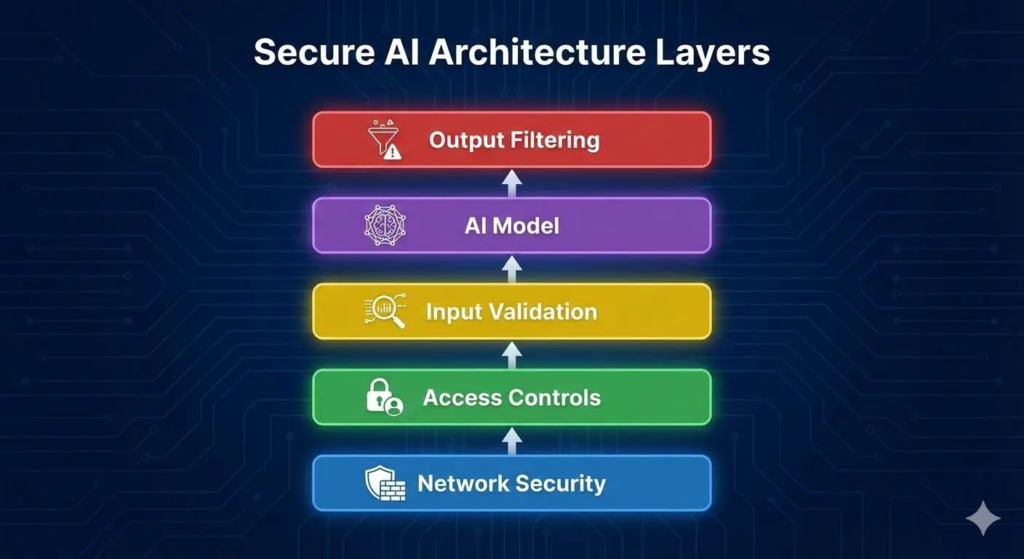
Technical architecture choices significantly impact AI security. Well-designed systems incorporate security controls at multiple layers making successful attacks substantially harder while maintaining usability for legitimate users.
Private AI Deployment Options
On-Premises Models: Organizations with strict data residency requirements deploy AI models entirely within corporate infrastructure. This approach provides maximum data control preventing any sensitive information from leaving company networks. On-premises deployment requires substantial infrastructure investment and AI expertise but eliminates risks from third-party AI service providers accessing or storing company data.
Virtual Private Cloud Instances: Cloud-based AI deployments within private virtual networks offer a middle ground between on-premises control and managed service convenience. Organizations run AI models in isolated cloud environments with strict network boundaries preventing unauthorized access, following proven cloud security tips such as network segmentation, encryption, and access monitoring. This architecture suits enterprises with cloud infrastructure but requiring strong data isolation.
Hybrid Approaches: Many organizations combine private AI for sensitive workloads with managed services for general use cases. Customer service might use private AI trained on customer data while marketing uses public AI for content generation. Hybrid approaches require clear policies defining which use cases warrant private deployment versus accepting managed service trade-offs.
Prompt Filtering and Validation
Content Filtering: Implement filters analyzing prompts before they reach AI models detecting attempts at prompt injection, data exfiltration, or policy violations. Modern content filters use pattern matching, keyword detection, and even AI-based classification identifying malicious prompts. Filters block obvious attacks while flagging suspicious patterns for security team review.
Rate Limiting: Restrict how many AI requests individual users or applications can make within time windows. Rate limiting prevents automated attacks attempting to extract training data through repeated queries or overwhelming systems with malicious prompts. Limits should allow legitimate use while making large-scale attacks impractical.
Output Sanitization: Analyze AI-generated outputs before presenting them to users removing sensitive information that should not be disclosed. Sanitization catches cases where models inadvertently reproduce training data, generate inappropriate content, or reveal information violating policies. This defense-in-depth approach provides protection even when prompt filtering fails.
Secure AI Architecture Layers
Enterprise AI Governance Framework
AI Usage Policies: Clear policies define acceptable AI use including which tools employees may use, what data they can process, and prohibited applications. Effective policies balance security requirements with enabling productive AI adoption. Policies should cover both official company-sanctioned AI tools and restrictions on unauthorized external services.
Security Training: Employees need training understanding AI security risks and safe usage practices. Training covers recognizing sensitive data that should not be shared with AI, identifying potential prompt injection attacks, and following company policies. Regular refreshers keep security awareness current as AI capabilities and threats evolve rapidly.
Vendor Assessment: Organizations using external AI services must evaluate vendor security practices. Assessment includes data handling policies, encryption standards, access controls, incident response capabilities, and compliance certifications. Understand whether vendors use customer data for training, how long they retain information, and what controls prevent unauthorized access. For comprehensive security evaluation guidance, SOC 2 compliance frameworks provide structured approaches to vendor security assessment.
Continuous Monitoring: Deploy monitoring systems tracking AI usage patterns, detecting policy violations, and identifying potential security incidents. Monitoring should cover prompt content, data accessed, outputs generated, and user behavior anomalies. Automated alerts enable rapid response when suspicious activity occurs before significant damage results.
Incident Response Planning: Prepare procedures addressing AI security incidents including data exposure, model compromise, or policy violations. Response plans define escalation paths, containment actions, notification requirements, and recovery procedures. Regular exercises test whether teams can execute response plans effectively under pressure.
Enterprise AI Security Implementation Checklist
Organizations deploying AI safely follow systematic approaches ensuring critical security controls are in place before expanding AI usage across the enterprise.
Assessment Phase: Inventory current AI usage both authorized and shadow IT. Identify which business units use AI, what tools they employ, and what data they process. Classify data by sensitivity determining which information requires protection. Evaluate existing security controls assessing whether they address AI-specific risks.
Policy Development: Create comprehensive AI usage policies based on risk assessment. Define approved AI tools and services, establish data handling requirements, and specify prohibited use cases. Develop vendor evaluation criteria for third-party AI services. Establish governance processes for reviewing and approving new AI initiatives.
Technical Controls: Implement DLP solutions monitoring AI service usage. Deploy content filtering and prompt validation systems. Configure access controls limiting AI system access to authorized users. Establish monitoring capturing AI usage patterns and potential security incidents. Enable logging and audit trails supporting investigation when issues occur.
Training and Communication: Educate employees about AI security risks and company policies. Provide clear guidance on acceptable AI use including examples of permitted and prohibited activities. Create channels for employees asking questions about AI security. Communicate how security teams support rather than block productive AI adoption.
Ongoing Operations: Monitor AI usage continuously identifying policy violations and security anomalies. Review and update policies as AI technology evolves and new risks emerge. Conduct periodic security assessments validating control effectiveness. Maintain vendor relationships ensuring third-party AI providers meet security standards.
Common AI Security Mistakes to Avoid
Blocking AI Entirely: Some organizations respond to AI security concerns by prohibiting all AI tool usage. This approach fails because employees use AI services regardless of policy creating shadow IT beyond security team visibility. Total bans drive usage underground rather than enabling safe adoption. Effective strategies provide approved AI options with appropriate controls rather than attempting complete prohibition.
Ignoring Shadow AI: Failing to discover and address unauthorized AI usage creates significant security gaps. Employees using ChatGPT, Claude, or similar services without oversight may expose sensitive data through well-intentioned productivity efforts. Organizations need discovery mechanisms identifying shadow AI usage then providing secure alternatives rather than simply banning detected tools.
Inadequate Vendor Due Diligence: Rushing into contracts with AI vendors without thorough security evaluation exposes organizations to preventable risks. Understand vendor data handling practices, security certifications, breach notification procedures, and liability terms. Many AI vendors disclaim responsibility for data security making thorough evaluation critical before committing sensitive information.
Neglecting Model Security: Organizations training custom AI models sometimes focus exclusively on model performance ignoring security throughout the training pipeline. Compromised training data, inadequate access controls on models, and lack of monitoring create vulnerabilities. Model security requires attention from data collection through deployment and ongoing operations.
Building Secure AI Adoption
Safe AI deployment requires balancing security concerns against genuine business value from AI adoption. Organizations succeed by implementing practical controls enabling productive AI use while preventing unacceptable risks. This means moving beyond simple prohibition toward governed AI usage with appropriate safeguards matching sensitivity of data and criticality of applications.
Effective AI security combines technical controls, clear policies, employee education, and continuous monitoring. No single measure provides complete protection. Defense-in-depth approaches recognize that some controls will fail requiring backup protections catching threats that bypass initial defenses. Organizations treating AI security as ongoing process rather than one-time implementation adapt successfully as technology and threats evolve.
For enterprises navigating AI security challenges, Diginatives provides expert guidance implementing secure AI solutions. Our team combines technical AI expertise with deep security knowledge helping organizations deploy AI safely without compromising productivity. We understand both generative AI capabilities and enterprise security requirements delivering practical solutions balancing innovation with protection.
Ready to Deploy AI Securely?
Schedule a consultation to discuss your enterprise AI security requirements.
Contact Diginatives
Discover more from Diginatives
Subscribe to get the latest posts sent to your email.