
Here’s a scene I’ve watched play out more times than I’d like to admit. A CTO opens a spreadsheet. Two rows: “staff augmentation,” “outsourcing.” Someone in the room asks, only half-joking, “aren’t these basically the same thing?” They’re not. And I’ve watched the wrong pick burn through a quarter’s runway before anyone admitted the model was the problem, not the vendor.
So let’s actually sort out staff augmentation vs outsourcing – not the glossary-page version, the version based on what happens after the contract gets signed and the Slack channel gets created.
What Is Staff Augmentation?

You hire individual people who join your team, run on your process, and answer to your managers. Simple as that.
Honestly, the staff augmentation meaning gets more complicated in marketing copy than it needs to be. Strip away the jargon and it’s this: your sprint planning stays yours, your codebase decisions stay yours, your PM stays yours. You just… add hands. Need two backend developers for four months? You get two developers who show up in your standups and take direction from your team lead like they’d been there since day one. The project doesn’t change shape. The headcount does.
Which is exactly why “what is staff augmentation” spikes as a search term right around the moment a hiring freeze collides with a deadline nobody’s willing to move. It fixes a capacity problem. It doesn’t touch process – for better or worse.
What Is Outsourcing, Really?
You’re not renting hands here – you’re buying a finished result, built by a team that manages itself.
Different transaction entirely. A vendor takes a feature, a module, sometimes a whole product, and owns it end to end. Their PM runs their standups. Their engineers report to their lead. You get status updates on a schedule, not a front-row seat to the day-to-day grind.
I’ve seen this work beautifully for founders who simply don’t have the bandwidth to manage engineers. I’ve also watched it collapse when the spec going in was fuzzy – and outsourcing is brutally unforgiving of fuzzy specs in a way staff augmentation just isn’t.
Staff Augmentation vs Outsourcing: The Core Differences
It’s not really about cost. It’s about who’s steering.
Here’s the version I actually walk clients through – the one vendor sales pages tend to skip over.
| Factor | Staff Augmentation | Outsourcing |
| Who manages the work | You do | The vendor does |
| Speed to start | Usually 1–3 weeks | Often 4–8 weeks (scoping first) |
| Best for | Filling a gap in a team that already works | Projects with a genuinely fixed scope |
| IP and process control | Stays in-house | Shared, contract-defined |
| Flexibility mid-project | High – redirect daily | Low – changes mean change orders |
| Hidden risk | You still need internal management bandwidth | Vague specs turn into scope creep, fast |
Notice cost isn’t at the top of that list, even though it’s almost always the first thing I get asked about. Both models swing cheaper or pricier depending on region, seniority, contract structure – the usual variables. What actually decides whether a staff augmentation vs outsourcing call was the right one? Who’s making the calls day to day. That’s it. That’s the whole thing.
Staff Augmentation vs Managed Services: Where People Get Confused
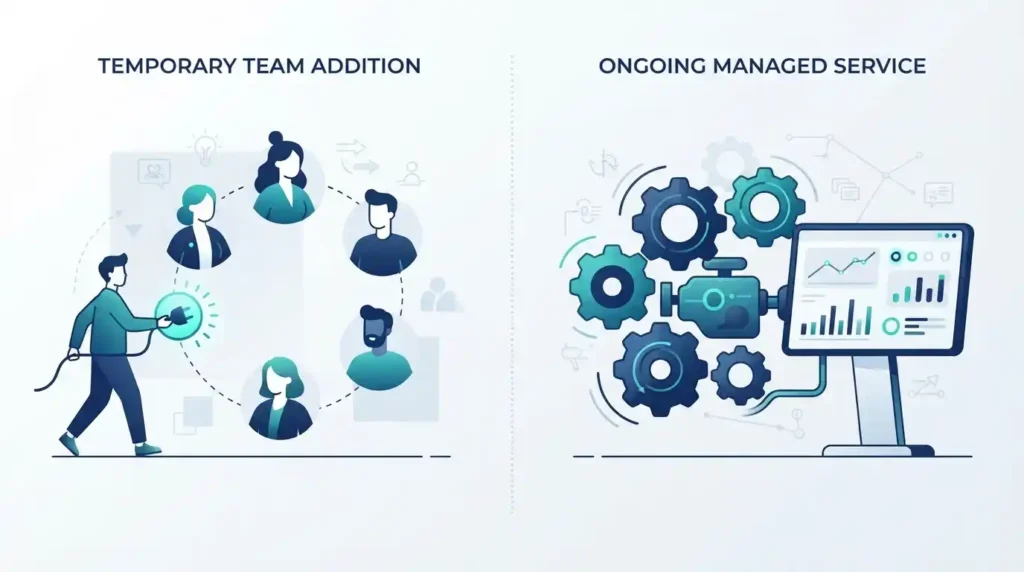
Managed services run an ongoing function for you. Staff augmentation ends when the engagement ends.
This is the mix-up I hear most often, and I get why. Staff augmentation vs managed services isn’t really about how big the project is – it’s about whether something is temporary headcount or a standing function someone else runs forever. A managed services provider might operate your security operations center indefinitely: their SLA, their escalation path, their reporting rhythm, running whether or not you’ve got a project live at all. Staff augmentation doesn’t have that permanence. No function keeps running on your behalf after the contract closes. Just people, plugged into a team you already have.
Need eyes on your cloud environment at 2am, every night, forever? Managed services. Need three more engineers through Q2? Staff augmentation.
Staff Augmentation vs Consulting: A Different Question Entirely

Consulting sells you an answer. Staff augmentation sells you hands to build it.
I hear this comparison less, but it trips people up when they haven’t actually figured out what they’re building yet. Staff augmentation vs consulting really just comes down to what stage you’re at. Consultants assess, recommend, and frequently leave before a single line of production code exists. Augmented engineers show up and build. Already know your architecture and your roadmap and just need more throughput? Consultants are the wrong line item. Not sure yet what you’re building? Adding staff without a plan just means more people, moving faster, in the wrong direction.
When Staff Augmentation Is the Right Call

Strong internal process plus a capacity gap equals staff augmentation.
From what I’ve watched work, over and over: this model wins when your team already owns the roadmap, already has real code review standards, and isn’t rewriting the plan every sprint. You’re not short on direction. You’re short on throughput. It also wins whenever the work touches something sensitive – architecture you don’t want walking out the door in someone else’s head. Security work, AI work – in my experience these lean toward augmentation more often than not, mostly because the context an engineer needs there can’t really be handed over in a written spec. Some of it just has to be absorbed by sitting in the room.
When Outsourcing Makes More Sense
Quick overview: Well-defined project, zero bandwidth to manage it – outsource it.
The flip side is just as true. Five-person startup, customer portal needs building, nobody has an hour to run daily standups with new hires? Hand the whole build to a vendor who owns delivery start to finish. It’s also the better call for one-off work with a hard spec and a finish line in sight – a website rebuild, a migration, an integration – where you don’t need anyone sticking around once it ships.
A Real Scenario: How This Plays Out
Quick overview: Same company, same quarter, two different problems, two different models.
A mid-size SaaS company I worked with needed two things at the same time: a security audit ahead of a compliance deadline, and three extra engineers to burn down a backlog before their next funding-round demo. They outsourced the audit – fixed scope, fixed deadline, zero appetite to manage it themselves. For the backlog, they brought on augmented staff who dropped straight into existing sprints, existing tools, reported to their existing engineering manager. Same quarter. Two totally different shapes of problem. Two totally different tools.
How to Decide: A Quick Framework
Three honest questions, and the answer basically picks itself.
Can you actually manage this work day to day, or is that bandwidth just not there? Do you need this expertise to stick around and absorb your institutional context, or is it a single deliverable and done? And is the scope locked, or is it going to keep shifting as you learn more? Answer “I want to manage it” and “scope will move” – staff augmentation, almost every time. Answer “no bandwidth” and “scope is locked” – outsourcing wins.
FAQs
Is staff augmentation cheaper than outsourcing?
Not automatically. Rates move around by region and seniority in both models. The real gap shows up in management overhead – staff augmentation eats your internal team’s time to direct the work, outsourcing shifts that weight onto the vendor.
Can staff augmentation and outsourcing be used together?
All the time, actually, more than people expect. A lot of companies outsource one self-contained project while running staff augmentation in parallel to cover an ongoing gap on the core product team.
What is the staff augmentation meaning in a security or compliance context?
In cybersecurity specifically, it usually means bringing in a specialist – a penetration tester, a DFIR analyst, an AWS security engineer – who works inside your existing security team’s process instead of running an independent audit on their own clock.
How fast can a staff augmentation engagement start?
Most placements start in one to three weeks. No deliverable to scope upfront, just a skill set to match to a role.
Is staff augmentation the same as a dedicated team model?
No. A dedicated team is usually a full squad – PM, engineers, QA – managed together, often by the vendor, for something long-running. Staff augmentation is individual people slotting into a team you’re already managing.
The Bottom Line
There’s no universal right answer buried in staff augmentation vs outsourcing. There’s a right answer for your project. Protective of process and control, just need more hands? Staff augmentation. Well-scoped project, no internal bandwidth to run it? Outsourcing. Most growing companies end up using both at different points – and that’s not a contradiction. That’s just matching the tool to the problem sitting in front of you.
And if you’re still weighing a third or fourth option: staff augmentation vs managed services comes down to temporary headcount versus a function someone else runs forever, and staff augmentation vs consulting comes down to execution versus advice. Figure out which of those three questions you’re actually asking, and honestly, the right model tends to pick itself.
Discover more from Diginatives
Subscribe to get the latest posts sent to your email.