
Enterprise AI spending has hit levels nobody would have predicted three years ago. Hundreds of billions of dollars, poured into proof-of-concepts, GenAI sandboxes, internal copilots, automated workflows you name it. And yet, behind the polished board decks and the demo-day applause, most of these projects never make it to a live production environment. They just… stop.
The numbers back this up, and honestly, they’re not subtle:
- MIT’s Project NANDA found that 95% of enterprise Generative AI pilots fail to deliver any measurable profit-and-loss impact. No revenue bump, no cost savings that show up on a spreadsheet.
- RAND Corporation puts the failure rate at over 80% for AI projects reaching meaningful production roughly double the failure rate of ordinary, non-AI IT projects.
- Gartner says up to 85% of AI projects fail, mostly because of poor data readiness, and predicts more than half of GenAI proofs-of-concept will get abandoned once costs start climbing and the business value stays fuzzy.
- McKinsey’s surveys show 88% of enterprises are using AI somewhere in the business. Only 39% can point to any real EBIT impact from it.
When something dazzles in a demo and then falls apart in production, the instinct is to blame the model. “Maybe we need GPT-6” or “let’s try the new Claude model.” But that’s rarely the actual problem modern foundation models are good enough for almost everything enterprises are trying to do with them. The real bottleneck is architectural, operational, and honestly kind of boring: pipelines, ownership, measurement.
This article digs into why that gap exists the one between “cool prototype” and “thing that actually runs the business” and what it actually takes to close it.
if what you need is roadmap creation, use-case prioritization, or governance frameworks, that’s covered on our AI Strategy Consulting Services page. This piece is deliberately narrower it’s about execution, scaling architecture, and the engineering discipline that gets a pilot across the finish line.
The Sandbox Illusion: Where Most AI Pilots Fail

Here’s the thing about Ai pilots Fail: they work in a sandbox because the sandbox is rigged in their favor. Not maliciously just by nature.
Think about how most pilots actually get built. Someone exports a clean CSV. The prompts get tested against a tidy, hand-picked dataset. There’s no legacy system throwing weird API errors, no rate limits, no edge cases (because a developer quietly filtered them out somewhere around week two). Latency doesn’t matter. Token costs don’t matter. Model drift doesn’t exist yet because the pilot’s only been running for six weeks.
Under those conditions? Of course it looks transformative. It answers questions, drafts emails, parses documents and it does it well.
Then it hits production. Suddenly there’s unsanitized user input, three different database schemas that don’t quite match, pipeline failures that make no sense, strict latency SLAs from the ops team, security reviews nobody scheduled for, and token costs that scale a lot faster than anyone modeled. Moving from pilot to production isn’t a deployment step. It’s a jump from prompt experimentation to actual enterprise software engineering MLOps resilience included.
The Four Reasons Pilots Actually Stall
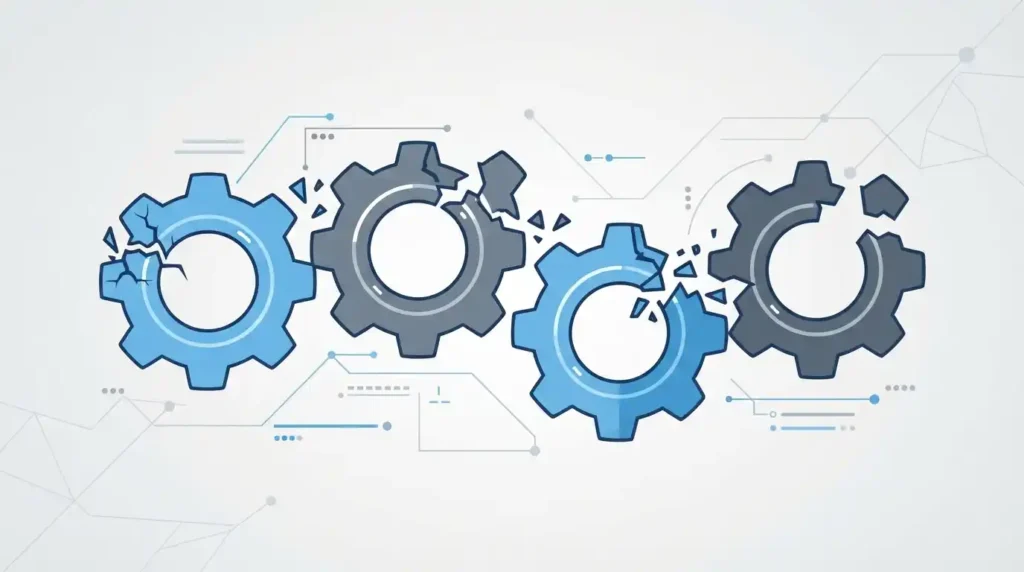
Strip away the excuses, and almost every failed AI pilot traces back to one of four root causes.
1. Weak data foundations (and a training-serving mismatch nobody caught)
A model’s only as good as what’s feeding it. In the prototype phase, that’s usually a clean, static context window someone built by hand. In production, that data has to come from real-time ERPs, CRMs, and SQL databases dynamically fetched, parsed, normalized, vectorized, all of it, on the fly.
That shift creates two failure points worth naming:
- Training-serving skew. The dataset used to evaluate the prototype almost never looks like live traffic. Real inputs have missing fields, weird formatting, mixed languages, records that are six months out of date. The moment real traffic hits, accuracy drops sometimes sharply.
- No durable context architecture. A prompt wrapper isn’t a system. Without a real RAG pipeline, knowledge graph, or session memory, the model can’t hold state across a multi-step workflow. It’s answering each question like it’s the first one it’s ever seen.
Gartner has flagged poor data readiness as the number one reason AI projects get abandoned, and that tracks with what we see in practice too. No clean, API-accessible, real-time pipeline no scaling. Full stop.
2. Nobody defined what “success” even means
Most software either works or it doesn’t an API returns a valid payload, or it throws an error. AI isn’t like that. It’s non-deterministic by design, and yet a shocking number of pilots launch with zero quantitative success criteria. Just vibes, basically. “The testers liked it.”
Without a real evaluation pipeline LLM-as-a-judge setups, assertion testing, a proper golden dataset teams run into two walls:
- No baseline. If nobody recorded the pre-pilot numbers (error rate, handling time, extraction accuracy whatever the metric is), there’s no way to prove the AI actually improved anything.
- Fear of regression. Every time someone tweaks a system prompt or swaps model providers, there’s no way to know if they fixed one edge case while quietly breaking three others.
Without automated evals wired into CI/CD, no engineering leader worth their salt is going to sign off on a production rollout. And honestly, they shouldn’t.
3. The “hours saved” trap
This one’s my favorite because it sounds so reasonable and is so often wrong.
The pitch usually goes: “This assistant saves 500 support reps two hours a week that’s $1.5M in efficiency.” Sounds great. Except saved time isn’t money. It’s vapor. Unless someone actively captures and redirects that freed-up capacity, it just… evaporates into longer lunch breaks and extra meetings. The P&L never sees a dime of it.
Before a single line of production code gets written, someone needs to answer:
- Are those saved hours converting into higher throughput with the same headcount?
- Are people getting reallocated from manual busywork to something that actually drives revenue?
- Can the system absorb a volume spike without anyone hiring a contractor?
If there’s no straight line from “efficiency” to an actual cost reduction or revenue number, the CFO is going to pull funding before this thing ever reaches production. And they’d be right to.
4. Nobody who owns the outcome actually owns the pilot
This is the organizational one, and it’s sneaky because it has nothing to do with the technology.
Most pilots get funded and built by a central Innovation Lab or an IT team. They build something impressive, demo it to leadership, everyone claps. Then it’s time to actually deploy and that’s when things stall, because:
- The person who’d own this in production (VP of Claims, Head of Underwriting, whoever) never had input on the requirements.
- Their team’s KPIs and incentives are still tied to the old, legacy workflow.
- Nobody budgeted staff time for handling exceptions or escalations once it’s live.
When R&D tries to hand the finished pilot over to Operations, the handoff just… doesn’t happen. Without a named executive who owns both the process redesign and the P&L metric, the pilot sits in the lab collecting dust. Forever, sometimes.
Stop Measuring “Hours Saved” Measure This Instead
If you want a pilot to actually reach production, the metrics have to change. Abstract efficiency claims don’t survive contact with a CFO. Line-item P&L impact does.
| Legacy Pilot Metric (Vaporware) | Production Outcome Metric (Real Impact) |
|---|---|
| “Saves 3 hours per user per week” | 45% reduction in unit cost per transaction |
| “Improves employee satisfaction” | 3.2x throughput increase, zero added headcount |
| “90% accuracy in testing” | 68% drop in compliance rework expenses |
| “Faster initial response times” | 35% faster sales cycle / contract execution |
A few things worth actually tracking:
- Unit cost per transaction — total cost (compute + human review + infra) per completed output, compared against the fully-loaded human cost it’s replacing.
- Throughput on fixed overhead — how much volume gets processed without adding headcount.
- Defect and rework elimination — the dollar value of errors and compliance fines that stopped happening once guardrails were in place.
- Revenue cycle velocity — how much faster things like quote-to-close or underwriting actually move.
AI Pilots Fail Without This: The Pre-Scale Checklist

Before anyone greenlights a pilot for production, it’s worth running through this not as a formality, but because skipping any one of these is usually where things quietly break six weeks later.
Data & infrastructure
- Live, production-grade APIs not static batch exports
- Real-time schema drift detection before bad data hits your prompts
- Dynamic context retrieval with proper chunking and re-ranking
Evaluation & quality control
- A real golden dataset 100+ edge cases, not 12
- Automated evals wired into CI/CD (precision, faithfulness, hallucination rate)
- A human-in-the-loop escalation path for flagged outputs
Architecture, cost & latency
- Smart model routing cheap models for easy tasks, frontier models where reasoning actually matters
- Token budget caps and semantic caching enforced at the gateway
- A fallback mechanism for when your primary provider has a bad day
Operational alignment
- A named P&L owner who’s actually sponsoring this, not just watching from the sidelines
- Documented baseline metrics from before the AI touched anything
- A real plan for where the freed-up capacity goes
Closing the Gap Takes Engineering, Not Magic
Scaling AI past the sandbox stage was never really a model problem. It’s a systems engineering problem, a data architecture problem, and more often than people want to admit an organizational alignment problem. The companies that get this right don’t treat AI like a shiny side project. They build it into their architecture like any other resilient, production-grade system.
Solid data infrastructure. Automated evaluation. A P&L owner who’s actually accountable. Real financial metrics instead of soft “efficiency” numbers. Get those four things right, and the odds shift dramatically in your favor.
If you’re past the demo stage and ready to build something that actually holds up in production, talk to our engineering team about scaling your AI pilot.
Discover more from Diginatives
Subscribe to get the latest posts sent to your email.