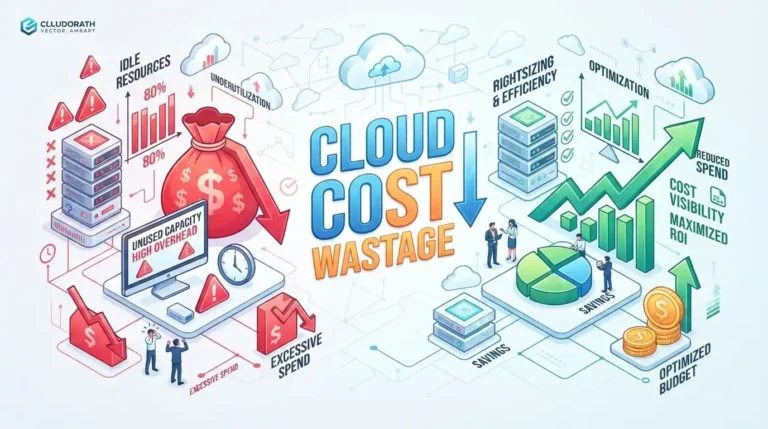
Uncontrolled cloud infrastructure costs can quickly undermine enterprise profitability. As multi-cloud architectures become more complex, true cost optimization must move beyond basic bill cleanup to include structured operational efficiency strategies.
Executing an effective cloud cost optimization strategy ensures your organization optimizes performance while eliminating waste. Relying solely on reactive monthly bill audits no longer works; modern infrastructure demands continuous monitoring, team accountability and strategic FinOps frameworks for successful operations management.
This comprehensive guide presents effective, cost-cutting cloud cost optimization techniques designed to reduce spend without impacting system speed, reliability or scalability.
What Is Cloud Cost Optimization, and Why It Fails in 2026
At its core, cloud cost optimization refers to the practice of reducing overall cloud expenditure by identifying wasteful spending practices, allocating resources appropriately, and making use of provider discounts structures. Rather than simply cutting services back or increasing spending levels on cloud infrastructure costs; Cloud cost management aims at maximizing value produced from each dollar spent on its infrastructure.
Most projects fail because organizations view it as an one-off project rather than an ongoing operational discipline. Common factors for failure include:
- Lack of Visibility: Engineering teams typically deploy resources without fully understanding their long-term cost impact and potential implications.
- Over-provisioning: Developers choose larger instances than necessary in order to avoid performance bottlenecks, leading to significant resource waste.
- Decentralized Purchasing: Different departments often create cloud assets separately making centralized cloud spend management challenging.
- Ignoring Idle Assets: Bypassing Cost Optimization Solutions: Test environments, unattached storage volumes and static IPs which remain idle are still being charged against accounts invisibly –
cost optimization strategies need to take this into account when making technical deployment decisions for cloud environments in line with business objectives.
The Shift from Basic Cost Cutting to Modern FinOps
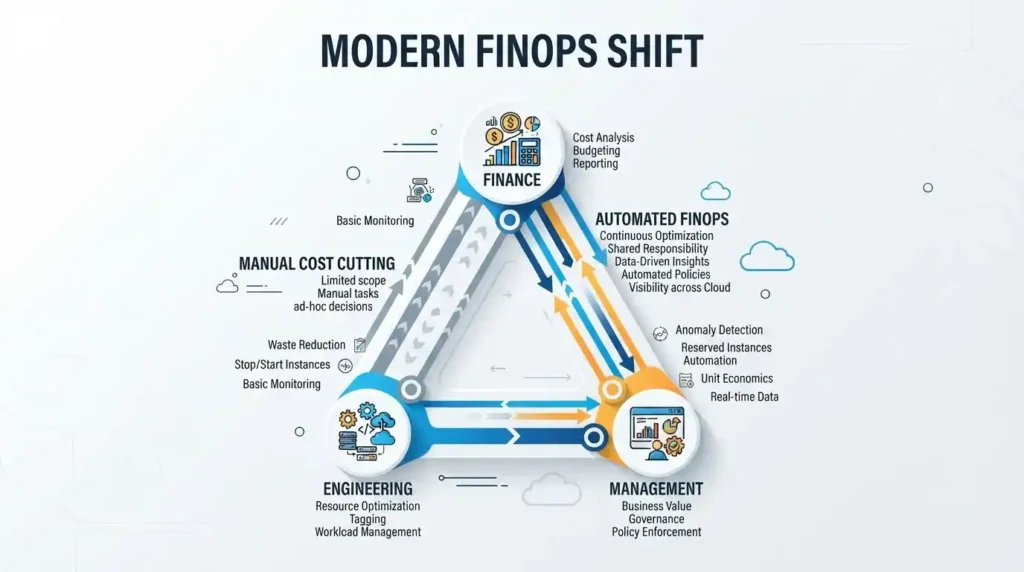
Traditional cost cutting efforts focused on engineering teams manually reviewing monthly bills and deleting obvious unused virtual machines from cloud environments. But as cloud costs have become more dynamic with rapid microservice deployments, auto-scaling groups, and multi-region setups requiring automated financing ops systems, manual processes simply cannot keep up.
FinOps (Financial Operations) emerged to address this operational gap. FinOps is an evolving cloud financial management discipline that brings accountability and oversight of cloud spend; serving as an intermediary between finance, engineering and business leadership.
FinOps strategies 2026 aim to understand business value per cloud dollar rather than simply cutting infrastructure spending. Instead of asking “How can we reduce our bill?,” mature FinOps models pose the question, “Are we getting optimal performance and revenue yield from our cloud infrastructure?”
Core Pillars of Cloud Cost Management for Multi-Cloud Environments
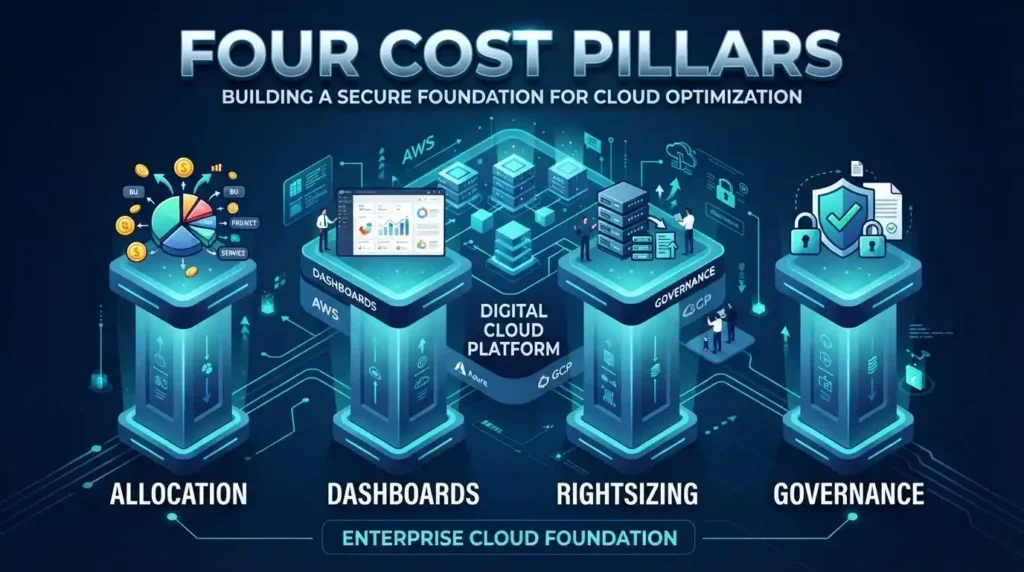
Successful cloud cost management relies on four key pillars. Without them, technical cost-cutting techniques will only produce temporary results.
1. Cost Allocation and Resource Tagging
Allocating Cost and Tagging It is impossible to optimize what cannot be tracked. Establish and enforce strict resource tagging policies across all environments (i.e. Owner, Environment, CostCenter and Project), so your teams can easily link every line item on a cloud bill back to its respective product feature or business unit.
2. Visibility and Reporting
To effectively monitor cloud spending trends daily rather than monthly, real-time dashboards that display spending trends daily rather than monthly are essential in preventing unexpected bill spikes due to runaway processes or configuration errors from becoming a source of concern.
3. Continuous Rightsizing
Rightsizing with Care Over time, infrastructure requirements change and must be assessed periodically to make sure virtual machines, databases and container nodes meet actual workload requirements instead of peak theoretical loads.
4. Automated Governance
Manual adjustments do not scale. For maximum control in your environments, implement automated guardrails, infrastructure-as-code policies and scheduled shutdown routines in order to keep consistent control.
9 Actionable Cloud Cost Optimization Strategies
Implementing systematic cloud cost optimization strategies delivers immediate, compound savings. Here are nine field-tested cloud best practices you can put into action today for maximum return:
| Strategy | Action / Details | Benefit / Impact |
| Compute Sizing | Match CPU/RAM to actual workloads | Eliminate paid, unused capacity |
| Commitments | Use Savings Plans & Reserved Instances | @ 30%-70% rate reductions |
| Storage Hygiene | Remove orphaned disks & snapshots | Halt silent, recurring storage fees |
| Serverless Setup | Fine tune memory/execution timeouts | Prevent runaway microservice bills |
| Architectural Flow | Optimize egress and cross-region routing | whilst lowering bandwidth costs |
1. Rightsizing Cloud Resources for Compute and Storage
Dynamically Rightsizing Cloud Resources is still the single most effective technical way to reduce direct costs. Engineers tend to provision instances on initial assumptions rather than performance data.
- Assess Utilization Data: Take a close look at CPU, RAM, disk I/O, and network usage over a 30-day window for each instance running at less than 15% average CPU utilization; downsize accordingly to reduce costs and make space available.
- Modernize Instance Families: Cloud providers often release newer hardware generations (e.g., upgrading from AWS Graviton2 to Graviton3) that offer 10-20% improved performance at lower cost points for moving workloads onto them. This can give a substantial performance boost at reduced price points for your workloads.
- Storage Tiering: Move inactive objects from high-performance block/object storage into colder storage tiers like Amazon S3 Glacier or Azure Archive Storage using lifecycle automated rules. Rightsizing cloud resources continually trims excess compute waste across your fleet of systems.
2. Advanced AWS Cost Optimization Strategies (Savings Plans vs Reserved Instances)
To maximize AWS cost optimization, shift away from on-demand pricing for predictable baseline workloads; on-demand infrastructure is often the more expensive way to run compute long-term.
- AWS Savings Plans: Get up to 72% savings off on-demand pricing by making a commitment for an hourly compute usage (measured in $/hour). Compute Savings Plans offer maximum flexibility, automatically applying across EC2, Fargate, and Lambda instances no matter their region or instance family.
- Reserved Instances (RIs): Reserved instances are ideal for databases like Amazon RDS where capacity requirements remain stable over multiple-year horizons.
- Spot Instances: For workloads requiring fault tolerance, stateless processing or batch processing capabilities, AWS Spot Instances can provide access to spare compute capacity at up to 90% discount over On-Demand rates. Utilizing both commitments and Spot instances together forms the cornerstone of modern AWS cost optimization.
3. Azure Cost Optimization and Enterprise Discount Performance
To optimize Microsoft infrastructure costs effectively, organizations should focus on specific Azure cost optimization levers:
- Azure Hybrid Benefit: Realize existing investments by applying on-premises Windows Server and SQL Server licenses to Azure virtual machines, drastically cutting operational execution costs significantly.
- Reserve Azure Reservations: Opting for one- or three-year plans can unlock savings of up to 72% over pay-as-you-go pricing for virtual machines (VMs), SQL databases, and Cosmos DB storage solutions.
- Dev/Test Pricing Plans: Take advantage of dedicated Azure Dev/Test pricing plans to operate non-production environments at discounted rates without incurring Microsoft software licensing fees on sandbox workloads, thus helping stabilize monthly bills for enterprise Azure cost optimization programs.
4. Serverless Cost Optimization: Avoiding Hidden Execution Spikes
Although serverless architectures reduce idle compute costs, poorly optimized configurations may still result in unexpected cost spikes that require serverless cost optimization requiring fine-grained performance tuning to effectively mitigate.
- Memory Vs Execution Speed: On AWS Lambda platforms, allocating more memory also increases CPU power proportionately; increasing memory can actually decrease total execution time and thus lower total execution costs.
- Timeout Limits: Set strict function timeout limits in order to prevent infinite loops or failed database calls from running continuously and skyrocketing your bill.
- API Gateway Caching: Implement caching at the API layer to serve repetitive requests directly rather than calling serverless execution functions every time they arise, instead.
5. Eliminating Unattached Storage, Idle IPs, and Orphaned Snapshots
Waste builds silently in cloud accounts through abandoned assets:
- Elastic Block Storage (EBS/Managed Disks): After virtual machines have been deleted, attached storage volumes often remain attached and continue billing your account even if virtualization was successfully terminated.
- Orphaned Volume Snapshots: As time goes on, old backup snapshots accumulate. To maintain compliance, implement automated retention policies and delete those older than your compliance policy requires.
- Unused Elastic IP Addresses: Cloud providers typically charge hourly fees for static public IP addresses that have been provisioned but remain unused; regular hygiene audits form the cornerstone of effective Cloud cost management .
Multi-Cloud Cost Optimization across AWS, Azure and Google Cloud
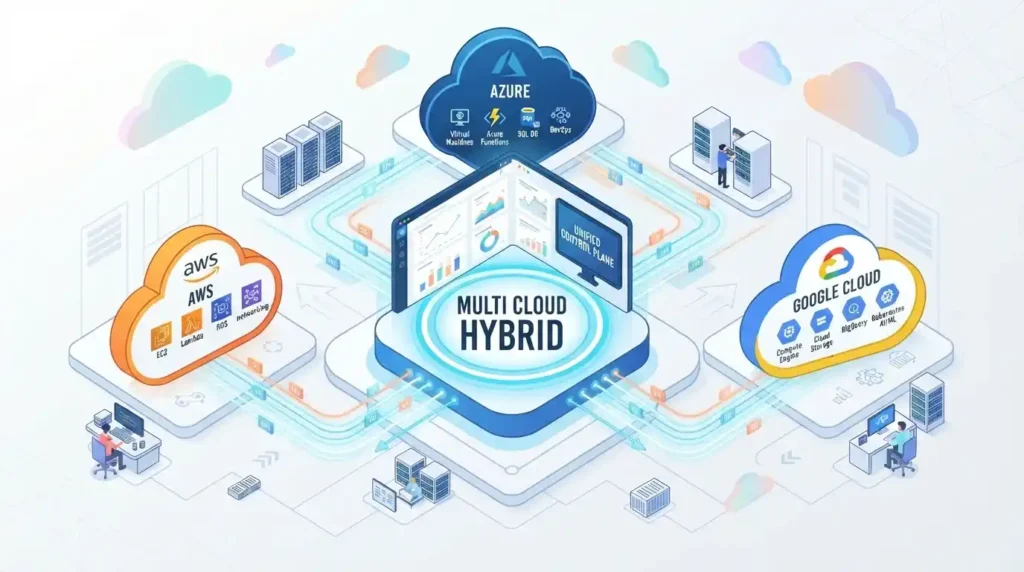
Operating across multiple cloud providers increases operational complexity; for effective multi-cloud cost optimization to take place requires standard cross-platform management strategies that will facilitate effective cost control strategies across each cloud provider.
- Normalize Cloud Metrics: Use third-party cost management platforms or unified data lakes to convert vendor-specific terms into standard cost metrics.
- Control Data Egress Costs: Moving data out of cloud networks (egress) or between providers incurs considerable fees, so architects should place heavy data processing functions closer to primary repositories for maximum efficiency.
- Avoid Vendor Lock-In: Build portable infrastructure using containers and infrastructure-as-code (such as Terraform). This flexibility enables you to migrate non-critical workloads quickly to whatever cloud partner offers the most attractive pricing terms.
An effective multi-cloud cost optimization strategy keeps vendors competing for your business.
Strategic Cloud Spend Management: Aligning Tech and Finance Teams

Tech teams typically drive cloud spending while finance teams hold accountable budgets; therefore bridging this divide is essential for long-term cloud spend management success.
- Implement Unit Economics: Move away from looking solely at cloud bills; instead measure cost per user, transaction or active customer. If your cloud bill grows 20% but active paid users increase 100%, this could actually improve efficiency!
- Set Anomaly Detection Alerts: Create automated machine learning alerts that trigger immediately if daily spending strays outside normal operational baselines.
- Gamify Cost Efficiency: Publicly share department-level cost metrics within your engineering organization and recognize teams that proactively optimize infrastructure and eliminate waste. Culture-driven cloud spend management ensures cost control without impeding product delivery.
Track Key Metrics of Cloud Cost Optimization
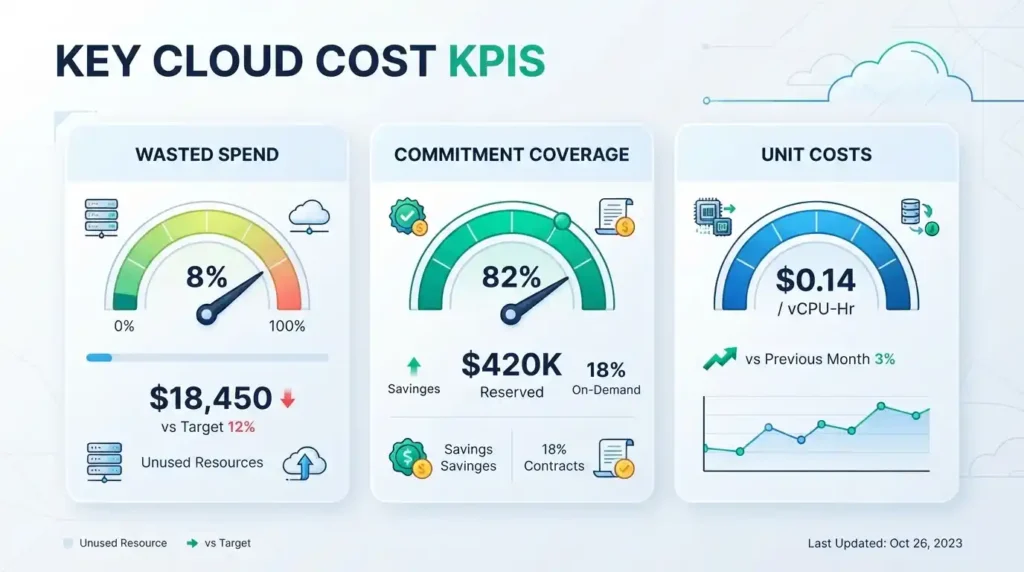
In order to assess the results of your Cloud cost management initiatives, track these essential key performance indicators (KPIs).
- Wasted Spend Percentage: This measures the percentage of total cloud spend that goes towards idle, unattached or severely underutilized resources (Target: less than 5%).
- Commitment Coverage Rate (CCR): This measure determines how many eligible compute workloads are covered by Reserved Instances, Savings Plans or committed use discounts (Target: 70%-84%).
- Tagging Coverage (TCV): The proportion of running cloud assets which strictly comply with organizational tagging standards (Target > 95%).
- Unit Cost Trends: By tracking these operational benchmarks, your enterprise infrastructure remains lean, predictable, and fully in line with business growth.
Frequently Asked Questions About Cloud Cost Optimization Solutions
What are the primary goals of cloud cost optimization?
Cloud cost optimization’s primary aim is to maximize business value from investments made into cloud infrastructure by eliminating wasteful spending on unnecessary infrastructure resources, matching provisioned resources with actual application needs and taking full advantage of volume discount structures.
How does FinOps differ from traditional cloud cost management?
Traditional cost management primarily relies on reactive cost-cutting measures after bills arrive; in contrast, FinOps is an operational culture that ensures continuous financial accountability to engineering and deployment decisions in real time.
How often should an organization perform cloud cost optimization?
Optimization should take place continuously. While in-depth architectural reviews might occur quarterly, automated anomaly alerts, rightsizing checks, and waste cleanup routines should take place daily or weekly.
What is Rightsizing in Cloud Computing?
Rightsizing refers to the practice of reviewing compute, storage and networking resources with an eye toward aligning their configuration parameters (CPU, RAM and throughput) closely with actual operational workloads without sacrificing performance.
Discover more from Diginatives
Subscribe to get the latest posts sent to your email.