
Agentic artificial intelligence enables AI systems to plan, make decisions, and complete tasks with minimal human intervention. While this improves efficiency, it also introduces new security risks that organizations must address and agentic AI security has quickly become one of the top priorities for cybersecurity teams heading into 2026.
Before diving into the security implications, it’s crucial to discuss what exactly is agentic AI, and how it differs from traditional AI systems. Conventional artificial intelligence focuses on answering questions, executing simple requests, and generating outputs based on specific inputs. In comparison, agentic artificial intelligence refers to software systems that can operate independently, and make decisions without waiting for constant human input. Understanding this distinction helps cybersecurity teams grasp the unique risks associated with self-driven software systems and why a proactive defense strategy matters more than ever.
Quick-Reference Security Checklist
- ✅Every agent has scoped, least-privilege, time-limited credentials
- ✅Read/write/send permissions are separated and independently gated
- ✅All tool calls and prompts are logged and monitored for anomalies
- ✅Indirect prompt injection has been tested via red teaming before go-live
- ✅Every third-party tool/integration has undergone a security review
- ✅Sensitive data flows are covered by DLP and encryption
- ✅A documented, tested kill switch exists for every production agent
- ✅High-stakes actions require explicit human approval
- ✅Controls are mapped to OWASP LLM Top 10 / MITRE ATLAS / NIST AI RMF
- ✅Incident response plan explicitly covers agentic AI failure modes
Why Traditional Security Tools Are Failing Against Agentic AI Security Threats

Traditional cybersecurity solutions were designed for predictable software, not autonomous AI agents. As AI systems become more independent, organizations need security strategies that can monitor intelligent decision-making.
Many organizations continue relying on conventional cybersecurity measures to detect and stop autonomous AI threats. However, traditional security controls are ineffective against self-driving software systems for multiple reasons:
- Autonomous AI Agents Can Make Decisions
Most organizations are accustomed to securing apps that simply respond to user input. Agentic AI, on the other hand, can make independent decisions. In many cases, compromised AI systems can execute malicious instructions faster than humans can react. - Agentic AI Can Interact With Multiple Systems
Self-driving AI applications often use various tools and external systems to complete tasks. Each additional network call presents new opportunities for attacks, and increases the overall risk surface. - AI Agents Can Use Third-Party Software
Many AI agents rely on external systems to access data, perform calculations, and complete transactions. The same flexibility can be abused by bad actors to route requests through compromised nodes. - Autonomously Driven Software Can Learn and Evolve
Many agentic AI applications continue improving their performance based on past interactions. The same characteristic could allow hackers to bypass security controls by tricking the system into granting administrative privileges. - Agentic AI Security Requires Continuous Monitoring
Most traditional security tools focus on securing the network and endpoints. Autonomous AI applications, however, require a different approach because their behavior depends on objectives, data, and external tools.
How Agentic AI Security Challenges Are Changing Modern Cyber Defense

Autonomous AI expands the attack surface by interacting with multiple systems, handling sensitive data, and making independent decisions. These capabilities require stronger governance and continuous monitoring.
Autonomous AI has become a major cybersecurity concern as more businesses adopt self-driving software systems. Autonomous systems present unique challenges stemming from expanded attack surface, excessive permissions, and modified input.
Expanded Attack Surface
One of the biggest risks of autonomous AI stems from the fact that autonomous systems often interact with multiple external systems. In the simplest terms, every new API call grants access to another network, and creates additional entry points for attackers.
Excessive Permissions
Most agentic AI applications require elevated permissions to perform their primary functions. Many autonomous systems use email clients, calendars, databases, and other critical systems to complete tasks. If the permissions are not properly restricted, compromised AI agents can cause significant damage by granting access to restricted data.
Prompt Engineering and Indirect Injection
Autonomous systems often rely on user input to execute commands and make decisions. One of the main Agentic AI security risks stems from the fact that attackers can abuse indirect injection to abuse prompts and inject malicious code. Unlike traditional software attacks, prompt engineering does not rely on vulnerabilities in the application code. Instead, bad actors can influence the behavior of AI agents by modifying requests, documents, and external data sources.
Data Exfiltration Risks
Most autonomous systems process and store sensitive information such as email content, customer data, financial reports, internal communications, and other restricted or confidential documents. Without proper safeguards, such data can be accidentally exposed to unauthorized users.
Security teams overseeing these systems must implement strict data protection measures to prevent exfiltration attempts from compromising the integrity of their systems. For a deeper look at controls like DLP and access governance, see our guide on mitigating AI security risks in enterprises.
How Threat Actors Exploit Agentic AI and Why Security Teams Must Prepare
Attackers no longer need to target only software vulnerabilities. They can also manipulate autonomous AI systems through malicious inputs, compromised integrations, or excessive permissions.
Malicious actors often seek to exploit autonomous systems by:
- Manipulating their behavior through malicious inputs and unauthorized instructions
- Interacting with vulnerable third parties to gain indirect access to the main application
- Injecting unauthorized instructions to alter how the AI agent behaves
One of the main ways attackers can abuse agentic AI stems from the fact that many self-driving systems rely on user prompts to perform certain actions. In many cases, malicious prompts can be abused to trick the AI into granting administrative privileges or exfiltrating data. Another risk area stems from the ability of attackers to compromise trusted external systems and abuse their permissions to target the main application.
Business Impact of Agentic AI Security Risks
Most organizations understand the potential business impact of third-party breaches, data leaks, and ransomware attacks. However, many cybersecurity teams fail to consider the destructive impact of agentic AI security threats. Essentially, compromised autonomous systems could cause widespread disruption and financial losses and the numbers already back this up. According to IBM’s 2025 Cost of a Data Breach Report, the global average cost of a breach reached $4.44 million, and breaches involving unauthorized or unmonitored AI tools added roughly $670,000 to the average cost. As autonomous systems become ubiquitous across critical industries, their destructive impact could be far greater than any traditional attack.
Securing these systems requires organizations to rethink their approach to digital defense by implementing stricter security controls around autonomous systems.
How to Defend Against Agentic AI: Modern Security Strategies

Defending against autonomous AI requires more than traditional cybersecurity controls. Organizations should combine governance, access management, monitoring, and human oversight to reduce emerging risks.
Securing autonomous systems is critical for any organization that wants to benefit from the advantages of self-driving software. Achieving strong protection in this space requires a combination of governance policies, continuous monitoring, and access restrictions before deploying any autonomous systems in production.
1. Always Follow the Principle of Least Privilege
Every AI agent must be granted only the permissions required to perform its primary functions. For example, organizations should restrict access to applications, data, and tools that are necessary to complete specific tasks. The principle of least privilege also applies to network access and administrative privileges — a core pillar of our broader approach to mitigating AI security risks in enterprises.
2. Monitor All AI Traffic for Potential Threats
Most conventional security tools focus on protecting the network and endpoints. Autonomous systems, however, represent a new risk surface that requires behavioral monitoring and continuous inspection. Essentially, security teams must inspect all interactions between AI agents and external systems to detect any suspicious activity, an approach we cover in detail in our AI red teaming framework for simulating and testing these attack scenarios before they happen.
3. Always Verify External Integrations
Most agentic AI applications rely on external systems to perform their primary functions. Organizations must conduct comprehensive risk assessments of all third-party integrations to ensure there are no security misconfigurations.
4. Restrict Access to Sensitive Data
Many autonomous systems store and process restricted data such as emails, customer information, financial reports, and other sensitive documents. Security teams must ensure that such data is protected with strong encryption and access controls.
5. Ensure Human Oversight of All Critical Functions
Agentic AI security requires organizations to review all financial transactions, legal contracts, and other critical processes managed by autonomous systems. The OpenAI-Hugging Face incident is a real-world example of what happens when an autonomous agent operates without a reliable kill switch or human checkpoint in place.
By implementing the right safeguards, cybersecurity teams can effectively mitigate most agentic AI risks before they cause any damage.
Building an AI Security Framework for Autonomous Systems
An agentic AI security framework helps organizations develop a comprehensive set of policies, procedures, and controls around autonomous systems. Most self-driving applications require governance and risk management policies to ensure proper oversight of their operations. Organizations should always conduct comprehensive risk assessments before implementing any agentic AI solutions in production.
Key elements of this framework include risk assessments, identity and access management, continuous auditing and monitoring, and incident response planning. Most such frameworks should include clearly defined incident response procedures for autonomous systems. Organizations should always update their existing cybersecurity policies to include AI-specific response procedures — and can use structured AI red teaming exercises to validate these controls before an agent goes live.
AI Agents for Real-Time Security Questionnaire Support Tools and Compliance
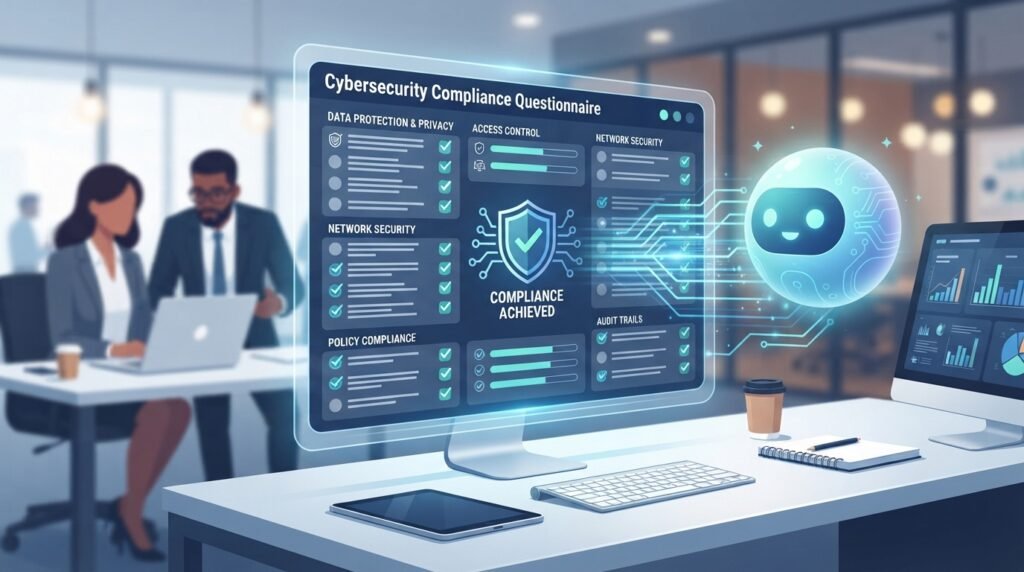
AI-powered questionnaire tools help security teams complete compliance assessments faster while reducing repetitive manual work. Human review remains essential before sharing sensitive information.
Many companies have begun using AI agents to assist with security questionnaire support tools — a decision that often ties into the broader build vs. buy question organizations face when adopting AI agents. The benefits of agentic AI solutions include reduced administrative burden, and faster processing of security-related requests. For example, AI-driven questionnaire tools can automatically retrieve prior responses, and analyze relevant security documents to recommend answers and reduce manual effort.
Agentic AI questionnaire tools can significantly reduce the amount of time required to complete security assessments. However, organizations should always follow standard security practices when configuring access controls and permissions for such systems.
Agentic AI and Cybersecurity Questionnaire Support
Organizations can use these AI-driven tools to analyze prior responses and provide recommendations for security questionnaires. As an alternative to traditional questionnaire support procedures, autonomous systems can be programmed to extract, analyze, and summarize relevant information.
These tools can significantly accelerate the processing of security assessments while reducing the risk of errors. However, organizations should always follow cybersecurity best practices when configuring such systems. For example, companies should always enforce strict access controls and privacy safeguards when working with sensitive information from external parties.
Emerging Agentic AI Security Solutions Including Pindrop and Anonybit
Security vendors are developing advanced technologies to protect autonomous AI systems from evolving cyber threats. These innovations strengthen identity verification, monitoring, and access control.
The cybersecurity industry is witnessing an innovation boom as companies seek new ways to address the risks associated with autonomous systems. Solutions such as Pindrop and Anonybit demonstrate how organizations can leverage emerging technologies to enhance their cybersecurity posture. While there are many different approaches to securing agentic AI, these innovations represent forward-thinking security strategies that address various risks associated with self-driving AI systems. In the coming years, expect to see more companies adopt similar solutions to reduce the attack surface and strengthen their digital defense.
The Future of Agentic AI Security
Autonomous systems will play a pivotal role in the evolution of modern technology, and businesses across multiple industries are already preparing for the transition. Agentic AI security will become an increasingly crucial aspect of digital defense as self-driving software gains greater autonomy and responsibility.
Looking ahead, it is safe to assume that many organizations will continue investing in solutions such as automated monitoring, enhanced identity management, and comprehensive governance policies for autonomous systems. This will become the next major frontier in cybersecurity as companies seek ways to secure highly sophisticated AI applications. In the future, you can expect to see a wide variety of organizations using these tools and services to strengthen their protection against autonomous AI threats.
Why Businesses Must Prepare for the Future of Agentic AI Security
Autonomous AI is reshaping how organizations operate, but it also introduces security challenges that cannot be ignored. Businesses that invest in governance, continuous monitoring, and responsible AI deployment today will be better prepared for tomorrow’s evolving cyber threats.
Frequently Asked Questions (FAQs)
What is agentic AI?
Agentic AI refers to software systems that can operate autonomously, and perform multiple functions without requiring constant human input. These systems are typically capable of making decisions, using external tools, and completing tasks without human assistance.
Why is Agentic AI security important?
Agentic AI systems often make use of various external tools and applications. Because of their increased complexity and autonomy, securing them is critically important in making sure such systems cannot be exploited to compromise data, and cause disruptions to business-critical operations.
How can organizations defend against agentic AI risks?
Learning how to defend against agentic AI requires organizations to implement strong access controls, and secure their systems in order to prevent autonomous systems from being compromised.
Can AI agents improve cybersecurity?
Agentic AI can be used for a wide range of tasks including threat detection, analyzing security incidents, and assisting with security questionnaire support tools. In short, autonomous systems offer tremendous opportunities for improving cybersecurity
What industries benefit the most from Agentic AI security?
This is especially valuable in industries where cybersecurity incidents can cause particularly destructive consequences. As such, healthcare, finance, government, technology, and other industries can benefit tremendously from these solutions.
Discover more from Diginatives
Subscribe to get the latest posts sent to your email.