For defense contractors, preparing for Cybersecurity Maturity Model Certification (CMMC) can be a challenging process. There are assessments, requirements, documentation, technical controls, and a variety of other factors, and several professionals who play a part in the endeavor. That is why a CMMC Registered Practitioner (RP) can be a great help to organizations seeking certification.
An RP is someone who works with Organizations Seeking Certification (OSCs) to help them understand their requirements, identify gaps, and prepare for the assessment. The RP role is particularly important as companies in the Defense Industrial Base (DIB) continue to seek ways to protect Federal Contract Information (FCI) and Controlled Unclassified Information (CUI).
What Is a CMMC RP and Why Does an OSC Need One for Preparation?
Let us start by defining what a CMMC Registered Practitioner is. A Registered Practitioner is a cybersecurity professional who helps an organization prepare for the requirements of Cybersecurity Maturity Model Certification. According to Cyber AB, RPs are “individuals who have demonstrated competency in the appropriate CMMC levels and provide consultative preparation services to Organizations Seeking Certification (OSCs).” An RP can work independently or be a part of a Registered Practitioner Organization (RPO).
It is important to note that an RP provides consultative services to an OSC. This means that the professional can help the company understand what to expect during the assessment and prepare accordingly. For example, an RP can work with an OSC to review its cybersecurity posture, identify gaps, organize remediation, and ensure that everyone understands their roles.
A typical RP service involves:
- Reviewing the current practices of an OSC
- Mapping them to CMMC requirements
- Identifying gaps and addressing them
- Preparing documentation
- Establishing and reviewing policies and procedures
- Explaining requirements to the company
- Preparing the OSC for the assessment
This service is especially beneficial to small- and medium-sized defense contractors that do not have a compliance team with extensive knowledge of requirements.
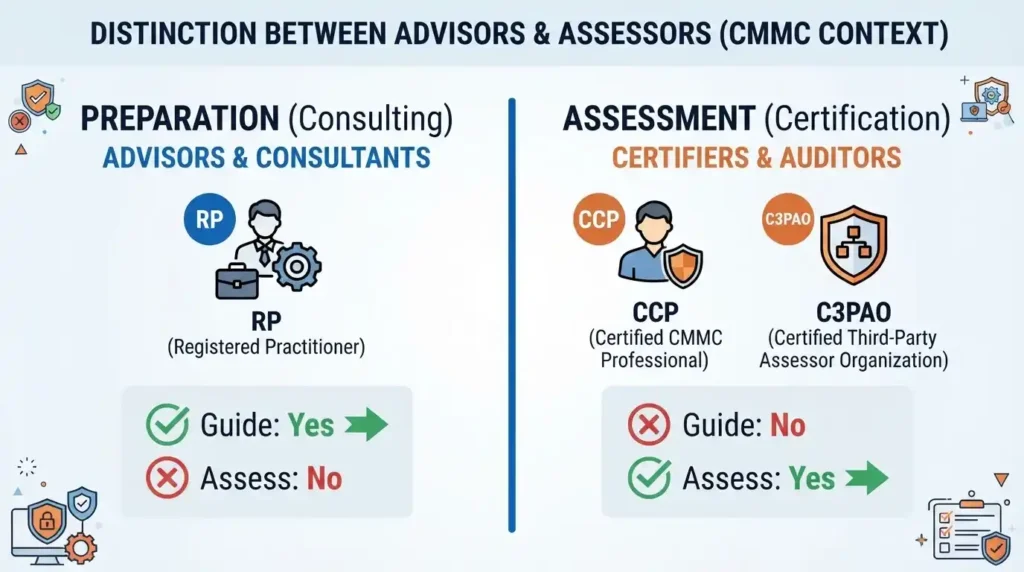
However, an RP is not someone who can certify an organization. This function is reserved for the authorized assessment organization and its assessors. The separation of duties is essential, as it allows an OSC to understand the role of each professional they work with.
Understanding the CMMC RP Role Within the Broader 2.0 Ecosystem
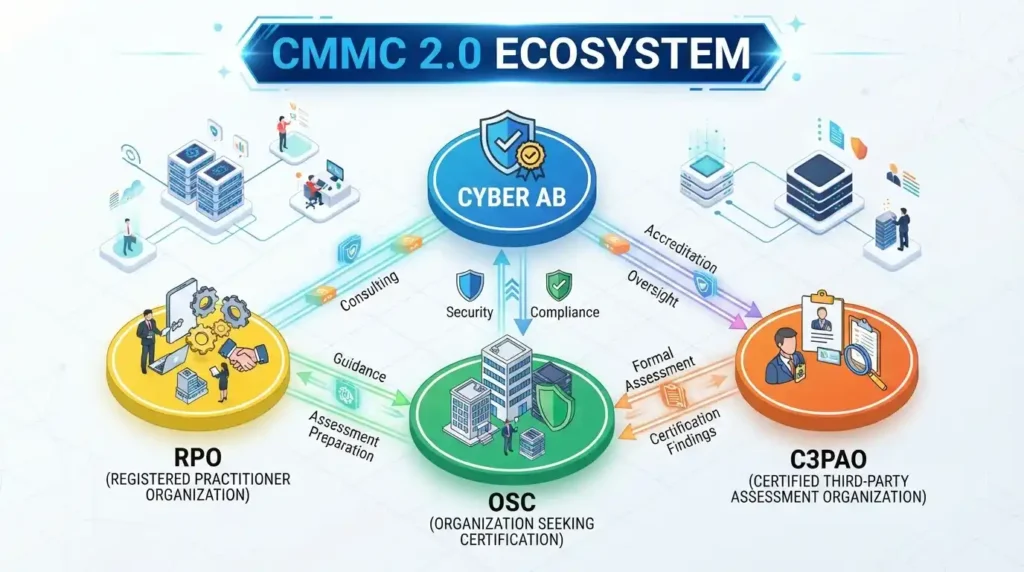
The 2.0 ecosystem consists of several types of authorized organizations and individuals, each of which serves a different purpose. An OSC must understand the distinctions between them so that they can choose the right professionals for their needs. For example, an OSC may work with RPs, RPOs, C3PAOs, and other assessment personnel.
A CMMC RP focuses on helping an OSC prepare for the assessment, whereas an RPO offers implementation and preparation services to the company. A C3PAO, on the other hand, is a certified third-party assessment organization that assesses OSCs. According to cyberab C3PAOs perform assessments using qualified assessment personnel.
It is essential to understand the differences between these entities. In particular, an OSC must be aware of who can help them prepare for the evaluation and who can officially certify them.
What Does a CMMC Registered Practitioner Actually Do?
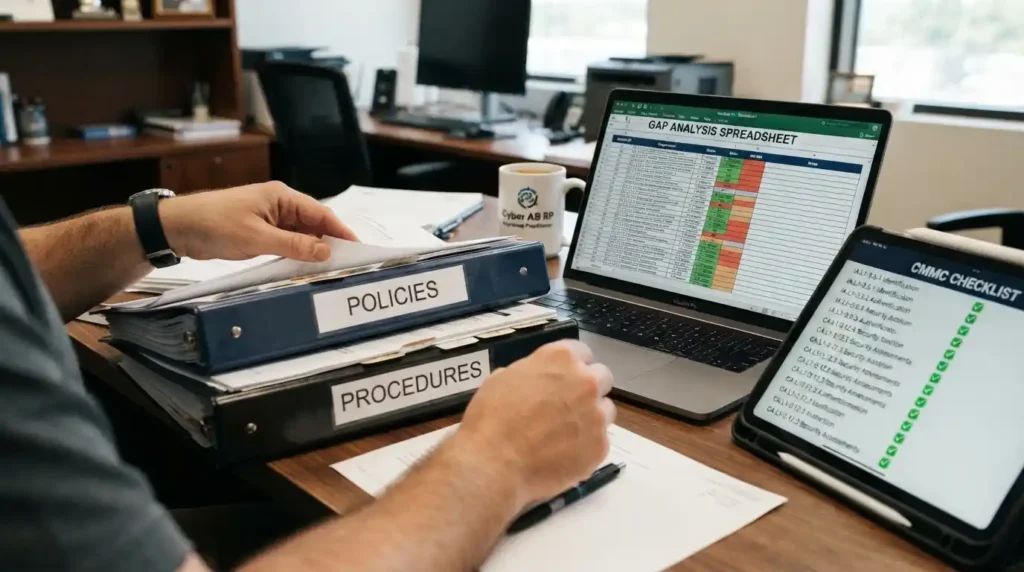
The duties of an RP can vary depending on the OSC’s size, cybersecurity maturity, and the CMMC level they wish to achieve. Generally, an RP will work with an OSC to help it understand which requirements apply to it, establish and document the appropriate security practices, and address any gaps. For example, an RP can work with an organization to identify the relevant cybersecurity domains and practices for its Cybersecurity Maturity Model Certification level.
Then, the practitioner can review the current state of the company’s cybersecurity practices. In particular, an RP may find that the OSC has implemented certain policies but does not have sufficient evidence that shows that they are consistently following them. In other cases, a company may have the necessary technical safeguards but lack supporting documentation.
Why the RP Matters for Smaller Defense Contractors
Many large defense companies have dedicated compliance and cybersecurity teams. Small and medium-sized defense contractors, on the other hand, often do not have the resources to maintain such departments. That is why an RP can be beneficial to an OSC, as they can provide the expertise of a qualified practitioner without the need to hire a full-time team.
An RP can help an OSC leadership understand their requirements and address gaps in their practices. For example, a qualified practitioner can help an OSC answer the following questions:
- What are the requirements that apply to our organization?
- What gaps should we address?
- What documentation should we maintain?
- What evidence should we provide?
- Are our cybersecurity practices aligned with the requirements?
- Are we ready for the assessment?
Comparing CMMC RP, RPO, CCP, and C3PAO Roles for Defense Contractors
| CMMC Role | Primary Function | Works With OSCs? | Performs Official Assessment? |
|---|---|---|---|
| Registered Practitioner (RP) | Provides consultative CMMC preparation | Yes | No |
| Registered Practitioner Organization (RPO) | Provides preparation through practitioners | Yes | No |
| CMMC Certified Professional (CCP) | Qualified assessment professional for applicable assessment activities | Yes | Depends on authorized role |
| C3PAO | Conducts official third-party assessments | Yes | Yes |
A Current 2026 Consideration
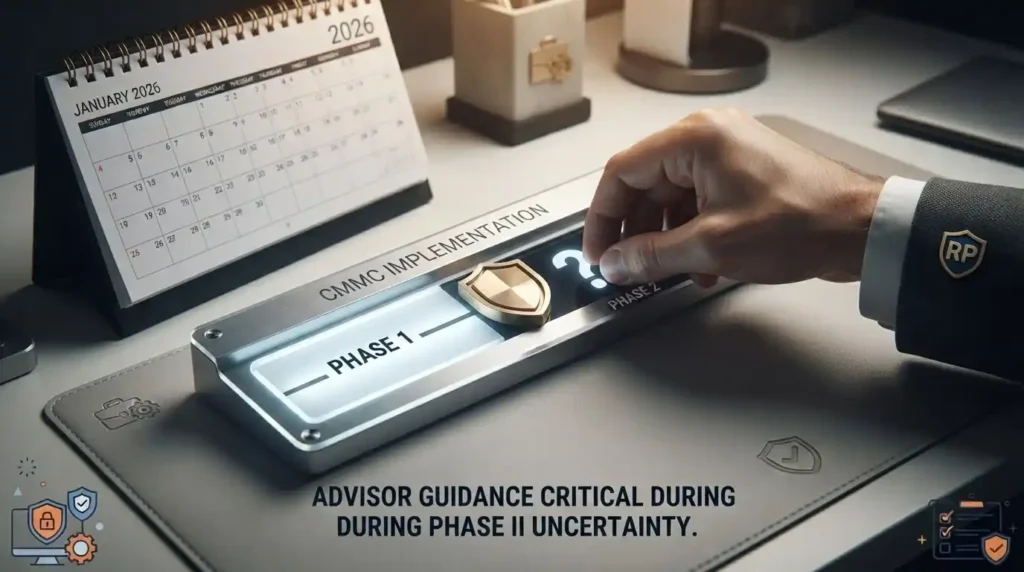
CMMC requirements and implementation timelines are currently subject to change. In July 2026, the Department of War announced a suspension of the planned Phase 2 requirements while a broader review of the program is conducted. Phase 1 self-assessment obligations were not reported as suspended. That makes it especially important for OSCs to rely on current official information rather than older CMMC articles that may describe previous implementation dates as if they are still active.
How to Choose a CMMC Registered Practitioner for Your Organization
When it comes to choosing a CMMC Registered Practitioner (RP), an Organization Seeking Certification (OSC) has to be careful to pick the right one. After all, a good practitioner will not just have the proper jargon in their knowledge base. Ideally, they should be able to interpret requirements to real-world cybersecurity practices relevant for the customer’s ecosystem.
Prior to choosing an RP, an OSC has to:
- check if the candidate has the valid Cyber AB status
- understand the scope of services
- consider practitioners’ practical experience
- make sure consulting and assessment activities are separated
- clarify the main differences between CMMC RP vs CCP roles, and RPOs in general.
CMMC RP vs CCP vs RPO: Main Differences
The terms CMMC RP vs CCP and CMMC RP vs RPO can be confusing for an OSC that looks to navigate the program. The reason for this misunderstanding is that practitioners working on both sides of the process (consulting and assessment) use the same overarching framework but have different roles and responsibilities.
For starters, a Registered Practitioner typically helps an OSC prepare for an assessment. An RPO is an organization that employs RPs, while the Certified Professional belongs to the assessment side of the ecosystem. When choosing between CMMC RP vs CCP, an OSC has to understand that the former helps prepare the customer for a evaluation, while the latter conducts it. It is also necessary to differentiate between RPOs and RPs, as the former employs the latter to assist OSCs.
In short, there are four main players in the CMMC ecosystem:
- Cybersecurity Maturity Model Certification RP – an individual that helps an OSC prepare for a CMMC assessment;
- CMMC RPO – an organization that employs RPs to help OSCs;
- C3PAO – conducts independent assessments of OSCs;
- CMMC CCP – has achieved the certification requirements associated with the relevant role in the program.
CMMC RP Meaning for OSCs Preparing in 2026
The CMMC RP meaning is simple: a Registered Practitioner is an individual that helps organizations prepare for the CMMC assessment. However, given the current state of the program in 2026, an OSC has to understand the subtle differences between preparing for and undergoing a CMMC evaluation. Specifically, the Department of War announced on July 13, 2026, that the requirements associated with CMMC Phase II were immediately suspended. The original implementation date was set for November 10, 2026, while the requirements associated with Phase I remained in full effect.
This does not mean that an OSC can neglect the cybersecurity aspects of their operations. For instance, if an organization processes FCI or CUI, it has to maintain the required cybersecurity maturity levels at all times irrespective of the changes to the CMMC program. As such, an OSC can still benefit from engaging an RP to perform a gap analysis, improve documentation, and address any shortcomings in their cybersecurity posture.
At the same time, this change highlights the importance of due diligence when preparing for the CMMC assessment. In particular, an OSC has to base their preparations on the most recent Cyber AB resources as opposed to relying on information that was published years earlier.
Conclusion
When it comes to CMMC, it is not enough to simply understand the requirements that an OSC has to meet. At least as important is the knowledge of the professionals and organizations that can help an organization prepare for the assessment and achieve the desired level of cybersecurity maturity.
A CMMC Registered Practitioner can serve as a consultant for an OSC, which means that the organization has to understand the roles played by RPs, RPOs, CCPs, and C3PAOs. An RP is helpful for an OSC that lacks the know-how to prepare for the CMMC evaluation, whereas a CCP conducts it. The current state of the Cybersecurity Maturity Model Certification program is also noteworthy, as Phase II requirements were suspended in July 2026.
This update further emphasizes the need for an OSC to rely on the latest information from Cyber AB and the Department of War when preparing for the assessment. In the end, a CMMC RP can help an OSC take advantage of the current state of the program and turn it into an opportunity to improve its cybersecurity posture.
Frequently Asked Questions about CMMC RPs
What is a CMMC RP?
A CMMC RP is a member of the CMMC community who provides advisory services to an OSC that looks for help in preparing for the CMMC assessment. Cyber AB differentiates between individual RPs and RPOs, which are organizations that employ RPs to help OSCs.
What does a CMMC Registered Practitioner do?
An RP serves as a consultant for an OSC and helps it understand the requirements associated with the chosen CMMC level, prepare the relevant documentation, and address any gaps prior to the assessment.
Is a CMMC RP the same thing as a C3PAO?
No, an RP is not the same thing as a C3PAO, which is an entity that performs independent assessments for the CMMC program. In short, RPs prepare an OSC for the evaluation, while C3PAOs conduct it. An organization has to be aware of this difference before choosing between these two options.
What is the difference between a CMMC RP and RPO?
An RP is an individual, while an RPO is an organization that employs RPs to help OSCs prepare for the assessment. In other words, RPOs are organizations that hire RPs, whereas the latter are independent consultants.
Does an OSC need a CMMC Registered Practitioner?
It depends on the maturity and preparedness of an OSC, as well as its knowledge of the CMMC requirements. Ideally, an RP should be engaged by an organization that lacks the expertise or time to prepare for the CMMC assessment.
Where can I verify a CMMC Registered Practitioner?
The best way to verify an RP is to use the Cyber AB ecosystem and related resources that list all relevant candidates for the role. In short, always rely on the information that comes directly from Cyber AB.
Discover more from Diginatives
Subscribe to get the latest posts sent to your email.