Hyperautomation is the practice of combining RPA, AI, machine learning, and workflow orchestration into one unified system instead of using each tool separately, they work together to automate complete, end-to-end business processes across an organization, not just isolated tasks.
Traditional automation is great at handling the boring, repetitive stuff clear rules, predictable inputs, done. But that’s not really what businesses need anymore. What’s changing now is bigger: entire workflows getting reworked, not just single tasks. Legacy systems that don’t talk to each other, PDFs and scanned documents nobody wants to touch manually, decisions that used to need a human in the loop autonomous AI agents are starting to handle all of it.
And honestly, that’s the real shift. Task automation was always about efficiency at the margins. Full orchestration is different it cuts operational overhead, clears out the bottlenecks that slow teams down, and speeds up execution across departments that used to operate in silos.
Companies looking into AI integration services usually land here eventually anyway. Makes sense once you’ve connected AI into your core operations, why stop at one department? End-to-end orchestration is just the logical next step, not some separate initiative bolted on afterward.
What Is Hyperautomation in 2026?

Hyperautomation is a strategic approach where businesses bring together multiple automation technologies RPA, Generative AI, Agentic AI, process mining, and low-code tools into what functions as one cohesive digital workforce, rather than a bunch of disconnected systems.
Earlier automation was much more rigid. Companies used standalone bots for fixed, repetitive routines say, pulling data from a spreadsheet and dropping it into an ERP system. It worked fine as long as everything stayed predictable. But the moment something unexpected happened an error mid-process, or a document that came in a slightly different format than usual the whole thing would just break.
Today, this model integrates cognitive capabilities into every workflow it touches:
- Ingestion: Intelligent Document Processing (IDP) reads unstructured data from invoices, contracts, or customer support emails.
- Decision-Making: Machine learning models and Large Language Models (LLMs) evaluate context, verify compliance, and make dynamic routing decisions.
- Execution: Software bots and API integration engines (like n8n or custom middleware) execute transactions across disparate software stacks without human delay a role traditionally handled by dedicated RPA platforms.
- Discovery: Continuous process mining analyzes system logs to identify hidden bottlenecks and recommend new automation opportunities automatically.
Hyperautomation vs Automation vs RPA: Understanding the Differences
This approach combines basic automation and software bots into an adaptive, self-learning ecosystem, rather than replacing either one.
- Basic Automation: Focuses on simple, linear tasks triggered by explicit rules (e.g., sending an automated email notification when a form is submitted).
- Robotic Process Automation (RPA): Deploys software “robots” to emulate human interactions on a user interface (e.g., logging into a legacy portal and extracting standard fields).
- Hyperautomation: Orchestrates RPA, AI agents, analytics, and integration middleware across the complete end-to-end lifecycle of a business process.
| Dimension | Basic Automation | Robotic Process Automation (RPA) | Hyperautomation |
|---|---|---|---|
| Scope | Single task / single app | Repetitive, structured UI tasks | Cross-functional, end-to-end business workflows |
| Data Handling | Structured data only | Structured, predictable formats | Structured & unstructured data (PDFs, audio, images) |
| Decision-Making | Binary IF/THEN rules | Strict rules-based logic | Adaptive, cognitive AI & ML decisioning |
| Adaptability | Low (requires manual update) | Breaks on system UI changes | High (self-healing, handles edge exceptions) |
| Primary Tooling | Scripts, webhooks | UiPath, Automation Anywhere | RPA + n8n + AI agents + process mining |
If you’re still deciding which layer of this stack your business actually needs, our breakdown of AI Agents vs RPA walks through when a rules-based bot is enough and when a reasoning-capable AI agent is worth the investment.
Core Benefits of Hyperautomation for Business
Hyperautomation provides the operational backbone required to scale enterprise throughput without proportionally increasing headcount.
  Traditional Scaling                Hyperautomation Scaling

  Operational                        Operational
  Cost / Volume                      Cost / Volume
       ^                                  ^
       |     / Workload                   |       / Workload
       |    /                             |      /
       |   / Headcount                    |     /------- Operational Cost
       |  /                               |    /         (Scales Elastically)
       +------------>                     +------------>
1. Eliminates Operational Bottlenecks Across Legacy Systems
Most enterprises operate on a hybrid tech stack: modern cloud CRMs paired with multi-decade-old back-office ERPs. This layered approach bridges these disconnected environments via custom API layers, custom middleware, and automation bots, establishing seamless data flow between systems that were never designed to talk to each other.

2. Reduces Human Error and Exception Handling Costs
Standalone software bots fail when faced with irregular inputs, forcing human workers to manually handle exceptions. By incorporating machine learning and Natural Language Processing (NLP), an AI-augmented setup handles unstructured variances autonomously, cutting manual intervention significantly and freeing staff for higher-value work.
3. Provides Real-Time Process Visibility and Analytics
Because this kind of orchestration relies on tools like n8n, custom APIs, and event logging platforms, every transaction creates an audit trail. Operations leaders gain end-to-end visibility into cycle times, error rates, and compliance benchmarks data that used to live only in individual employees’ inboxes and spreadsheets.
Real-World Hyperautomation Use Cases in Enterprise

Hyperautomation applies to any business unit burdened by cross-system processes and document handling.
Financial Operations: End-to-End Invoice Reconciliation
Finance teams typically download invoice attachments manually, parse line items, check ERP purchase orders, and route approvals via email. In this kind of orchestrated workflow, an IDP engine captures unstructured PDF invoices directly from inbox feeds, generative AI verifies line items against purchase orders, an API posts valid records straight into the ERP, and a software bot executes payment. Human staff step in only for flagged fraud risk.
Healthcare & Revenue Cycle Management (RCM)
Patient onboarding and prior authorization normally require cross-referencing insurance portals, electronic health records, and clinical notes by hand. An AI-driven pipeline lets models extract diagnostic codes from clinical documentation, match them against insurance payer policies, and use automated submission bots to secure approvals reducing claim denials and administrative overhead in the process.
IT & Security Operations Center (SOC): Automated Incident Response
Security teams face constant alert fatigue investigating hundreds of daily events across disparate cloud infrastructure. Threat intelligence triggers an orchestration engine, an AI agent enriches the alert with asset context, runs diagnostic checks, revokes compromised credentials, and isolates affected endpoints automatically. Teams weighing whether to build this in-house or bring in outside support often start by comparing IT support engineers vs. help desk technicians to understand which skill set their SOC actually needs.
Hyperautomation Tools Comparison
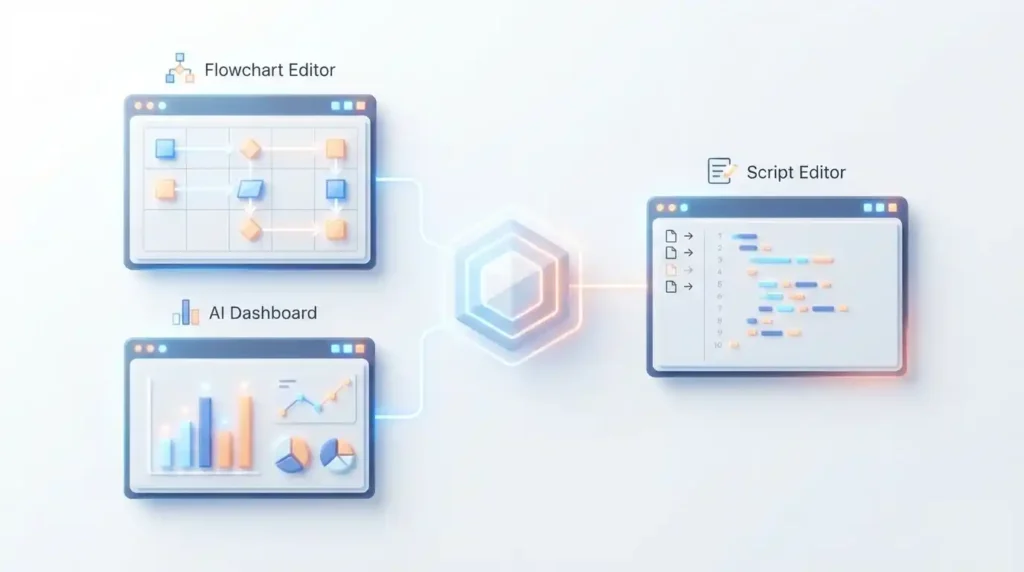
Building a hyperautomation stack requires selecting complementary components rather than searching for a single magic tool.
- Workflow Orchestration Engines (n8n, Workato): Connect apps, APIs, and databases seamlessly. Open-source, self-hostable platforms like n8n provide enterprise-grade data security while coordinating complex asynchronous tasks.
- Cognitive & AI Frameworks (Agentic AI, LLMs): Manage ambiguous decisions. Rather than following linear IF/THEN rules, autonomous AI agents analyze context, parse natural language, and evaluate policy compliance before triggering downstream tools.
- Legacy-System Bots (UiPath, Power Automate): When legacy software lacks modern REST APIs, surface automation bots emulate human keystrokes to interact directly with legacy desktop applications. We cover this layer in more depth, including how to manage its total cost, in our dedicated RPA guides.
- Process Mining & Analytics Tools (Celonis, custom telemetry): Analyze event logs from ERPs, CRMs, and databases to reconstruct how workflows actually run in reality the same analytical thinking behind predictive analytics in test automation, applied to business processes instead of QA cycles.
Key Hyperautomation Trends in 2026

Hyperautomation strategies continue to evolve rapidly alongside advances in specialized AI models.
- Rise of Agentic AI Teams: Rather than static scripts, organizations deploy fleets of autonomous AI agents that collaborate to execute multi-step business objectives.
- Shift to API-First & Open-Source Orchestration: Companies are replacing bloated, expensive legacy RPA setups with lightweight API integration engines like n8n paired with custom Python services.
- Embedded Process Security & Governance: As automated systems take over core workflows, embedding real-time compliance frameworks and access management guards prevents data leaks or runaway AI behavior. This mirrors the shift already underway in AI-driven compliance automation, where continuous evidence collection is replacing manual audit prep.
Overcoming Hyperautomation Implementation Challenges

Hyperautomation initiatives fail when enterprises treat them solely as technical projects rather than operational redesigns.
Challenge 1: Automation Fragmentation Solution: Establish a central automation governance board. Use a central orchestration hub, such as n8n or custom middleware, rather than deploying disconnected bots across isolated departments.
Challenge 2: Legacy Infrastructure Friction Solution: Combine API integrations for modern SaaS tools with targeted automation bots for legacy terminal applications that have no modern integration path.
Challenge 3: Change Management and Skill Gaps Solution: Cross-train internal teams to build low-code workflows while relying on dedicated automation specialists for complex AI integration architecture a hybrid model most AI integration services engagements are built around.
Frequently Asked Questions
Is hyperautomation the same as AI automation?
No. AI automation refers specifically to applying artificial intelligence like machine learning or computer vision to automate individual cognitive tasks. Hyperautomation is an overarching ecosystem strategy that combines AI, RPA, process mining, and workflow orchestration tools to streamline full end-to-end processes.
Does hyperautomation replace RPA?
Hyperautomation does not replace RPA; it expands its capabilities. While standalone RPA struggles with unstructured data or changing user interfaces, hyperautomation wraps RPA inside AI decision-making models and API integrations, enabling bots to handle more complex enterprise scenarios.
Which industries benefit most from hyperautomation?
Industries with document-heavy workflows, legacy IT systems, and strict compliance environments benefit the most financial services, healthcare, logistics, insurance, telecom, and enterprise IT operations tend to see the highest returns on investment.
How long does it take to implement hyperautomation?
Targeted initial workflows, such as automating invoice extraction or email triage, can go live within 4 to 8 weeks using low-code orchestration engines like n8n. Scaled, organization-wide automation strategies are typically deployed in phases across 6 to 12 months.
Is hyperautomation only for large enterprises?
While enterprise-grade automation architectures handle vast datasets, small and mid-sized businesses can adopt the same practices using accessible open-source orchestration tools, APIs, and modular AI models without massive upfront infrastructure investment.
Next Steps for Your Automation Strategy
Transitioning to hyperautomation does not mean replacing your entire operational infrastructure overnight. The most effective approach starts with process discovery: identify a high-volume, error-prone workflow such as client onboarding, invoice processing, or IT support routing and map its underlying data dependencies before touching any tooling.
By integrating cognitive decision-making with robust API orchestration, you can transform fragile, disconnected automation scripts into a scalable digital workforce that grows with the business instead of breaking every time a process changes.
Discover more from Diginatives
Subscribe to get the latest posts sent to your email.