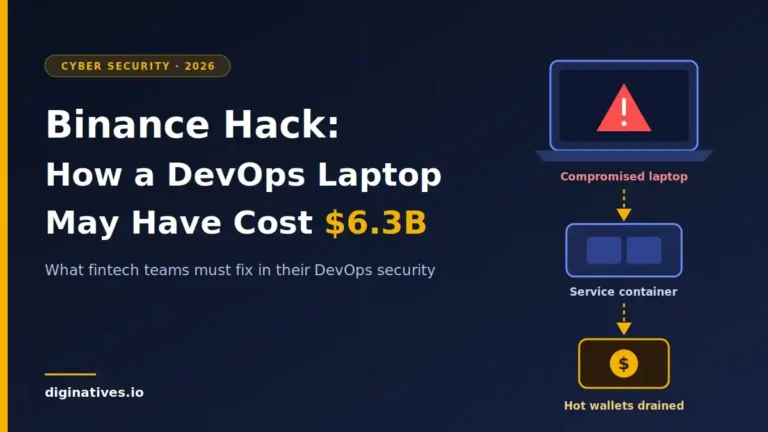
On October 29, 2026, Binance lost roughly $6.3 billion in the largest crypto theft on record. Binance’s first findings point to a surprisingly ordinary starting point: a DevOps engineer’s laptop. That detail makes Binance hack DevOps security a topic every fintech team should understand, because almost every company has engineers with laptops and access to production systems. This article covers what is confirmed, what is still unknown, and what you can fix this week. Everything below is accurate as of November 2, 2026, and Binance has not yet released its full post-mortem.
What Happened in the Binance Hack?
On October 29, 2026, attackers pulled around $6.3 billion out of Binance’s hot wallets, and most of it was gone within about 20 minutes.
According to TRM Labs, a blockchain analytics firm, the money left wallets spread across ten blockchains. Binance paused deposits and withdrawals, revoked the authorization on the affected address, and called in law enforcement and blockchain intelligence partners to help trace the funds.
Help from other crypto companies came quickly. Tether said it froze more than $1.5 billion in tokens tied to the incident, and Circle froze over $800 million in USDC. Binance said it would cover the losses from its SAFU emergency fund and its own company money. It also promised to publish an updated proof of reserves once the repairs were finished.
It’s hard to overstate the size of this one. The theft is about four times bigger than the $1.5 billion Bybit attack in February 2025, which held the record until now.
How Could a DevOps Laptop Lead to a $6.3 Billion Loss?
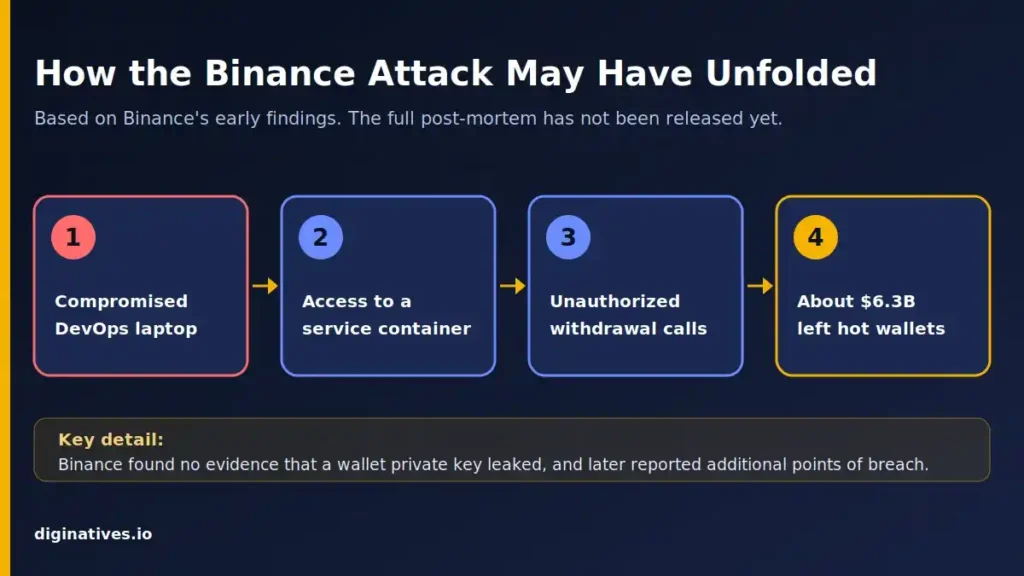
Binance’s early investigation says the laptop gave the attacker a way into a service container, and that container could submit unauthorized withdrawal requests.
A laptop doesn’t hold the money. What it holds is trust. A DevOps engineer’s machine usually stores cloud credentials, access tokens, SSH keys, VPN sessions and deployment tools, or at least has a way to reach them. So when an attacker takes over a compromised developer laptop, they inherit all of that access, and to the systems behind it they look like any other employee doing their job.
Binance also said it found no evidence that any wallet private key leaked. TRM Labs and Elliptic read the incident differently from a classic key theft. In their assessment, the attacker got Binance’s own hot wallet signing system to approve transactions the attacker had chosen. That is an analyst view, not a confirmed finding from Binance.
One more point deserves attention. Binance later said it had found additional points of breach and called the incident a complex attack. So the laptop may be the front door and not the whole story. This is why the Binance hack DevOps security angle is useful, but it should be written about with care until the post-mortem arrives.
Who Is Behind the Binance Hack?
Researchers and the FBI point to North Korea, and analysts name a hacking unit called TraderTraitor.
Blockchain analysts at TRM Labs, Chainalysis and Elliptic tied the theft to North Korean actors. NPR reported that the FBI confirmed North Korea’s role on Saturday, October 31. The FBI also blamed the same unit, which is linked to the Lazarus Group, for the 2025 Bybit theft.
When you build your own defense plan, the group’s name matters less than how it works. State-backed hackers are patient. They study the staff, then go after whoever has the right access instead of attacking the strongest firewall. Binance hasn’t said how the laptop was compromised, so don’t guess at the method in your own briefings.
Where Did the Stolen Binance Money Go?
Roughly half has been frozen, and the rest is being pushed through thousands of wallets to hide the trail. The money can’t vanish, because every transfer is public, but it can be buried in noise.
Crypto can’t simply disappear. Every transfer sits on a public ledger, and that is how analysts can follow it. Stopping it is the hard part. Around $3 billion was frozen, mostly stablecoins that issuers like Circle and Tether are able to lock. But about $2.4 billion was bitcoin and ether, and no company can freeze those.
For that remaining money, Chainalysis says the attackers are running automated laundering, firing off thousands of transactions and passing funds between addresses, often back to earlier ones. The FBI said they were converting assets mainly into ether. The next step experts worry about is selling it for cash through over-the-counter laundering networks, where recovery gets much harder.
How Does the Binance Hack Compare With the Bybit Hack?
Both were record thefts, both were linked to the same North Korean unit, and both reportedly began at an engineer’s computer rather than a flaw in the blockchain itself.
| Point | Bybit hack | Binance hack |
| Date | February 2025 | October 29, 2026 |
| Amount | About $1.5 billion | About $6.3 billion |
| Reported starting point | A developer’s computer | A DevOps engineer’s laptop (early finding) |
| Attribution | FBI named TraderTraitor, North Korea | FBI confirmed North Korea; analysts name TraderTraitor |
| Record status | Largest theft until October 2026 | Largest crypto theft on record |
The pattern is the useful part when you study Binance hack DevOps security. In both cases the blockchains were not reported as the weak point. What gave way was the chain of access around them: people, devices and internal systems. Anyone asking how to prevent a crypto exchange hack should start there.
Why Are DevOps Engineers a Common Target?
Their accounts can reach production, secrets and deployment pipelines, so compromising one person can open many doors at once.
Attackers understand this well. A regular employee account might only read email. A DevOps account can change infrastructure, pull secrets from a vault, push code or reach internal containers. North Korean groups also have a long record, documented by many security researchers, of approaching developers with fake job offers or coding tests that carry malware. Binance hasn’t said that method was used here, but it shows why DevOps endpoint security has to be as strong as the protection around the servers themselves.
Convenience matters too. DevOps people work fast, leave sessions open and keep tokens stored locally. None of that is careless by default. It’s simply how the job works, so security has to be planned around it.
What Are the Main Binance Hack Lessons for Fintechs?
Treat engineer devices as part of production, keep money-moving systems behind more than one approval, and plan to respond within minutes.
The Binance hack lessons come down to four points:
- A laptop can be a production system. If a device can reach infrastructure that moves money, it deserves the same controls as a server.
- One short path to withdrawals is too short. If a single compromised container can submit a withdrawal, the attacker only needs to reach that container. Put independent checks between “a service can call the signer” and “money leaves”.
- Speed decides the damage. Most of the funds moved in about 20 minutes. An alert that someone reads the next morning is no help at that pace.
- Partners are part of your defense. Stablecoin issuers froze large amounts quickly. Getting in touch fast with them, with exchanges and with law enforcement can stop real money from disappearing.
How Can Fintechs Prevent a Similar Breach?
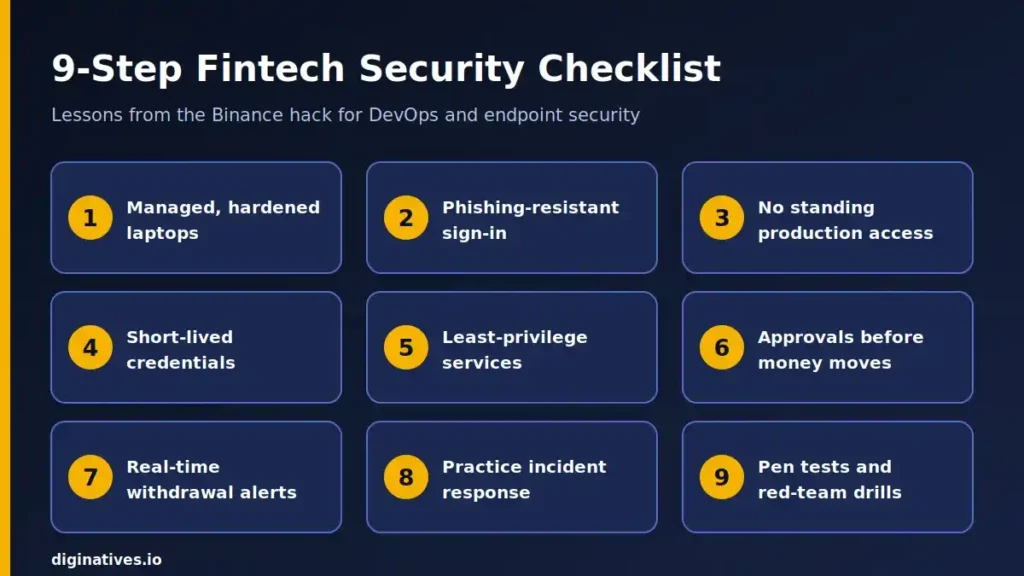
Lock down engineers’ devices, use credentials that expire quickly instead of ones that last forever, give each service only the access it needs, and put approvals and monitoring on anything that moves money.
This fintech security checklist is built around Binance hack DevOps security. Some items take longer than others, but every one of them cuts your risk.
- Strengthen DevOps endpoint security. Give engineers company-managed laptops with full-disk encryption, automatic updates and endpoint detection and response (EDR) tools. Any device with production access should stay free of personal browsing and unapproved software. Good DevOps endpoint security begins with knowing exactly which devices those are.
- Use phishing-resistant sign-in. Hardware security keys and passkeys are much harder to steal than SMS codes or app prompts.
- Remove standing access. Give engineers production access only when they need it, for a limited time, and with a logged reason. If a laptop gets taken over on a quiet Tuesday, nothing powerful should be sitting there waiting.
- Prefer short-lived credentials. Attackers hunt for static keys left in files and environment variables. Short-lived tokens expire before they’re of any use.
- Limit what each service can do. A container that only needs to read balances should never be able to request a withdrawal. Segment your networks and review service permissions on a regular schedule.
- Put controls between your systems and the money. For high-value transfers, require approvals from separate people or systems, set withdrawal limits, and keep allow lists of known destinations.
- Watch for odd behavior in real time. Set alerts for unusual withdrawal volume, new destination addresses and large batches of signed transactions. Also keep a tested way to pause outflows quickly.
- Practice the response. Run a tabletop exercise where a DevOps laptop is compromised late on a Friday night. See who gets called, who can pause systems and how long it all takes.
- Test the way attackers work. A penetration test or red-team exercise that includes social engineering will show whether your engineers’ devices can really become an entry point.
This is how a team can prevent a crypto exchange hack of this kind, and it applies just as well to payment apps, lenders and SaaS platforms.
Can a Small Fintech Be Hit the Same Way?
Yes. Company size doesn’t change the method, and smaller teams often have fewer checks in place.
Binance has a large security team and still lost billions, so a startup with five engineers shouldn’t assume it’s too small to matter. Attackers don’t need billions to make it worth their while. A smaller payment platform with weak approvals can even be a cheaper target. The good news is that small teams can put the Binance hack DevOps security lessons to work quickly, because the basics are simple.In a week you can have every engineer on hardware keys. Old tokens can be cleared out in a day, and a one-page response plan is something you can finish before lunch. Begin with the controls that cost the least and reduce the most risk.
What Did Binance Do Right After the Attack?
It paused withdrawals, revoked the affected address authorization, brought in partners and law enforcement, and publicly promised to cover the losses.
Binance kept users updated along the way and reopened withdrawals in phases starting November 1. CNBC reported $3.64 billion in net outflows after the reopening, which is about 2.1% of the exchange’s $171 billion in assets. Binance said it had already covered around 95% of the impacted amount.
The open questions still matter, though. How was the laptop compromised? Why could it reach a container with the power to withdraw funds? And what were the additional points of breach? Until the full post-mortem comes out, anyone who claims to know the complete root cause is guessing.
Does a SOC 2 or ISO 27001 Certificate Prevent This Kind of Attack?
Short answer: No. A certificate can’t promise that. The controls behind SOC 2 and ISO 27001 do reduce the odds, but only when your team follows them every day.
Both frameworks cover access management, device control, change reviews and incident planning. That is the exact ground where an attack that starts from a compromised developer laptop is won or lost. Where companies go wrong is treating the certificate like a finish line. An audit checks you on one particular day, and attackers don’t wait for audit day. They keep testing you all year. To be clear, we’re saying nothing about Binance’s own compliance status here. The point is simply that a fintech security checklist is only worth something if people stick to it daily.
What Should Your Team Do Next?
Start with an honest review of who can reach production from which device, and fix the shortest paths to money first.
Pick one hour this week. List every engineer with production access, the devices they use and what each device can reach. Then check whether a single compromised account could trigger a money movement without a second control. If the answer is yes, that is your first fix.
At Diginatives, we help fintech and SaaS teams with penetration testing, DevOps and cloud security reviews, and SOC 2 and ISO 27001 readiness. If you want a second pair of eyes on your Binance hack DevOps security gaps, our team can review your access paths and show you where an attacker would likely start.
The story will keep developing as Binance shares more details. The core message is unlikely to change: protect the people and devices that touch your production systems as seriously as you protect the systems themselves.
Discover more from Diginatives
Subscribe to get the latest posts sent to your email.