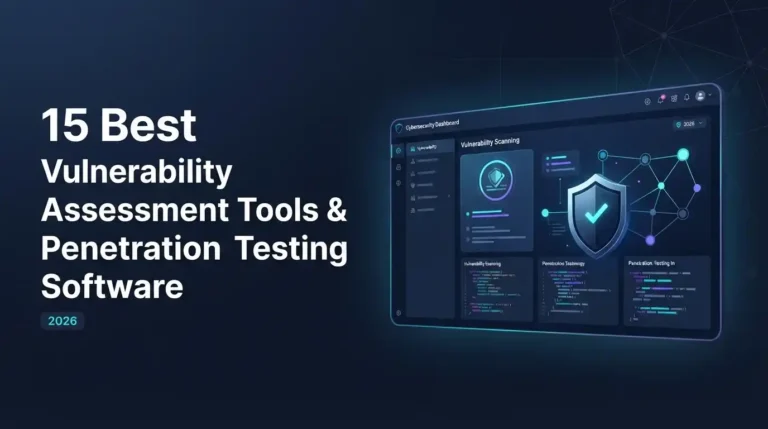
Looking for the best vulnerability assessment tools? For most teams, Nessus is the strongest all-round vulnerability scanner, Burp Suite leads for web application testing, and Metasploit is the standard for penetration testing simulations. Free options like OpenVAS and Nmap work well for smaller teams on a budget. The full comparison and pricing breakdown is below.
If you’re still deciding whether you need scanning, testing, or both, our guide on what a vulnerability assessment is covers the process and the six-step methodology in more detail. This article picks up from there it’s about which tools to actually use.
Comparison Table: Best Vulnerability Assessment Tools at a Glance
| Tool | Category | Best For | Starting Price |
|---|---|---|---|
| Nessus | Vulnerability Scanning | All-round network scanning | ~$4,485/year |
| OpenVAS | Vulnerability Scanning | Budget-conscious teams | Free (open source) |
| Qualys VMDR | Vulnerability Scanning | Enterprise, cloud-heavy environments | Custom pricing |
| Nmap | Vulnerability Scanning | Network discovery, port scanning | Free (open source) |
| Nikto | Vulnerability Scanning | Quick web server checks | Free (open source) |
| Metasploit | Penetration Testing | Exploit simulation, red teams | Free / $2,000+ (Pro) |
| Burp Suite | Penetration Testing | Web app security testing | Free / $449/year (Pro) |
| Kali Linux | Penetration Testing | Full pentest OS toolkit | Free (open source) |
| Wireshark | Penetration Testing | Network traffic analysis | Free (open source) |
| Hydra | Penetration Testing | Password/login strength testing | Free (open source) |
| Acunetix | Combined | Automated web app scan + exploit | Custom pricing |
| Netsparker (Invicti) | Combined | Low false-positive web scanning | Custom pricing |
| Rapid7 InsightVM | Combined | Enterprise risk dashboards | Custom pricing |
| Intruder | Combined | Continuous attack surface monitoring | From $172/month |
| Astra Pentest | Combined | Scanner + manual pentest bundled | From $1,999/year |
(Pricing changes often always confirm current rates on the vendor’s site before budgeting.)
Best Vulnerability Assessment Tools for Scanning
These scanners check systems on their own and flag weaknesses before anyone has to look for them manually. At Diginatives, when we run assessments for our clients, we usually pair two of the best vulnerability assessment tools below rather than relying on just one no single scanner catches everything, and running Nessus alongside something like OpenVAS or Qualys consistently surfaces flaws that one tool alone would miss.
1. Nessus
Tenable’s Nessus checks over 190,000 known vulnerabilities across networks, servers, and endpoints. It’s the tool most security teams learn on first, and for good reason — the scan configuration is straightforward and the reports translate weak points into a fix-priority list without much extra work.
- Best for: Teams that want one reliable scanner covering most of their infrastructure
- Pricing: Around $4,485/year for Nessus Professional; a limited free version (Nessus Essentials) covers up to 16 IPs
- Watch out for: Larger environments need Tenable.io or Tenable.sc for centralized management Nessus alone doesn’t scale well past a few hundred assets
2. OpenVAS
OpenVAS (part of the Greenbone Community Edition) is the go-to free scanner when budget is tight. It’s updated daily with new vulnerability tests and covers a wide range of systems.
- Best for: Startups and small teams that need solid coverage without a licensing cost
- Pricing: Free, open source
- Watch out for: Setup takes more manual work than commercial tools, and support is community-based only
3. Qualys VMDR
Qualys runs entirely from the cloud, which makes it a strong fit for organizations managing assets across multiple cloud providers. It combines vulnerability detection with patch prioritization in one dashboard.
- Best for: Enterprises with hybrid or multi-cloud infrastructure
- Pricing: Custom, quote-based generally priced for mid-size to large organizations
- Watch out for: The interface has a learning curve, and pricing isn’t transparent upfront
4. Nmap
Nmap isn’t a vulnerability scanner in the traditional sense it’s a network mapping tool that shows open ports, running services, and devices on a network. Most security teams use it as a first step before running a deeper scan.
- Best for: Network discovery and reconnaissance before formal testing
- Pricing: Free, open source
- Watch out for: It identifies exposure points, not the vulnerabilities themselves — pair it with a dedicated scanner
5. Nikto
Nikto is a lightweight web server scanner. It checks for outdated software versions, dangerous files, and common misconfigurations in a few minutes.
- Best for: Fast, surface-level web server checks
- Pricing: Free, open source
- Watch out for: It generates a fair number of false positives and doesn’t dig deep treat it as a quick first pass, not a full audit
Best Penetration Testing Tools
Scanning finds the weaknesses. These tools simulate what happens if someone actually tries to exploit them.
6. Metasploit
Metasploit is the industry-standard exploitation framework. It comes with thousands of pre-built exploit modules, so testers can simulate real attack scenarios against networks and applications without building exploits from scratch.
- Best for: Teams running structured penetration tests, from beginners to advanced red teams
- Pricing: Free (Framework); Metasploit Pro starts around $2,000+ per year
- Watch out for: The free version requires command-line comfort Pro adds a GUI and reporting features
7. Burp Suite
Burp Suite is the standard tool for web application penetration testing. It intercepts and manipulates traffic between browser and server, which makes it effective for finding injection flaws, broken authentication, and session issues.
- Best for: Any team doing serious web app security testing
- Pricing: Free (Community Edition, limited); Professional at $449/year per user
- Watch out for: The Community Edition strips out automated scanning — most real testing needs the paid tier
8. Kali Linux
Kali Linux isn’t a single tool it’s a full Linux distribution pre-loaded with hundreds of security testing tools, including several already on this list. It’s the default OS for most professional pentest teams.
- Best for: Testers who want an all-in-one environment rather than installing tools individually
- Pricing: Free, open source
- Watch out for: It’s built for practitioners who already know the underlying tools — not a beginner-friendly starting point on its own
9. Wireshark
Wireshark captures and inspects network traffic packet by packet. It won’t find vulnerabilities directly, but it’s essential for understanding what’s actually happening on a network during and after a test.
- Best for: Deep network traffic analysis and diagnosing suspicious activity
- Pricing: Free, open source
- Watch out for: Reading raw packet captures has a real learning curve
10. Hydra
Hydra is a fast password-cracking tool used to test login strength against protocols like SSH, FTP, and web login forms.
- Best for: Testing whether weak or default credentials can be brute-forced
- Pricing: Free, open source
- Watch out for: Always confirm you have explicit authorization before running it against any system brute-force testing on systems you don’t own is illegal
Best Combined Vulnerability Assessment and Penetration Testing Platforms
These platforms bundle scanning and exploit simulation into one product, usually with a subscription model.
11. Acunetix
Acunetix automates both scanning and exploit verification for web applications, checking for SQL injection, XSS, and similar flaws, then confirming which findings are real versus false positives.
- Best for: Teams that want scan results pre-verified before a human reviews them
- Pricing: Custom, quote-based
- Watch out for: Primarily focused on web apps not a full network vulnerability solution on its own
12. Netsparker (now Invicti)
Netsparker, rebranded as Invicti, uses proof-based scanning to automatically confirm exploitable vulnerabilities, which cuts down significantly on the false positives that plague most automated scanners.
- Best for: Teams tired of manually triaging false positives from other scanners
- Pricing: Custom, quote-based
- Watch out for: Enterprise-focused pricing puts it out of reach for smaller teams
13. Rapid7 InsightVM
InsightVM tracks vulnerability risk across an environment over time, with live dashboards that show which assets are improving and which keep showing the same flaws quarter after quarter.
- Best for: Larger organizations that need ongoing risk tracking, not just one-time scans
- Pricing: Custom, quote-based
- Watch out for: Full value takes time to set up it’s built for continuous programs, not a quick one-off assessment
14. Intruder
Intruder positions itself as a simpler, more continuous alternative to enterprise scanners it monitors your external attack surface and re-scans automatically whenever new threats are published.
- Best for: Small to mid-size teams that want ongoing monitoring without enterprise complexity
- Pricing: Starts around $172/month for the Essential plan
- Watch out for: Less configurable than Nessus or Qualys for teams with very specific scanning needs
15. Astra Pentest
Astra combines an automated vulnerability scanner with a manual penetration test performed by a human team, delivered through one dashboard with a publishable compliance report at the end.
- Best for: Teams that need a pentest for compliance (SOC 2, ISO 27001) without hiring a separate firm
- Pricing: Starts around $1,999/year
- Watch out for: Manual testing rounds are typically limited to a set schedule (e.g., quarterly) rather than continuous
How to Choose the Best Vulnerability Assessment Tools for Your Team
A few questions narrow the list fast:
- What are you scanning? Network infrastructure, web apps, and cloud environments each favor different tools Nmap and Nessus for networks, Burp Suite and Acunetix for web apps, Qualys or Intruder for cloud-heavy setups.
- Scanning or exploiting, or both? Tools like OpenVAS and Nessus only scan. Metasploit and Hydra only test exploitability. Platforms like Astra and Rapid7 do both in one place.
- In-house team or none? Free tools like Kali Linux and Metasploit assume someone on staff knows how to run them. Platforms like Astra or Intruder are built for teams without a dedicated security specialist.
- Compliance requirement on the table? If you need a report for SOC 2, ISO 27001, or a similar audit, prioritize tools built for that Astra Pentest and Rapid7 both generate audit-ready documentation.
FAQs
Is Nessus or OpenVAS better?
Nessus has a more polished interface and better support, but costs money. OpenVAS covers similar ground for free, at the cost of a steeper setup process.
Do I need both a vulnerability scanner and a penetration testing tool?
For most organizations, yes. Scanners find the flaws; penetration testing confirms whether those flaws are actually exploitable in practice.
Which of these tools is beginner-friendly?
Nessus and Intruder have the gentlest learning curves. Metasploit and Kali Linux assume more existing security knowledge.
Are free tools like Nmap and OpenVAS good enough for a small business?
They can cover the basics well. As systems and compliance needs grow, most teams eventually add a paid platform for reporting and support.
What are the best vulnerability assessment tools overall?
Based on coverage, reliability, and reporting quality, Nessus, Qualys VMDR, and OpenVAS are consistently ranked among the top picks available in 2026 the right choice depends on budget and infrastructure size.
Discover more from Diginatives
Subscribe to get the latest posts sent to your email.