What Is a Vulnerability Assessment?
A vulnerability assessment is a security process. It goes through networks apps, cloud services, and databases looking for cracks that hackers could later slip through. The goal isn’t to actually break anything – it’s simply to spot the weak points first and hand security teams a clear list of what needs fixing, starting with the most urgent issues.
And this really matters. Verizon’s 2026 Data Breach Investigations Report looked at more than 22,000 confirmed breaches spread across 145 countries, and one finding stood out: attackers are now getting in through known software flaws more often than through stolen passwords. That method alone was behind around 31% of breaches, compared to about 20% just a year earlier. Running regular vulnerability assessments is how companies stay ahead of that trend – catching the weak spots before someone else does.
How a Vulnerability Assessment Works: The 6 Key Steps
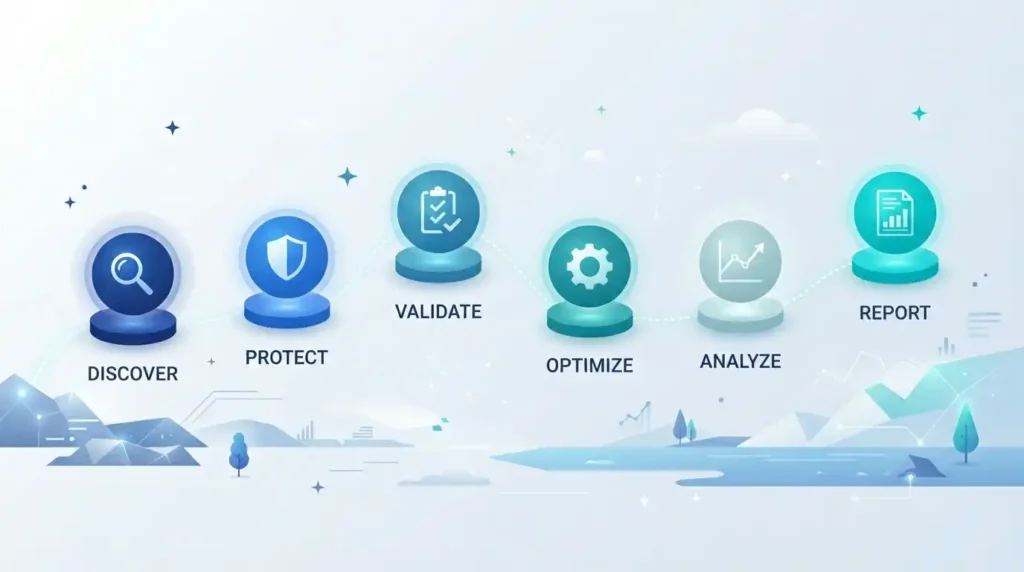
The process follows a clear sequence.
- Asset identification. Map out everything that needs scanning, including servers, apps, cloud accounts, and endpoints.
- Scanning. Run automated tools against those assets.
- Detection. Flag the weaknesses the scan finds.
- Analysis. Judge how serious each flaw is and what it could expose.
- Report generation. Document findings in a format security teams can act on.
- Resolution and re-scan. Fix the issues, then scan again to confirm they are gone.
Skipping any one of these steps usually causes trouble later. A common failure pattern looks like this: a team runs the scan and gets a 40-page report. Nobody owns turning it into a fix list. The same critical flaw shows up again next quarter, still untouched.
Why Periodic Vulnerability Assessments Matter
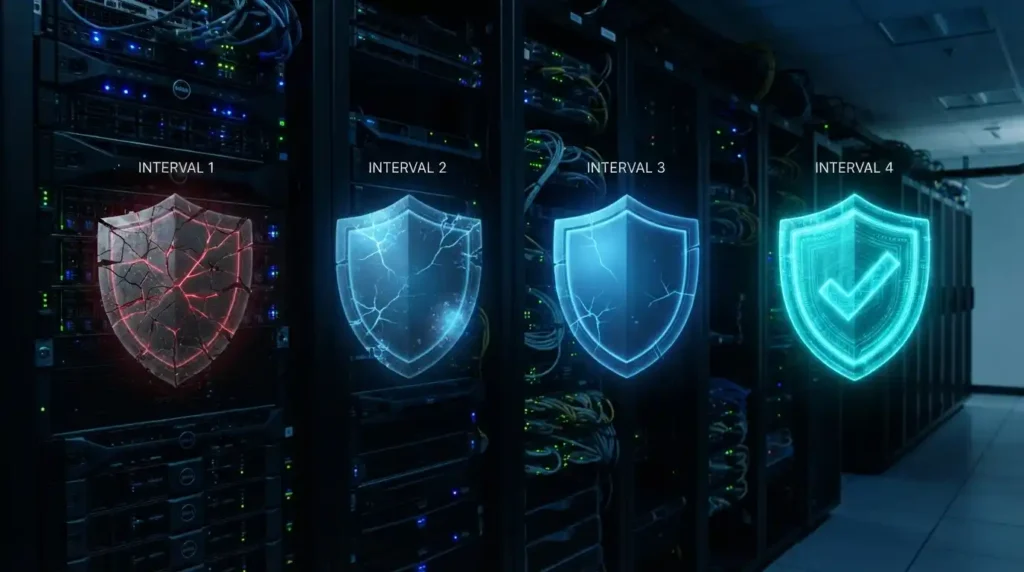
Vulnerability assessments are now a critical aspect of every organization. With increased complexity of networks, many companies are unable to manually identify all possible areas of weakness. Automated tools are effective in detecting flaws in organizational systems.
Networks grow more complex every year. No security team can manually check every system by hand. That is the core reason to run assessments on a schedule instead of waiting for a breach. The urgency keeps rising too. The same 2026 Verizon report found organizations fully remediate only about 26% of their most critical known-exploited vulnerabilities. They take an average of 43 days to patch the ones they do fix. Attackers, often helped by automated reconnaissance tools, move faster than that window allows. There are several benefits that companies enjoy when they conduct regular assessments.
- Earlier detection. The sooner a flaw is found, the more time a team has to patch it before attackers notice it.
- A smaller attack surface. Known, unpatched weaknesses are now the leading entry point for attackers. Closing them removes the easiest path in.
- Protected sensitive data. Customer records, financial details, and employee information are exactly what attackers want. A flaw exposing this data needs urgent attention.
- Compliance coverage. Finance, healthcare, and other regulated industries require regular security assessments as part of formal audits. Requirements vary by country and sector, so check local rules directly.
- Time saved through automation. Manually reviewing thousands of systems is not realistic. Automated tools handle the scanning so teams can focus on judgment calls.
Types of Vulnerability Assessments
Different parts of an organization need different scanning approaches.
| Type | What It Checks | Why It Matters |
|---|---|---|
| Network assessment | Servers, connected devices, infrastructure | Keeps core operations running securely |
| Web application assessment | Websites and customer-facing apps | Common entry point for external attackers |
| Host assessment | Individual machines, OS, installed software | Flaws often sit unnoticed on endpoints |
| Cloud security assessment | Cloud-hosted data and services | A growing share of business-critical data lives here |
| Database assessment | Systems storing sensitive records | A breach here often means direct data theft |
Vulnerability Assessments Scanning Tools and Methods
Nobody runs one scanner and calls it a day. You need network scanners for the open ports, outdated protocols, sloppy firewall rules. Then application scanners for the websites and APIs – injection points, broken auth, that kind of thing. And cloud posture tools for a totally different headache: exposed storage buckets, messy identity permissions, misconfigured services scattered across whatever cloud providers you’re using.
Underneath all of this, there are really two ways to scan:
- Authenticated scans log in with real credentials first. So they see the environment the way an insider would- or the way someone would if they’d already stolen a login.
- Unauthenticated scans skip that step entirely. No credentials, no access – just what’s visible from outside. This is closer to what an attacker sees before they’ve broken in.
Here’s the thing: you need both, because each one misses what the other catches. An authenticated scan can walk right past a public-facing misconfiguration since it’s not looking from the outside. An unauthenticated scan, meanwhile, has no way to reach internal flaws that are locked behind a login. So the teams that actually do this well don’t pick one – they run both on a schedule and watch how the results shift over time. That’s usually where the early warning signs show up. For a closer look at which network, application, and cloud scanners fit best, see our breakdown of scanning and testing tools.
Vulnerability Assessment vs Penetration Testing
Vulnerability assessment and penetration testing are two distinct but closely-related processes. Vulnerability assessment typically involves scanning systems to reveal weaknesses and generating a report of the issues detected. On the other hand, penetration testing entails performing an attack on a computer network to uncover how successful the attack would be. Organizations can perform automated scans for detecting flaws. At the same time, penetration testing can be utilized to reveal if attackers would be able to exploit the weaknesses that have been discovered.
Vulnerability Assessment vs. AI Red Teaming: What Is the Difference?

Traditional vulnerability assessments were built for a world of servers, apps, and networks. AI systems introduce a different kind of risk. A large language model or AI agent can be technically “vulnerability-free” by traditional scanning standards. It can still be tricked into leaking data or ignoring its own safety rules.
This is where AI red teaming comes in. It tests how an AI model behaves under adversarial prompts and manipulation attempts. It checks edge-case inputs instead of scanning for known software flaws. Our detailed breakdown of the AI red teaming framework covers how enterprises structure this testing for chatbots and AI agents.
Organizations that deploy both AI systems and traditional infrastructure need both practices. A vulnerability assessment protects the servers and applications. AI red teaming protects the model’s behavior and decision logic. Skipping either one leaves a real gap that attackers can find.
What To Do After Discovering Vulnerabilities in Systems?
Detecting the flaws in systems is the first step. After the vulnerability assessment, companies need to analyze the risks and impact of the weaknesses. The following considerations are important in this process: risks posed by the flaw, whether the asset affected is internet-facing, impact on business, availability of a public exploit, the relevance of the affected system, and the damage that can result from the flaw. Once the issues are prioritized, firms focus on addressing them accordingly. After the issues have been resolved, it is important to rescan the system to ensure that all areas of concern have been addressed. It is also critical to ensure that other aspects of the network, systems, and other assets are not faulty.
Turning Vulnerability Assessment Results Into a Security Roadmap
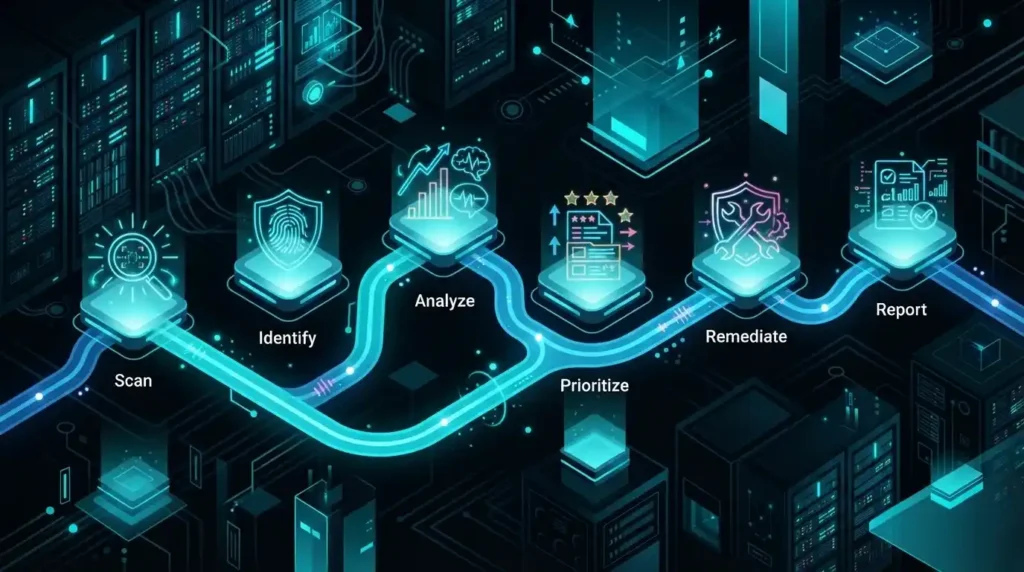
A completed scan report is not the finish line. It is the starting point for a roadmap. A few factors decide how urgently a given weakness needs attention:
- Is the affected system exposed to the internet?
- How critical is it to daily operations?
- Does a public exploit for it already exist?
- What would the business impact be if it were exploited?
Flaws that check all four boxes should jump to the top of the queue immediately. Everything else gets scheduled based on risk score and available resources.
Many regulated businesses also need to connect these findings to a formal compliance framework. Companies pursuing SOC 2 certification must show auditors a documented process for fixing vulnerabilities. Our guide on SOC 2 compliance for startups breaks down what auditors expect to see. Teams building AI products on a deadline can check our walkthrough on a SOC 2 compliant AI MVP. It lays out a practical, week-by-week approach.
Once a fix is deployed, re-scanning is non-negotiable. It confirms the issue is resolved and checks that the fix did not introduce a new one.
Common Challenges in Vulnerability Assessment
Automated tools help, but they are not the whole solution. False positives happen often. Outdated scanning tools can flag issues that do not actually exist, wasting a team’s time on phantom risks. Human review still matters. Someone with security expertise needs to look at the results before anyone acts on them.
A strong vulnerability management program combines automated scanning with penetration testing, ongoing monitoring, and clear internal policies. No single piece covers everything on its own. Teams that also build or deploy AI tools should track how autonomous systems change their risk profile. Our recent piece on the OpenAI-Hugging Face incident and AI kill switches explains why oversight controls now matter. AI oversight sits next to traditional security controls on many risk registers today.
Final thoughts: Finding and Managing System Vulnerabilities
Vulnerability assessment is vital for organizations as they enable firms to detect possible areas of weakness. Networks, websites and apps, cloud software, systems, databases, and other assets are prone to a number of flaws. The weakness can leave systems exposed to attackers, causing disruption of services and loss of important information. Thus, vulnerability assessments are critical for the success of the business. The main challenge with the assessments is that they only identify the weakness but do not address them. Automated tools and manual assessments, penetration testing, monitoring, and policies enable organizations to manage the issues and promote the security of systems, networks, and data.
Our cybersecurity services team can walk through a scan of your current environment. This shows how vulnerability scanning, AI red teaming, and compliance audits fit together for your organization.
Sources: Verizon 2026 Data Breach Investigations Report, 19th edition. CISA Known Exploited Vulnerabilities Catalog. NIST National Vulnerability Database.
FAQ’s
How often should these scans run? Most organizations run them
Most organizations run them quarterly at minimum. Internet-facing or high-risk systems need more frequent scans. Some regulated industries scan monthly or continuously.
How is this different from penetration testing?
Scanning identifies and reports weaknesses. Penetration testing actively tries to exploit them to test real-world impact. The two practices work together rather than replace each other.
What does a clean scan actually mean?
A clean result does not guarantee a risk-free system. It may mean the scanning tool is outdated or missed something. Regular tool updates and periodic penetration testing help catch what automated scans alone might miss.
Do small businesses need this too?
Yes. Attackers often target smaller organizations because they assume the security there is weaker. With vulnerability exploitation now outpacing credential theft industry-wide, even a basic quarterly scan closes off the easiest entry points.
Can a vulnerability assessment cover AI systems too?
Traditional scans cover the infrastructure an AI system runs on, such as servers and APIs. They do not test the model’s behavior. That gap is why AI red teaming exists as a separate, complementary practice.
Discover more from Diginatives
Subscribe to get the latest posts sent to your email.