Introduction
Every vendor pitch sounds the same these days. End-to-end Gen AI Capabilities solutions. Scalable AI transformation. Cutting-edge innovation. Strip away the buzzwords and half of them are reselling the same GPT wrapper with a different logo stuck on top.
I’ve sat through enough of these calls to know the pattern. A capabilities list, a client logo wall, a case study with numbers you can’t really verify. And the businesses on the other end of that call? They’re often making six-figure decisions off a 45-minute pitch.
So how do you actually separate a serious Gen AI vendor from one riding the hype wave? You check what they can build, not what they say they can build. Here’s the list, 11 capabilities, what each one actually looks like when it’s done right, and the questions I’d ask before signing anything.
A Quick Vendor Evaluation Checklist
Worth having these ready before your next vendor call:
- Real production examples, or just demos?
- Is there an actual maintenance/monitoring plan after launch, or does it end at deployment?
- Can they talk about bias testing without dodging the question?
- Do they host and fine-tune models themselves, or resell someone else’s API?
- Have they actually worked with your specific tech stack before?
- Will they ever tell you AI isn’t the right call?
If most of these get vague answers, that’s your answer.
1. Generative AI Model Development
A real vendor doesn’t just hand you an off-the-shelf model and call it a day. They build frameworks around your actual data, your industry, your use cases. Could be structured business data. Could be a messy pile of unstructured text pulled from five different legacy systems nobody wants to touch.
This is honestly where most vendors cut corners. It’s cheap to fine-tune a generic model slightly and call it “custom development.” Looks great in the demo. Falls apart the second it hits real production data, edge cases the model was never trained on, formatting nobody warned them about, industry jargon that confuses it completely.
Ask this: show me how it performs on our actual sample data, not your demo dataset. And what happens when the model drifts six months from now? If there’s no answer, that’s the answer.
2. Generative AI Integration
Building the model is the fun part. Getting it to actually work inside your ERP, your CRM, your ticketing system, without breaking three other things, that’s a completely different job. Honestly this is where most Gen AI projects quietly die.
Good vendors map your whole stack before writing any integration code. They know the API limits, the latency issues, where the new bottleneck is going to show up before it shows up. Bad integration is exactly why so many companies end up with a shiny AI pilot nobody actually uses. It works fine, technically. It just lives outside how people actually do their jobs, so it gets abandoned by week three.
Ask this: name the specific systems they’ve integrated with, not “CRM systems” as a vague category. And what’s the rollback plan if something breaks downstream?
3. Prompt Engineering
People treat this like it’s not real work. It is. Bad prompts give you inconsistent output, and inconsistency is what kills trust in an AI tool faster than anything else. One great answer followed by one weird one, and your team just stops using it.
The vendors who take this seriously version-control their prompts, test them against edge cases, keep refining based on actual usage, not a one-time tweak until the demo looks good. They also build in guardrails, fallback behavior for when the model’s unsure, boundaries on what it should even attempt to answer.
Ask this: how do they test prompts before pushing live? Is there any process for catching quality drops over time, or is this a “set it and forget it” situation?
4. MLOps Team Augmentation
Deploying is the easy part. Keeping something running well for months, not just surviving the first two weeks, is where in-house teams without a dedicated ML function get stretched thin fast.
A vendor with real MLOps chops can actually plug that gap, handling deployment pipelines, monitoring, scaling based on real usage, ongoing tuning as the live data reveals gaps the training data missed. Skip this and models degrade quietly. Accuracy slips, latency creeps, and nobody notices until a customer’s already annoyed.
Ask this: what monitoring or alerts exist post-launch? Who actually picks up the phone if things go sideways at 2am on a Saturday?
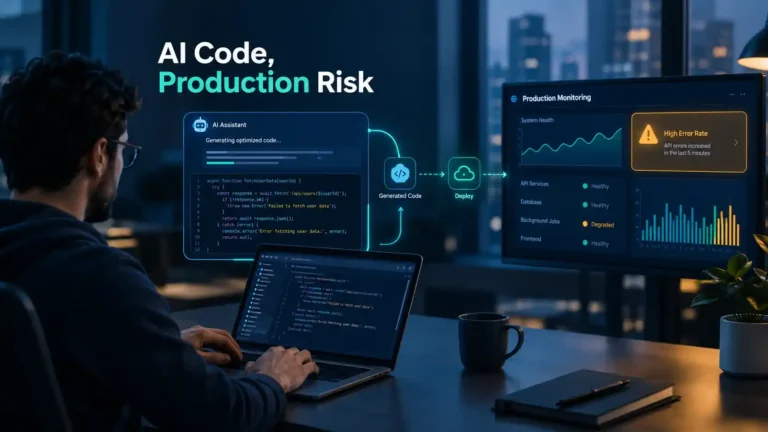
5. Automation and Code Generation
AI code generation genuinely speeds things up, less boilerplate, fewer manual mistakes on the predictable stuff. But only if the vendor knows where to actually use it instead of throwing it at everything because they can.
Here’s the part nobody likes admitting: AI-generated code still needs a human set of eyes on it, especially for security and edge cases. A vendor who implies this replaces code review entirely is quietly loading you up with technical debt that shows up in an audit six months from now.
Ask this: give me one real example where this cut a delivery timeline, with actual numbers. And what does their review process look like for AI-written code?
6. AI for Business Intelligence
Done right, generative AI in BI means faster, clearer decisions. Breaking down data silos, chewing through messier datasets than traditional BI tools can handle, surfacing insights people can act on without needing an analyst to translate a chart for them.
A chatbot bolted onto your dashboard that answers “what were sales last month” in plain English? That’s a thin version of something that can be much more powerful. Real value shows up when it’s pulling from multiple sources at once, catching anomalies before a human would, and explaining its reasoning instead of just spitting out a number and walking away.
Ask this: can it work across more than one data source at the same time? What does it do when it genuinely doesn’t have enough info to answer confidently?
7. AI Consulting and Strategy
Technology without a direction attached is just an expensive experiment. Good vendors help build a roadmap tied to actual business goals and ROI, not a list of features chasing whatever a competitor announced last week.
There’s a conflict of interest worth noticing here too. A vendor paid per project has some incentive to keep finding you new projects. The ones worth trusting will tell you, sometimes, that AI isn’t the answer to a specific problem. That’s a better signal than a roadmap stuffed with initiatives.
Ask this: tell me about a time you told a client not to do an AI project. If they can’t answer, that tells you something.
8. Tailored LLM Fine-Tuning and Hosting
For businesses that need more control, fine-tuning and hosting your own LLM matters a lot, especially in regulated industries or anywhere sensitive data can’t just pass through a third-party API. Done right, you get a model tuned to your domain that also keeps your data exactly where it belongs.
This is a good filter for separating vendors with real infrastructure chops from ones just calling third-party APIs and marking up the invoice. Hosting your own model takes actual ML infrastructure knowledge, GPU provisioning, cost control, versioning, security hardening, and a surprising number of “AI-native” shops simply don’t have that in-house.
Ask this: do they host models themselves, or is this a reseller markup on someone else’s API? Where exactly does your data sit during fine-tuning?
9. Ethical and Responsible AI Implementation
Easy to skip in a sales deck, expensive to skip in real life. Bias testing, fairness checks, staying aligned with regulation, being able to explain how the model actually made a decision, all of this protects you from reputational and legal messes that show up after launch, once the thing’s already affecting real customers.
If a vendor gets vague or dodgy when you ask about bias testing, that’s not a small detail you can shrug off. It tells you a lot about how seriously they take the unglamorous parts of AI that never make it into a demo.
Ask this: how do they test for biased output before anything ships? Can they actually explain why the model said what it said, or is it a black box to them too?
10. Agent Development
Real agent development goes beyond chatbots, systems that handle multi-step tasks, hold an actual conversation, plug into your existing workflows and automate genuinely complicated processes instead of answering the same five FAQs. This space is moving fast, and vendor quality here is all over the place. A lot of what gets called an “AI agent” today is just a chatbot with a rebrand.
A real agent takes action. Updates a record, kicks off a workflow, hands off to a human when it hits a wall, not just generates text and stops.
Ask this: show me an agent completing a full multi-step task, not just answering one question. Curious how this compares to full custom builds? We cover that in Custom AI Model Development.
11. RAG (Retrieval-Augmented Generation) Services
A model only knows what it knows, and RAG fixes that by grounding it in your live data instead of relying purely on training data that might be outdated or just wrong for your specific situation. You get more accurate, more relevant answers, and a lot less risk of the model confidently making stuff up.
This matters most anywhere customer-facing or compliance-heavy, where a confident wrong answer is worse than no answer at all. Vendors who actually understand RAG talk about retrieval quality specifically, not just “yes we have RAG,” but how well it’s actually finding the right information before generating anything.
Ask this: how do they measure retrieval accuracy? What happens when it can’t find anything relevant? Does it say so, or does it just guess?
Conclusion
Generative AI really is changing how software gets built and how decisions get made. But there’s a real gap between vendors who deliver on that and vendors who just talk about it, and that gap is usually invisible until three months in, when the pilot that looked amazing in the demo needs actual maintenance and actual integration and someone actually accountable.
Use this list to filter, not to check a box. Ask the direct questions. Want real examples, not case-study language. And if you’re weighing consulting firms too, we broke down Top AI Consulting Companies in 2026 here. If you’re leaning toward hiring AI talent directly, this guide walks through that instead.
Frequently Asked Questions
What is meant by Gen AI?
A type of AI that creates new content, text, images, music, video, conversation, instead of just analyzing or sorting existing data.
What are 5 ways Gen AI is transforming the tech industry?
Changing software development, from writing code to optimizing design
Speeding up UI/UX prototyping
Strengthening cybersecurity
Accelerating research and innovation
Enabling real-time decisions
What are the 4 types of Gen AI transforming our world?
Large Language Models
Diffusion Models
Generative Adversarial Networks
Neural Radiance Fields
How long does deploying a custom Gen AI solution usually take?
Depends heavily on scope, but a focused, well-integrated build typically goes from discovery to production in months, not a year-plus enterprise saga. That’s assuming the vendor actually has delivery chops and isn’t purely a strategy shop.
Want a vendor that checks these boxes for real? Diginatives builds custom Gen AI solutions from model development through production, and we’re happy to walk through exactly how we handle each of these 11.
Discover more from Diginatives
Subscribe to get the latest posts sent to your email.