Ten years ago, IoT mostly meant a smart bulb or a fitness band. Today it means a wind turbine that orders its own spare part, a hospital bed that reports its own status, and a truck that warns you it’s running late before the driver does.
The scale shows how fast this moved. There were 18.5 billion connected IoT devices in 2024, and the count was forecast to reach 21.1 billion by the end of 2025, with about 39 billion expected by 2030. According to IoT Analytics
But more devices doesn’t automatically mean more value. The future of IoT depends on what those devices can do, how safe they are, and whether they work with each other. This guide breaks down the eight trends that matter most, with a side-by-side comparison so you can see where to focus.
Key Takeaways
- The future of IoT is about intelligence, security, and interoperability, not just device count.
- Forecasts point to roughly 39 billion connected devices by 2030.
- Edge computing and AI are moving decisions from the cloud to the device.
- 5G is only one option. Low-power networks still power most battery-based sensors.
- Security and regulation are now business requirements, not extras.
- Buyers are cautious, so proven ROI matters more than big rollouts.
What Is the Future of IoT?
IoT has continued to evolve, latest trends and progressions in software development are quickly reshaping its potential and future. As per the latest reports:
- The compound annual growth rate (CAGR) of IoT connections is 13.2% from 2025 to 2030.
- IoT connections are expected to increase from 21.1 billion in 2025 to 39 billion in 2030.
- The IoT market revenue is also projected to grow from $547 billion in 2025 to $865 billion by 2030
Keeping this scenario under consideration, we are presenting to you the latest trends in IoT software development.
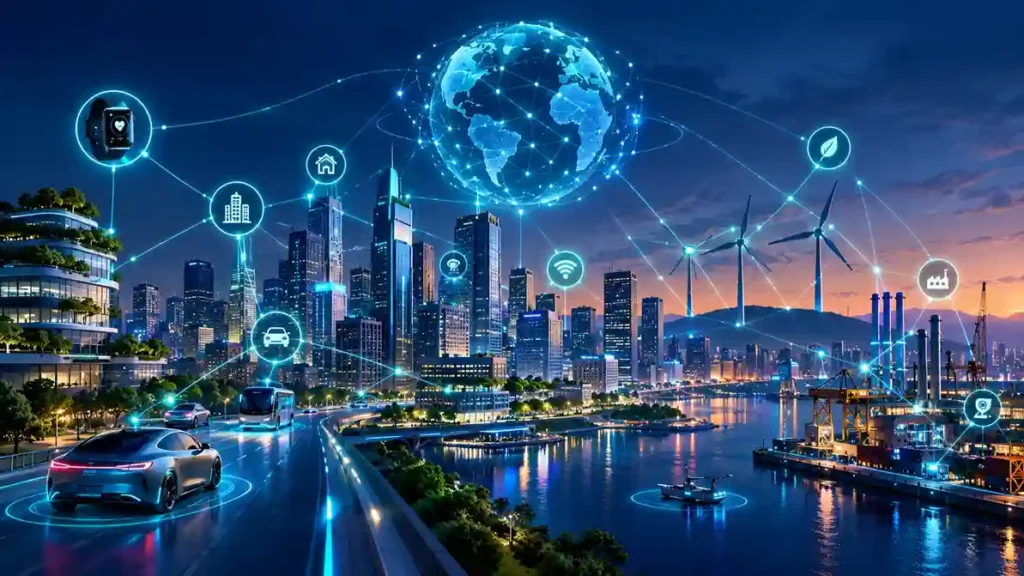
The Future of IoT at a Glance: 8 Trends Compared
The eight trends shaping IoT are edge computing, AIoT, varied connectivity, security, digital twins, industrial IoT, smart cities, and regulation. They differ in maturity and effort, so the table below shows what each does, where it fits best, and what to watch out for.
Trend What It Is Best For Main Benefit Key Challenge Edge Computing Processing data on or near the device Real-time systems, factories, vehicles Low latency, lower bandwidth cost Managing many distributed nodes AIoT AI models running on IoT data Predictive maintenance, vision, energy Predicts problems, not just reports them Needs quality data and skilled teams Modern Connectivity 5G, LoRaWAN, NB-IoT, BLE, satellite Every deployment, matched to the job Right cost and battery life per use case Choosing the wrong network IoT Security Zero trust, device identity, secure updates All connected products Reduces breach risk Ongoing patching effort Digital Twins Live virtual copy of a real asset Factories, energy, buildings Test changes without real downtime Model accuracy and setup cost Industrial IoT IoT in manufacturing, energy, logistics Operations with costly downtime Clearest and fastest ROI Connecting legacy machines Smart Cities IoT in public infrastructure Traffic, lighting, water, waste Better services, lower resource use Data privacy and governance Regulation and Standards Security laws and protocols like Matter Product makers and vendors Less lock-in, clearer rules Keeping up with changing deadlines
A Reality Check on IoT Growth
IoT is still growing, but more slowly and cautiously than early forecasts predicted. Companies are delaying spending until they see a clear return, so the market rewards focused projects over huge rollouts.
The growth is real but not smooth. The 2025 forecast was trimmed by about 300 million connections because companies postponed spending and demand in China came in softer than expected. Enterprise IoT spending rose only 10% in 2024, its slowest pace in over a decade.
The smart reading: the market is expanding, but buyers are pickier. They want proof of return before deploying thousands of sensors. Keep that in mind as you read the trends below.
The Rise In The Popularity of Edge Computing in IoT
This is one of the most significant trends in IoT software development. Previously, IoT devices were supported by cloud computing data storage and data processing. However, the important expansion of and demand for IoT products has developed a requirement for immediate processing. Therefore, edge computing has attained lots of prominence.
Edge computing is defined as the practice of data processing nearer to the source. This is done on the edge of the network. This method improves the overall efficiency, enhances the response time, and decreases the latency. Relying on edge computing allows IoT devices to rely on cloud infrastructure, make immediate decisions, and perform local analytics.
This allows immediate decision-making for jobs like collision evasion, navigation, and obstacle detection. Processing of data at the edge permits autonomous vehicles to react rapidly to their surroundings. This guarantees efficiency and safety on the road.
1.Integration of Artificial Intelligence (AI) in IoT Devices
AI technologies such as natural language processing and machine learning can convert IoT devices into intelligent systems. These systems are capable of advanced analytics and autonomous decision-making.
Incorporating AI capabilities into IoT devices allows you to unlock new opportunities. Some examples are individual user experience, anomaly detection, and predictive maintenance. AI-supported IoT devices can learn from user behavior. This helps them to adjust to evolving environments and operational optimization based on immediate data.
2.Blockchain Technology for Improved IoT Security
Security is important in the IoT ecosystem. This is because there are tons and tons of data being transferred from one device to another. Blockchain technology provides a reliable solution for improved security in IoT systems.
Blockchain offers a tamper-proof and decentralized ledger that can incorporated to safely verify and record transactions between IoT devices. IoT systems can avoid the risk of single failure points, unauthorized access, and data tampering. It allows safe and reliable identity management, transparent data sharing, and peer-to-peer communication.
3. Connectivity: 5G Is Just One Piece
Modern IoT uses several networks, not just 5G. 5G suits high-bandwidth, low-latency jobs, while LoRaWAN, NB-IoT, and Bluetooth Low Energy suit cheap, battery-powered sensors, and satellite covers remote areas.
5G matters for demanding tasks. Cellular IoT connections grew 16% in 2024, faster than IoT overall.
Yet a soil-moisture sensor in a field doesn’t need 5G. It needs years of battery life. That’s why LoRaWAN, NB-IoT, and Bluetooth Low Energy stay important. Even space is involved: more than 100 vendors are active in the satellite IoT market, mainly for tracking assets where there’s no coverage.
The lesson: pick the network for the job, not the buzzword.
4. IoT Security: The Trend Nobody Can Skip
Every connected device adds attack surface, so IoT security now centers on unique device identity, secure updates, zero-trust design, and network segmentation. Blockchain helps only in niche cases and isn’t a general fix.
Default passwords that never change and firmware that never gets updated remain the most common weak spots. Teams that take security seriously do four things:
- Give each device a unique identity
- Use secure boot and signed over-the-air updates
- Trust no device by default (zero trust)
- Segment networks so one breach can’t spread
You’ll hear that blockchain solves IoT security. It can help with tamper-proof logs in a supply chain, but it’s heavy for small, battery-powered devices, so treat it as a specialist tool.
5. Digital Twins: Test It Virtually First
A digital twin is a live virtual copy of a machine, building, or process fed by sensor data. Teams test changes on the twin first, which reduces risk and costly downtime.
Engineers can try a change on the twin, watch the result, and only then touch the real asset. It’s most valuable where downtime is expensive, such as factories, power plants, and large buildings.
6. Industrial IoT: Where the Money Is Made
Industrial IoT delivers the clearest ROI through less unplanned downtime, better energy use, and visible supply chains. The main obstacle is connecting older machines that use outdated protocols.
Consumer gadgets get attention, but factories, energy grids, and logistics networks are where IoT pays back most clearly. The hard part is rarely the new equipment. It’s integrating 20-year-old machines that speak obscure protocols, so budget time for it.
7. Smart Cities: From Pilots to Everyday Services
Smart cities use IoT to manage traffic, lighting, waste, water, and air quality. The trend is shifting from small pilots to daily services, with growing attention to data ownership and privacy.
Cities are moving past one-off experiments toward services residents actually notice, along with tougher questions about who owns the data and how long it’s kept.
8. Regulation and Standards Are Catching Up
IoT regulation is tightening worldwide, including Europe’s Cyber Resilience Act, while standards like Matter improve compatibility between brands. Product teams should plan for compliance and interoperability early.
For years IoT was a bit of a Wild West. That’s ending. IoT Analytics identified 41 key regulations in its 2025 to 2030 outlook. In Europe, the Cyber Resilience Act is bringing security duties to anyone selling connected products, with obligations phasing in over the next couple of years.
On the standards side, protocols like Matter aim to make smart-home devices from different brands work together, which means less lock-in.
Common IoT Challenges to Plan For
The most common IoT challenges are security risk, legacy integration, data quality, device lifecycle management, skills gaps, and unclear ROI. Planning for these early prevents most project failures.
- Security and privacy exposure
- Integration with older systems
- Poor data quality and huge data volumes
- Updating and retiring devices over time
- Shortage of skilled people
- Unclear or unproven return on investment
How Businesses Should Prepare for the Future of IoT
Start with a business problem, pilot on one use case, build in security and updates from day one, prefer open standards, and bring in experienced help for integration.
- Start with a problem, not a gadget. “We lose six hours a week to machine downtime” beats “we need IoT.”
- Pilot small. Prove the return on one line or site first.
- Build in updates from day one. A device you can’t patch is a liability.
- Prefer open standards to avoid vendor lock-in.
- Get experienced help for integration, where projects usually stall.
Conclusion
The technology is progressing day by day. This enables us to see more exciting developments in IoT software development. This shows that IoT has the capability of transforming industries and enhancing our daily lives. It has become an integral part of the digital ecosystems.
Frequently Asked Questions (FAQs)
What is the internet of things (IoT)?
It is a collective network of connected technology and devices that support communication between the cloud and the devices and the devices themselves.
What are some examples of IoT?
· Home security systems
· Self-driving cars
· Fitness tracking watches
· Kitchen Appliances
· Smart thermostat
What are the 4 types of IoT?
· Consumer IoT
· Commercial IoT
· Industrial IoT
· Infrastructural IoT
What are the 4 IoT components?
· User interface
· Data Processing
· Connectivity
· Devices and sensors
What is the future of IoT?
It’s a shift from simply connected devices to intelligent, secure, interoperable ones, with more AI at the edge, mixed connectivity, and tighter regulation. Forecasts point to about 39 billion devices by 2030.
Diginatives provides world-class IoT software development services. If you want flawless functioning of your organization; please contact us.
Discover more from Diginatives
Subscribe to get the latest posts sent to your email.