Remote blockchain developers used to be a niche hire for crypto startups. Not anymore. Banks, supply-chain teams and healthcare companies now want people who can write secure smart contracts, and there’s a global shortage of developers with specialized skills like Solidity, Rust and Hyperledger Fabric. So why do more companies turn to remote blockchain developers? Reach, cost and speed are the obvious answers. But 2026 adds a harder question: how do you hire remotely without opening a security hole? This guide covers both. coders
Introduction
Applying blockchain technology via a skilled team allows your company to unlock its complete potential and stay ahead in this digital world. Keeping this scenario under consideration, we are presenting to you some of the advantages of hiring remote blockchain developers.
What Are Remote Blockchain Developers?
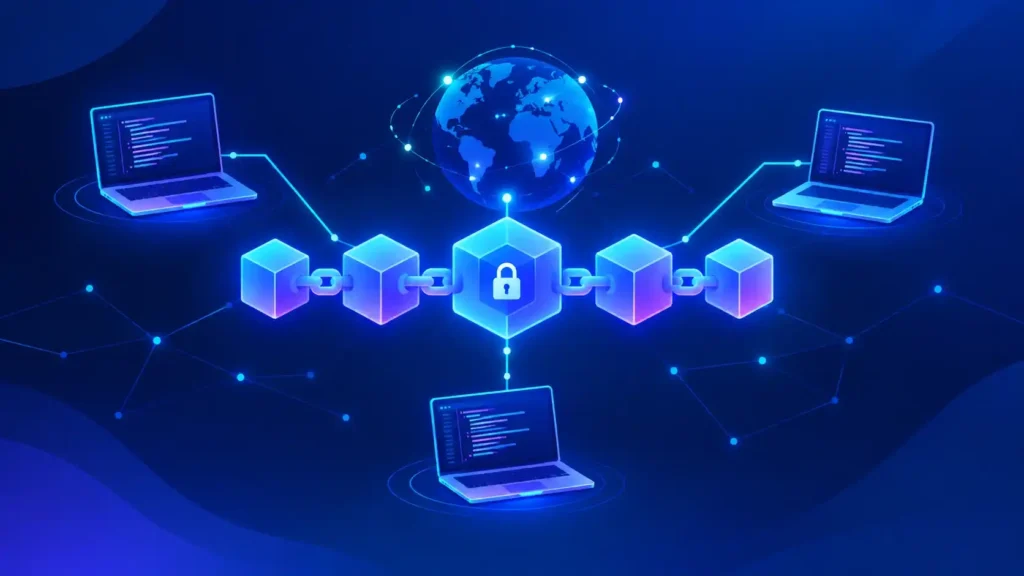
Start with the basics. A blockchain is a shared digital ledger. Transactions are grouped into blocks, each linked to the one before it, and a consensus method (such as proof-of-work or proof-of-stake) lets participants agree on what’s valid without a central authority. A remote blockchain developer builds on top of that, writing smart contracts, decentralized apps and integrations from outside your office. That might be another city or another country.
7 Reasons to Hire Remote Blockchain Developers
1. Skills you can’t easily find locally
The talent is scarce and the competition is real. Solidity is still the standard for Ethereum-compatible chains, while chains like Solana and Polkadot have created strong demand for Rust developers. One careers site listed more than 73,000 live blockchain roles in May 2026. If you only look in your own city, you’re competing for a tiny pool.
2. Solutions built for your use case
A bank needs something different from a logistics firm. A remote developer can build a private network for internal operations or a customer-facing dApp. Demand has also shifted from speculative crypto projects to enterprise uses in finance, supply chain, healthcare and real estate.
3. Security, with a reality check
Blockchain is tamper-resistant by design. That doesn’t make your company immune. Chainalysis recorded over $3.4 billion in crypto theft in 2025, with the Bybit hack alone about 44% of it. TRM Labs found that in 2025 infrastructure attacks made up about 76% of stolen value, against 12.1% for code exploits. In short, the weak spot is often key custody and access, not the contract code. An experienced developer helps with both.
4. Cost and flexibility
Remote hiring avoids relocation costs and lowers office overhead. It also lets you scale the team up or down as a project moves from proof of concept to MVP to full product. One caution: blockchain can cut out intermediaries, but not every process needs one. A good developer will tell you when it’s the wrong tool.
5. Real uses beyond cryptocurrency
Supply chain tracking, asset tokenization, smart contracts and DeFi platforms all fit here.
6. Keeping up with a fast field
Chains, languages and standards keep changing. A team that works across projects sees these shifts earlier than one engineer on a single stack.
7. Working with a development partner
Freelancers suit short, narrow tasks. A dedicated team stays aligned with your long-term goals, and some companies mix on-site and remote people in a hybrid setup. Choose based on how long and how complex the project is.
They are Specialist in Blockchain Technology
Hiring remote blockchain development workers has numerous advantages. They have dedicated professionals with comprehensive knowledge of blockchain technology. These developers are knowledgeable regarding different blockchain platforms, programming languages, and frameworks. This permits them to develop secure and robust blockchain solutions modified as per the company’s requirements.
They Have Time To Create Customized Blockchain Solutions
A remote blockchain developer can develop customized blockchain solutions that meet particular business requirements. They can develop and position your blockchain solution to serve your company’s particular use cases and industry verticals. This is done regardless of the implementation of a private blockchain network for intrinsic operations or the creating of a decentralized app for your clients.
Improved Data Integrity and Security
Blockchain technology is known for its inherent security features. It incorporates transparency and immutability. By hiring a remote blockchain developer, you can guarantee the application of robust security encryptions and protocols to safeguard your company’s sensitive data. In addition to this, the decentralized nature of blockchain reduces the risk of fraud and data breaches. This is because it offers improved reliability and data integrity.
Efficient Operations and Cost Savings
They design blockchain solutions in such a way that your company’s processes can be organized in such a way that costs are reduced. This remote worker can pinpoint the areas where blockchain can maximize your workflows, circumvent intermediaries, and pre-set-trust-based interactions. This results in more efficiency and reduced operational expenses.
Access to Ground-breaking Blockchain Applications
Blockchain technology is not just for cryptocurrencies; it has many uses in many sectors. You can benefit from a blockchain development company’s experience creating cutting-edge blockchain apps by working with them. Supply chain management systems, tokenization, smart contract creation, decentralized finance (DeFi) platforms, and more can help your business take advantage of blockchain technology’s revolutionary potential.
Future-Proofing Your Organization
By making personnel investments in blockchain development, you can future-proof your company against the rapidly changing digital ecosystem. The field of blockchain technology is always changing, so having a professional developer on staff will help your business keep on top of developments. They are able to take advantage of new developments in blockchain technology and adapt to them, keeping your business innovative and competitive.
Collaborative Partnership with Blockchain Development Companies
Partnering with a trustworthy blockchain development service will help you get the most out of hiring a blockchain developer. These organizations provide access to a pool of gifted developers with a variety of blockchain development expertise and talents. This cooperative relationship guarantees faster development, more effective resource allocation, and access to a wider spectrum of skills.
Remote vs In-House vs Freelancer vs Dedicated Team
| Factor | In-house | Freelancer | Dedicated remote team |
|---|---|---|---|
| Cost structure | Salary, benefits, office | Per task or hour | Monthly or project-based |
| Time to start | Slowest (hiring) | Fast | Fast |
| Scaling up or down | Hard | Limited | Easy |
| Range of skills | Limited to who you hire | One person’s skills | Several roles (contracts, front end, DevOps) |
| Continuity | High | Low (they may leave) | High |
| Management effort | High | Medium to high | Lower |
| Best for | Core, long-term product | Small or one-off jobs | MVPs a |
Risks of Hiring Remote Blockchain Developers (and How to Reduce Them)
Most articles skip this part, and it’s the part that matters most.
- Insider and identity risk. Chainalysis reports that North Korean attackers have often embedded IT workers inside crypto services. Verify identity, check references and code history, and do live technical interviews. pymnts
- Key and access control. Top attackers now go after signing infrastructure and key custody. Never give one person sole control of production keys. Use multisig, hardware wallets and least-privilege access. financefeeds
- Code quality. Have a separate specialist security reviewer check contracts before launch.
- Contracts and communication. Sign NDAs and IP agreements, and agree on overlapping working hours.
Final thoughts on hiring remote blockchain developers
Remote blockchain developers give you access to rare skills, flexible costs and faster delivery. They also raise a security question you can’t ignore. Pick people carefully, limit their access, and treat vetting as part of the job. To talk through your project, contact Diginatives.
Frequently Asked Questions (FAQs)
What is blockchain?
It can be defined as a digital ledger that is distributed and records transactions across various nodes and computers. Every transaction is put in a block and then it is linked to the past block. This forms a blockchain. This framework guarantees security, immutability, and data transparency the consensus mechanism permits network participants to agree on the authenticity of transactions without any requirement of any central authority.
What is a remote worker?
A remote worker is the one who is not physically present in your office. They are sitting in a different location yet managing your work.
What is a remote blockchain developer?
A developer who builds blockchain applications, such as smart contracts and dApps, from outside your office.
How much do remote blockchain developers cost?
How do I check a remote blockchain developer is trustworthy?
Verify identity, review past code, run a live technical test, limit access to keys, and start with a small paid task.
Can blockchain be used outside cryptocurrency?
Yes. Common uses include supply chain tracking, tokenization and secure record keeping.
Discover more from Diginatives
Subscribe to get the latest posts sent to your email.