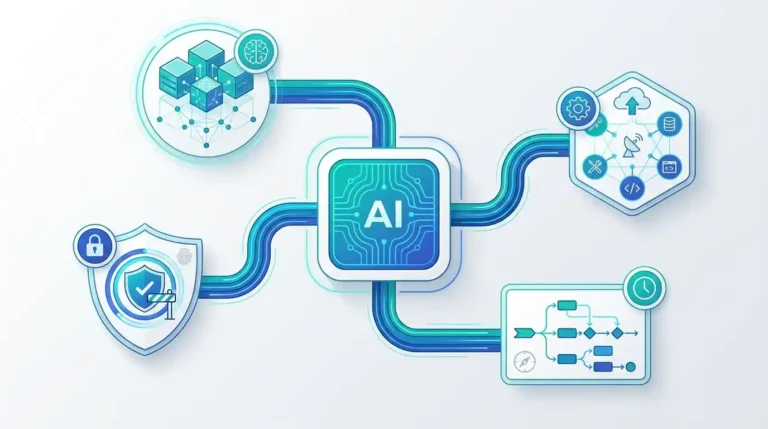
AI agent development company specialize in designing, creating, and deploying autonomous artificial intelligence software to read user intent, plan multi-step workflows independently, call external APIs without human oversight, and carry out complex business operations with minimum human oversight. While most chatbots simply retrieve answers then stop responding, an experienced AI development agency creates self-correcting agentic systems which take action and complete tasks across your enterprise stack.
At present, this transition is underway across industries. Businesses are abandoning simple text-generating chatbots and rigid automation scripts in favor of AI agent development companies to create intelligent goal-driven systems capable of running entire workflows end-to-end without much assistance from business leaders – whether orchestrating supply chains, routing customer operations or automating financial reporting is concerned, choosing the right partner can often make all the difference between an initiative’s successful launch or quietly fizzling out during early testing phases.
Understanding how agentic AI development services differ from traditional software delivery is also vital to making informed technology decisions. Businesses working with specialist AI agent development companies don’t just purchase software; rather they turn passive language models into something closer to an active member of their workforce that executes real business goals rather than simply responding to prompts.
Enterprise Automation and Agentic Systems
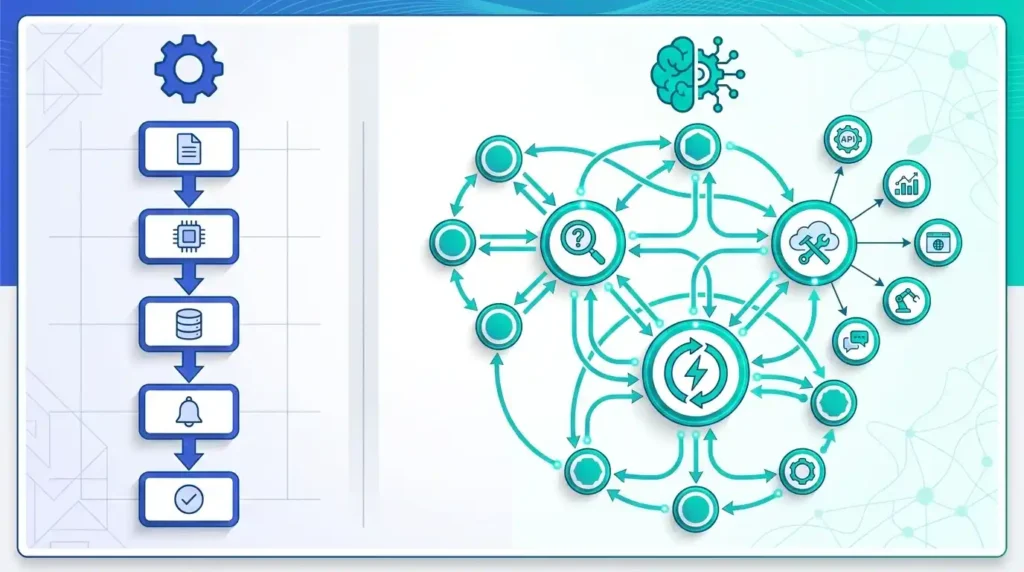
Traditional software operates under strict deterministic rules: when certain triggers occur, a program executes pre-written commands based on them. While this approach works well for routine tasks, when confronted with unpredictable inputs or edge cases it quickly breaks down. Conversational chatbots offer some relief by understanding natural language input but typically remain limited to retrieving static articles or providing scripted responses.
Autonomous software agents represent an unprecedented shift in business automation. Instead of adhering to rigid IF-THEN pathways, autonomous agents take an omni-dimensional approach; starting from high-level outcomes they break them down into individual tasks before identifying any necessary tools or databases that may be required, executing those steps and verifying for any errors as part of a check list process.
Businesses hiring an AI development agency gain access to highly experienced engineers capable of designing robust multi-layered systems.
Key Capabilities of Enterprise AI Agent Solutions
Constructing enterprise-grade agents requires more than simply connecting an API key with user interfaces. Top-tier AI agent development solutions encase six core architectural pillars to guarantee safety, accuracy and operational scale:
- Reasoning Core: This language model framework serves as the central hub for processing instructions, analyzing multi-step scenarios and determining logical next actions.
- Short and Long-Term Memory: Hybrid storage architectures employing vector databases which maintain context across long multi-turn interactions by drawing upon historical company data.
- Tool Calling and API Integration: Direct connections that allow software agents to execute actions across CRMs, ERPs, SQL databases and third-party web services.
- Planning and Task Decomposition: Orchestration systems which divide large objectives into manageable subtasks for execution in an orderly manner.
- Self-Reflection and Error Handling: Constant feedback loops where agents assess task outputs, detect errors and automatically retry failed operations automatically.
- Security and Governance Guardrails: Enterprise security controls that restrict agent access, ensure data privacy compliance, and require human approval for high-risk decisions.
In-House Development vs. Partnering with an AI Agent Development Agency
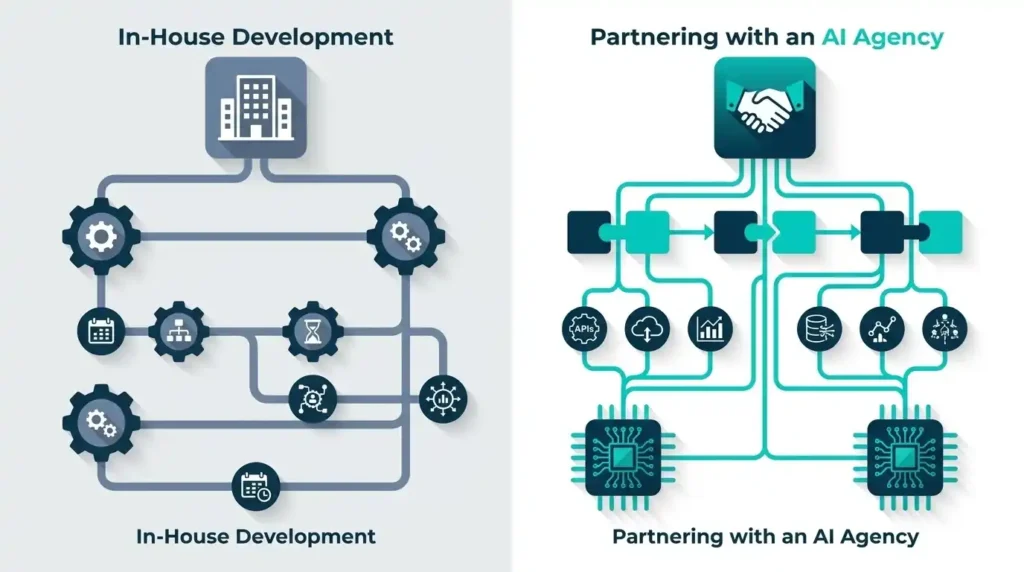
Tech leaders who want to deploy autonomous software often face the decision between building systems in-house or partnering with an established AI agent development agency.
Internal engineering teams understand company products intimately; however, developing production-grade agentic architectures requires expert team members with experience in vector indexing, prompt orchestration and non-deterministic software testing to build production-grade agentic architectures. Partnering with expert team members speeds development timelines while mitigating technical missteps.
| Evaluation Metric | In-House Engineering Team | Dedicated AI Agent Development Company |
|---|---|---|
| Time to Deploy | 8-14 months | 2 to 4 Months |
| Specialized AI Expertise | Variable/ Requires Hiring | Full Access to ML/AI Architects |
| Architectural Frameworks | Custom/Built from Scratch | that Are Field Tested (LangGraph, CrewAI AutoGen) |
| Initial Capital Investment | High Overhead Costs | Scalable Project-Based Pricing |
| Maintenance & Optimization | Internal Team Strain | Structured SLAs & Continuous Tuning |
Diginatives Is an Excellent AI Agent Development Partner
When selecting an enterprise development partner, proven implementation history trumps theoretical frameworks. Diginatives stands out among AI agent development companies by developing tailored agentic solutions designed specifically for mission-critical business environments.
Our engineering team boasts hands-on experience designing complex AI systems that deliver tangible ROI:
- Healthcare and Enterprise Dashboards: For Alkhidmat, we developed an AI-powered healthcare analytics dashboard, organizing multi-source operational data into intelligent diagnostic insights and automated patient management flows.
- High-Throughput Infrastructure: Our engineers specialize in Model Context Protocol (MCP) implementations and custom context routing, achieving up to three times faster data processing speeds while still achieving 99.9% system uptime across production environments.
- Multi-Agent Orchestration: At our firm, we specialize in designing collaborative multi-agent networks capable of handling asynchronous task routing, continuous self-correction and secure database interactions.
Diginatives offers expert AI development services to automate internal operations or develop customer-facing solutions, with systems anchored in enterprise governance and security for resilient performance.
Leading AI Agent Development Companies in the Market
Organizations seeking autonomous agent solutions typically select between AI engineering firms, product studios and large enterprise system integrators for development of AI agent development companies. Below is a selection of leading autonomous agent development firms providing autonomous agent solutions:
- Diginatives: A software and AI development company specializing in custom agentic architectures and high-throughput infrastructure, known for its healthcare analytics dashboard work with Alkhidmat, MCP implementations achieving up to 3x faster data processing, and 99.9% system uptime across production environments for mid-market and enterprise clients.
- ELEKS: An award-winning software engineering firm known for creating custom, production-grade agentic systems and multi-agent workflow engines for Fortune 500 enterprises.
- Master of Code Global offers high-touch conversational AI and adaptive agentic tools that seamlessly integrate into complex omnichannel workflows, while Markovate specializes in custom generative AI, LLM orchestration and task automation agents designed for mid-market and enterprise scale environments.
- Diffco: Based in Silicon Valley, this studio provides full-cycle AI development with finely integrated models and rapid prototype scaling.
- PLAVNO: Engineering agency that offers custom AI agent builds with security, audit trails and data governance controls as their priority.
- STS Software specializes in document-processing agents, task orchestration systems and API-driven workflow automation.
- Accenture is a global IT leader offering enterprise wide agentic transformations as well as large scale AI system integration services.
- IBM Watsonx Services: IBM is an enterprise platform and consulting provider offering modular agent architectures across hybrid-cloud environments that are tightly managed.
- Tata Consultancy Services (TCS): Global consultancy offering scalable autonomous software agent implementations tied directly to existing enterprise IT.
- Infosys: Focusing on enterprise AI operations by creating automated multi-agent networks designed to streamline corporate infrastructure.
| Company Name | Primary Focus Area | Target Market | Key Strength |
| Diginatives | Custom Agentic Architectures & High-Throughput Infrastructure | Mid-Market & Enterprise | Fast processing (3× speedup), 99.9% uptime, MCP integrations |
| ELEKS | Custom Multi-Agent Architecture | Enterprise & Fortune 500 | Scalable workflow engines & complex software engineering |
| Master of Code Global | Conversational Agents & Omnichannel AI | Mid-Market & Enterprise | High-touch conversational platforms & system integrations |
| Markovate | Generative AI & Task Automation | High-Growth & Enterprise | LLM orchestration and custom workflow automation |
| Diffco | Full-Cycle AI Engineering | Startups & Mid-Market | Silicon Valley engineering quality and rapid deployment |
| Plavno | Secure AI Agent Engineering | Enterprise & Fintech | Audit logging, safety guardrails, and compliance |
| STS Software | Document & API Task Agents | Mid-Market Businesses | Automated back-office workflows and system task orchestration |
| Accenture | Enterprise AI Integration | Global Enterprise | End-to-end digital transformation and change management |
| IBM Watsonx | Governed Enterprise AI | Global Enterprise | Secure, hybrid-cloud agent deployment and compliance |
| TCS | Legacy IT Agent Integration | Global Enterprise | Large-scale infrastructure modernization |
| Infosys | Enterprise AI Operations | Global Enterprise | Automated multi-agent orchestration for enterprise workflows |
Learning How Companies Approach Building Custom AI Agents
Business stakeholders benefit greatly from understanding how AI agents are created; it enables them to assess potential vendors and review project proposals more thoroughly. Professional development teams follow a structured engineering lifecycle designed to identify any failure points early and eliminate them early as well.
- Use Case Qualification: Prior to writing code, developers assess business workflows to ensure they deliver clear success metrics and high-volume ROI.
- Tool and API Integration: Prior to integrating tools or APIs, developers create secure API interfaces first in order to test database queries or third-party actions without interference from third parties.
- Orchestration Engineering: Engineers utilize frameworks such as LangGraph or AutoGen to manage multi-agent communications, logic branching, and memory structures for multi-agent interaction.
- Guardrails and System Testing: The agent undergoes automated test suites designed to measure task completion rates, hallucination frequencies and failure recovery protocols.
- Human-in-the-Loop Deployment: Initial rollout includes human review checkpoints for sensitive actions to ensure safety before giving full operational autonomy to autonomous systems.
- Observability and Tuning: Post-launch monitoring allows engineers to keep an eye on latency, token costs, success rates, and failure rates, providing feedback that allows for continual performance optimization.
How to Select an AI Agent Development Partner
Selecting among specialized AI agent development companies requires carefully considering both technical capabilities and domain expertise.
Ascertain their experience in multi-agent orchestration. A competent AI agent development provider should show successful enterprise deployments using production frameworks rather than simple prototype tools.
Next, focus on clear security protocols. Enterprise systems need granular data governance, context-aware access controls and strict compliance alignment (such as SOC2 or ISO 27001).
Finally, prioritize companies that place emphasis on evaluation metrics. Due to AI models being non-deterministic, your technology partner should use structured benchmarking pipelines in order to monitor accuracy and token expenditure over time.
Frequently Asked Questions
How do custom AI agents differ from standard chatbots?
Chatbots just retrieve answers from fixed scripts or documents. AI agents plan multi-step tasks, call external systems via APIs, check their own results, and complete full workflows without step-by-step human input.
What are the best frameworks for developing enterprise AI agents?
LangGraph, AutoGen, and CrewAI are the most common choices, each suited to different needs, fine-grained control, multi-agent coordination, or role-based delegation. The right pick depends on your workflow’s complexity.
What timeframe do AI agent development companies typically take to deploy custom agents?
A proof-of-concept usually takes 3 to 6 weeks. Full production deployment, with integrations and security testing included, typically runs 2 to 4 months.
How much do agentic AI development services cost?
Single-function agents range from $15,000 to $35,000. Complex, multi-agent enterprise systems can run $50,000 to $150,000 or more, depending on integration and security needs.
Driving Business Growth with Agentic Systems
Autonomous software systems represent a new frontier in enterprise productivity. By automating complex multi-step workflows, organizations can reduce operational costs, speed execution speeds and free human talent up to focus on high-value initiatives.
Partnering with an experienced AI agent development company provides access to the expertise, framework, and security structures needed to transform complex AI concepts into reliable enterprise tools.
Are you ready to leverage autonomous agents as part of a transformation in your business workflows? Get in touch with Diginatives’ engineering team now so they can discuss your project needs and create a personalized development roadmap.
Discover more from Diginatives
Subscribe to get the latest posts sent to your email.