When it comes to AI Agents vs RPA, businesses have been looking to automate repetitive tasks for years. Data entry, information transfers, invoice processing, and record management are all common examples of processes that don’t necessarily require a person to be in front of a computer all day. Robotic process automation (RPA) has long been a viable option for businesses looking to streamline these operations, and you can see a detailed breakdown of how these tools work in our guide on SAP Intelligent RPA. RPA bots can perform these monotonous tasks faster and with fewer errors.
Generally, RPA is best suited for processes that involve the same steps being repeated over and over again. For example, a business might use RPA to transfer information from one spreadsheet to another or to move data from an approved spreadsheet into a financial application. On the other hand, an AI agent could potentially understand the message, access information, and make a decision about what to do next an approach we explore further in our piece on Claude integrations for custom AI solutions.
This isn’t to say that one approach is better than the other, but rather that each has its place. If a process has very clear steps, it might make more sense to use a traditional automation tool rather than a more complex AI-based solution. However, when comparing AI Agents vs RPA today, AI agents are now challenging this space, promising more flexible solutions that can understand information and make decisions within a specific scope.
What Is the Difference Between AI Agents and RPA in Business Workflows?

In the debate of AI Agents vs RPA, the difference is best understood by looking at the instructions each automation tool requires. RPA typically relies on a set of instructions that are created by people. These instructions define the steps the bot must take and the decisions it must make.
For instance, an RPA bot might be instructed to:
- Open the finance application
- Find the invoice number
- Copy the amount
- Paste that amount into the accounting application
- Save the record
These instructions can be valuable for repetitive processes because they can be followed thousands of times without the bot making a mistake. However, there are limitations to this approach.
What If the Process Changes?
This is where the discussion of AI Agents vs RPA becomes more interesting. An AI agent has the potential to understand the information being processed. In addition, it might be able to access other applications, retrieve information, or even ask a person to intervene if the situation requires it.
AI Agents vs Traditional Automation
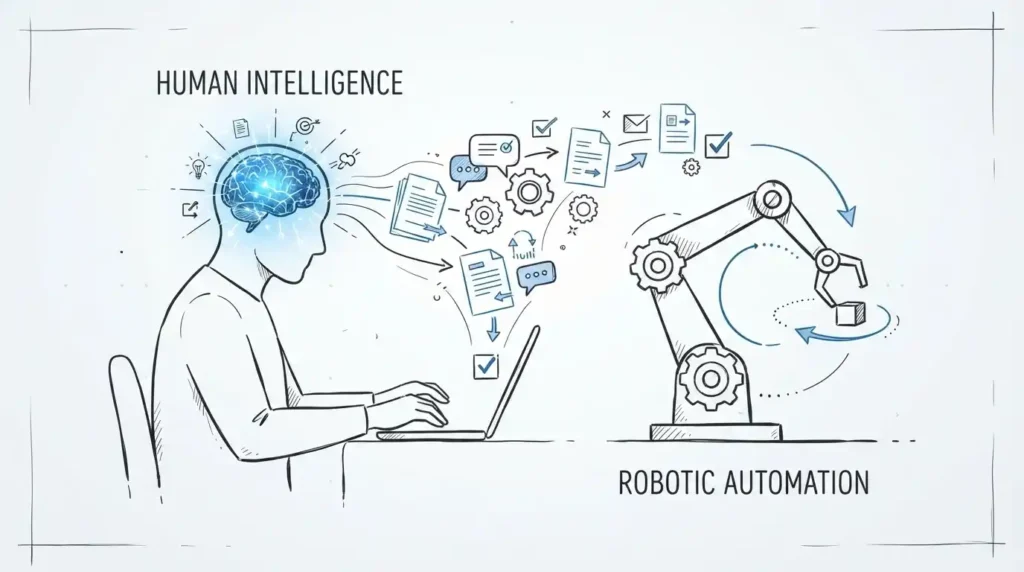
The difference between AI agents and traditional automation can also be seen in the way each approach handles decisions. Traditional automation, including RPA, typically follows instructions that state, “If this happens, do that.”
Meanwhile, in the context of AI Agents vs RPA, AI-based automation can be designed to accomplish a goal, such as understanding the context of a request and taking specific actions based on that information. This flexibility can be extremely valuable for processes like customer service, research, document reviews, or service requests, among other similar tasks. That said, a predictable automation process is generally easier to test and monitor because it’s designed to do a specific task under specific conditions. Therefore, an AI agent has more opportunities to interpret information, which means that businesses need to have appropriate safeguards in place.
When Does Intelligent Automation Make More Sense Than RPA?
The discussion of intelligent automation vs RPA isn’t necessarily about choosing one approach over the other. In many cases, intelligent automation builds upon traditional automation by adding features like machine learning, natural language processing, document capture, and other AI-based capabilities capabilities covered in more depth in our article on predictive analytics in test automation. For instance, an accounts-payable team might use a simple automation to move information from an invoice into a financial application.
This could be a great use of RPA because the information is likely to be structured in a predictable way. However, there are other steps that might need to be taken. Suppose that some suppliers send PDFs while others send scanned documents and still others send emails. IBM Research
AI-Driven Automation vs Rule-Based Automation

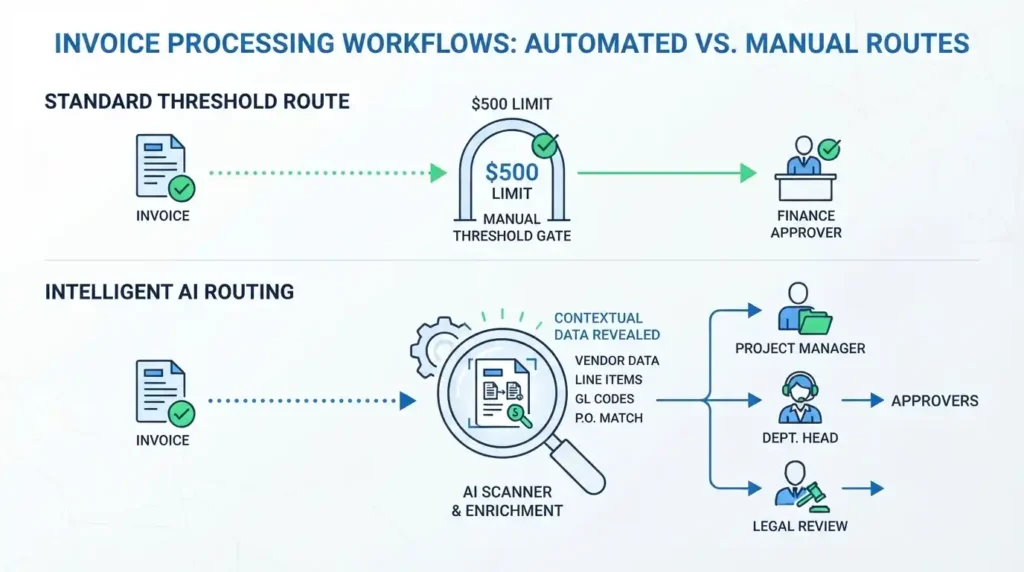
The difference between AI-driven automation vs rule-based automation is largely about how the automation tool interprets information. Rule-based automation typically works by applying predefined conditions. For instance, an invoice under $5,000 might automatically be sent to Manager A for approval, while an invoice over $5,000 would go to Manager B. In contrast, AI-driven automation has the potential to go beyond simple conditions by reviewing information, understanding the context, and taking more nuanced actions. As a result, an AI agent could potentially review an invoice, recognize the supplier, understand the information on the invoice, and decide who should handle the approval.
Cognitive Automation vs RPA
The discussion of cognitive automation vs RPA is similar to the conversation about AI Agents vs RPA. RPA tools are extremely effective at executing predefined actions, while cognitive automation has the potential to understand information in a way that’s similar to a human worker. This can be extremely valuable for processes that involve documents, emails, or other unstructured data. It’s also worth noting that many processes involve a combination of structured and unstructured information.
AI Agents vs RPA: Comparing Their Strengths and Business Use Cases
| Factor | RPA | AI Agents |
|---|---|---|
| Best suited for | Repetitive, stable tasks | Variable, context-heavy tasks |
| Instructions | Predefined workflows | Goals, context, and available tools |
| Data | Mostly structured | Structured and unstructured |
| Process changes | Usually needs workflow updates | Can adapt more easily |
| Decision-making | Rule-based | Context-aware |
| Predictability | Very high for fixed workflows | Can vary depending on the task |
| Implementation | Often simpler for established processes | Often simpler for established processes |
RPA vs AI: Which Is Better for Your Business in 2026?
If their activities are rule-guided, robotic process automation is a safe bet. On the other hand, if humans invest too much time reading, researching, reasoning, or resolving exceptions, consider AI.
RPA May Be the Right Fit If:
- The process is stable.
- Rules are clear.
- Data is structured.
- Exceptions are rare.
- There is a high-volume, repetitive process.
- Outcomes need to be predictable.
AI Agents May Be Worth Considering If:
- Requests are multi-format.
- The request requires interpretation.
- The process is situational.
- There are multiple systems to tie together.
- The desired outcome is clear, but the method is fluid.
There is another option: the best choice may involve both. In fact, this can be particularly valuable for businesses that want to use AI to enhance robotic process automation bots that are already in production. The same goes for companies evaluating the value of autonomous systems a topic covered further in our guide on Gen AI capabilities to look for in a vendor.
What About Autonomous AI Agents in Business?

Autonomous AI agents in business can be particularly valuable when the technology allows an agent to perform multiple related actions to achieve a specific goal. In practice, this typically means agents can follow a logical set of steps, even if each step is somewhat different. At the same time, “autonomy” should not be mistaken for carte blanche authorization to perform any action. Therefore, businesses using autonomous AI agents need to carefully consider what systems the agents can access, what actions require human approval, and what happens when something unexpected occurs safeguards we discuss in more detail in Agentic AI Security: 5 Proven Ways to Defend Against Emerging Threats.
This is especially critical in 2026, because a recent study by IBM Research on production automation provides valuable insight into how businesses are using autonomous agents.
How Should a Business Decide?
The Process, Not the Product, Is the Starting Point
The short answer is to analyze the process and ask these questions:
- What are the most repetitive tasks?
- What can be easily automated?
- Which steps change most often?
- Where do employees currently resolve exceptions?
- What type of data is involved in the process?
- What happens if the automation fails?
- Does the task require judgment?
- Does the task require human approval?
If the task is predictable, RPA may be sufficient. Otherwise, if the task requires humans to interpret information, consider AI.
The Future of Next-Generation Business Process Automation

Looking ahead, it is unlikely that future business process automation will involve replacing existing automation tools with next-generation capabilities. Instead, the future of business process automation is likely to involve using different technologies for different parts of the same process. For example, in a single process, an AI agent might be able to interpret a request, traditional automation might update legacy software, and a human might be needed to approve sensitive actions. This way, companies can capitalize on the benefits of individual solutions while limiting risks. At the same time, this approach makes automation easier to implement and safer, because organizations only rely on one solution for specific, limited tasks, rather than asking one tool to handle everything.
Conclusion
Ultimately, the AI Agents vs RPA debate is not about identifying the best option, but rather about understanding the strengths of each technology. Both AI agents and RPA automation have their place in the enterprise. RPA is likely to remain valuable for years to come due to its ability to deliver reliable, efficient outcomes by following predictable rules. Meanwhile, AI agents provide more flexibility, which is crucial when the situation requires judgment. As mentioned above, many organizations are likely to use a mix of RPA and AI automation.
Companies can benefit from keeping their existing RPA tools and using them for the same structured, repetitive tasks. At the same time, enterprises can use AI automation to handle tasks that involve more interpretation. Finally, humans should always be involved when it comes to high-impact decisions. This way, businesses reduce the potential risks associated with automation while being able to take advantage of new automation technologies.
Frequently Asked Questions
What is the difference between AI agents and RPA?
RPA automation follows rules, while AI agents interpret information and make decisions based on that information. Both can be valuable, but they are best suited for different types of tasks.
Is RPA still relevant in 2026?
Yes. Enterprises are still using RPA to automate predictable, rule-based, high-volume, and high-impact processes.
Are AI agents replacing RPA?
Not necessarily. Enterprises can use RPA and AI agents in tandem. RPA can help organizations perform basic repetitive tasks, while AI-driven systems handle more nuanced functions.
What is intelligent automation?
Intelligent automation refers to advanced automation technologies that help perform cognitive tasks. These include AI, machine learning, natural language processing, and systems that understand documents.
What is cognitive automation?
Cognitive automation is another term for technologies that help perform cognitive tasks. It covers AI, machine learning, natural language processing, and systems that understand documents.
Can RPA and AI agents work together?
Yes. An AI system can interpret information or determine the best course of action, while RPA can perform rule-based tasks within existing applications.
Which is better for my business: RPA or AI?
There is no one-size-fits-all answer, but autonomous systems are typically better at handling tasks that require judgment. Meanwhile, RPA is better at performing structured, repetitive tasks that do not involve much decision-making
Discover more from Diginatives
Subscribe to get the latest posts sent to your email.