Vanta vs Drata remain leading compliance automation platforms in 2026, offering SOC 2, ISO 27001, HIPAA, and more. While both streamline audits and security workflows, their strengths differ by automation depth, scalability, and usability.
Quick answer: Choose Vanta if you are a small or first-time team that wants the easiest setup and a lower starting cost. Choose Drata if you have an engineering team, many cloud and DevOps tools, and want deeper automation as you grow. Both help with SOC 2, ISO 27001, HIPAA, GDPR and PCI DSS.
Introduction
The inclination of companies in 2026 is rapidly increasing towards compliance automation platforms in response to meet the growing demand for regularization. Drata and Vanta are top-of-the-line competitors, providing a strong support base for the implementation of standards such as HIPAA, GDPR, PCI DSS, SOC 2, and ISO 27001. Both Drata and Vanta are pivotal solutions in the smooth operation of collecting evidence, auditing, and monitoring; however, they operate with different strategies and capabilities.
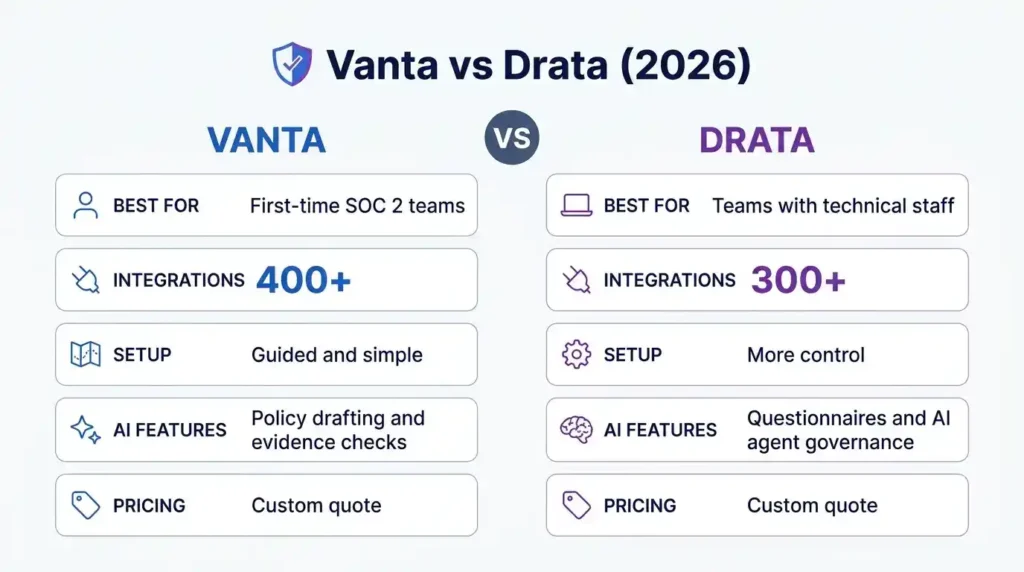
Vanta vs Drata Comparison Table (2026)
Here is how Vanta and Drata compare on the things buyers ask about most. Last checked: October 2026.
| Vanta | Drata | |
|---|---|---|
| Best for | First-time SOC 2 teams and startups that want a guided start | Teams with technical staff who want more control and customization |
| Ease of setup | Guided checklists, simple for non-technical teams | More options to configure, so setup can take longer |
| Integrations | 400+ prebuilt | 300+ prebuilt |
| Custom integrations | Yes, through its API | Yes, through its open API |
| Frameworks | SOC 2, ISO 27001, HIPAA, GDPR, PCI DSS and many more, plus custom frameworks | SOC 2, ISO 27001, HIPAA, GDPR, PCI DSS and many more, plus custom frameworks |
| Automation | Automated tests and continuous monitoring | Continuous automated control testing |
| AI features | AI Agent that drafts and edits policies, checks evidence, flags gaps, and helps with security questionnaires | AI for security questionnaires, explaining failed tests, AI-generated cloud tests, and AI agent governance |
| Trust Center | Yes | Yes |
| Pricing model | Custom quote, based on frameworks, employee count and add-ons | Custom quote, based on frameworks, systems and modules, not mainly per employee |
| Reported starting range* | From about $10,000 a year | From about $7,500 a year |
| Audit fees | Paid separately to your auditor | Paid separately to your auditor |
Neither company publishes a price list. Starting ranges are buyer-reported figures from third-party sources, not official prices, and real quotes vary a lot by company size and scope. Ask both for a quote with the same frameworks and headcount.
Key Differences Between Vanta and Drata
Ease of Use and Onboarding
Vanta is well known for being easy to access and use for user adoption. New entrants and setups that are less familiar with compliance can get maximum support from Vanta. The focus of Vanta in 2026 is mainly on clarity, a frictionless approach, with prior guides and providing stepwise checklists so that organizations can install the compliance systems smartly.
Drata is also an in-built meticulous solution inclined towards more adaptability. It adopts more automation, especially for synchronizing systems that collect evidence spontaneously. The inclusion of Drata increases the speed and enhances technological advancements for companies having security systems and technical teams.
Best for:
- Vanta: New entrants, compliance initiators, small teams
- Drata: Developing-phase to final entity with more sophistication and security
Automation and Integrations
Drata and Vanta both provide large-scale integrations with ticketing systems, identity platforms, cloud providers, and HRIS. Differentiating factors between these two are present in the intensity of quantitative intricacy and automation.
Drata is renowned for meticulous automation, providing constant supervision and controls, and higher modernized operations. In 2026, its increasing scope of integrations – especially in DevOps and infrastructure – offers companies concurrent evidence gathering, minimizing manual tasks.
Vanta also provides powerful automation, but it is more operated by pre-formats and is less adaptable. In 2026, Vanta enhanced its AI-powered strengths as well, mainly for risk assessment and policy drafting, resolving some gaps.
Best for:
- Drata: Organizations striving for strong technical controls and achieving higher automation levels
- Vanta: Companies focusing on straightforward operations and automated policy
Audit Readiness and Auditor Ecosystem
Drata and Vanta both help in sustaining extensive networks of audits, empowering smooth audit delivery.
However:
- Drata is usually chosen by auditors due to its deep streams of evidence and accuracy of controlled mapping.
- Vanta plays an important part in the preparation of the pre-audit, providing convenient educational resources and dashboards, enhancing the understanding of non-technical teams.
In 2026, Drata and Vanta both intensify collaboration with auditors, but Drata is more preferred by enterprise auditors.
Vanta vs Drata AI Features in 2026
Both platforms now use AI to cut down manual work.
Vanta: its AI Agent can draft and edit policies, check evidence, flag gaps and help with security questionnaires.
Drata: its AI helps answer security questionnaires, explains why a test failed, and can generate cloud tests. It also offers AI agent governance, which helps you track and control AI agents running in your company.
AI saves time on paperwork, but you still need real controls and an auditor to sign off.
Vanta vs Drata Pricing
Neither Vanta nor Drata publishes a price list. You get a custom quote based on your company size, the frameworks you need and any add-ons.
Third-party sources report starting points of roughly $7,500 a year for Drata and $10,000 a year for Vanta. Real contracts often cost much more as you add frameworks and people. These are buyer-reported numbers, not official prices.
Also remember that audit fees are separate. You pay your auditor on top of the platform cost.
Tip: ask both vendors for a quote with the same frameworks and headcount so you can compare fairly.
Which Platform Is Best in 2026?
- Vanta must be opted for less cost, easy adaptability, and smooth operations for new entrants and fast-growing set-ups.
- Drata is best suitable for deeper integrations across your security, DevOps ecosystem, advanced automation, and enterprise-grade scalability.
AI – Powered Products. Measurable Impact.
Conclusion:
In 2026, Vanta is preferred for usability and affordability, whereas Drata is the best fit for enterprise rigor and automation. The organization’s size, maturity, and compliance goals finally decide the best suitable choice.
Frequently Asked Questions (FAQs)
Is Drata or Vanta better for SOC 2 in 2026?
Both work well, but Drata offers deeper automation, while Vanta provides easier onboarding.
Is Vanta cheaper than Drata?
Not always. Both use custom quotes and neither publishes prices. Buyer-reported starting points are about $7,500 a year for Drata and $10,000 for Vanta, but your final price depends on size and frameworks.
Do both tools support multiple compliance frameworks?
Yes. Both cover major global frameworks and continue expanding.
Which tool scales better for growing companies?
Drata’s automation and integrations tend to make it the better choice for scaling organizations.
Can non-technical teams use Drata?
Yes, but Vanta’s interface is typically more beginner-friendly.
Do Vanta and Drata use AI?
Yes. Vanta has an AI Agent for policies, evidence and questionnaires. Drata uses AI for questionnaires, test failures, cloud tests and AI agent governance.
Which has more integrations?
Vanta lists 400+ prebuilt integrations. Drata lists 300+.
Looking to determine which platform aligns best with your security roadmap? I can help you compare specific features based on your environment just share your company size, frameworks, and budget.
Discover more from Diginatives
Subscribe to get the latest posts sent to your email.